“We’re in a crisis during a pandemic:’ Friends, family talk about overdose deaths

Advertisement

Advertise with us

Wanda Plain Eagle was picking up her best friend to help her arrange her son's funeral when she came face-to-face with the opioid crisis in Alberta.

Read this article for free:


By clicking the button above, an account will be created and you will begin to receive some of our recommended newsletters. You may opt out of any newsletter by visiting your Email and Communication Preferences page or by clicking "unsubscribe" at the bottom of any email.

or

Already have an account? Log in here »

To continue reading, please subscribe:

Digital Subscription

One year of digital access for only $1.44 a week*

  • Enjoy unlimited reading on winnipegfreepress.com
  • Read the E-Edition, our digital replica newspaper
  • Access News Break, our award-winning app
  • Play interactive puzzles

*Billed as $5.77 plus GST every four weeks. After 52 weeks, price increases to the regular rate of $19.95 plus GST every four weeks. Offer available to new and qualified returning subscribers only. Cancel any time.

To continue reading, please subscribe:

Add Free Press access to your Brandon Sun subscription for only an additional

$1 for the first 4 weeks*

  • Enjoy unlimited reading on winnipegfreepress.com
  • Read the E-Edition, our digital replica newspaper
  • Access News Break, our award-winning app
  • Play interactive puzzles
Start now

*Your next Brandon Sun subscription payment will increase by $1.00 and you will be charged $17.95 plus GST for four weeks. After four weeks, your payment will increase to $24.95 plus GST every four weeks.

Hey there, time traveller!
This article was published 17/12/2020 (2147 days ago), so information in it may no longer be current.

Wanda Plain Eagle was picking up her best friend to help her arrange her son’s funeral when she came face-to-face with the opioid crisis in Alberta.

She honked her horn to let her friend, whom she affectionately called Sissy, know that she was outside her house in Brockett, the Piikani Nation’s main community in southern Alberta.

“She wasn’t coming, so I went in,” Plain Eagle recalled during a recent interview with The Canadian Press.
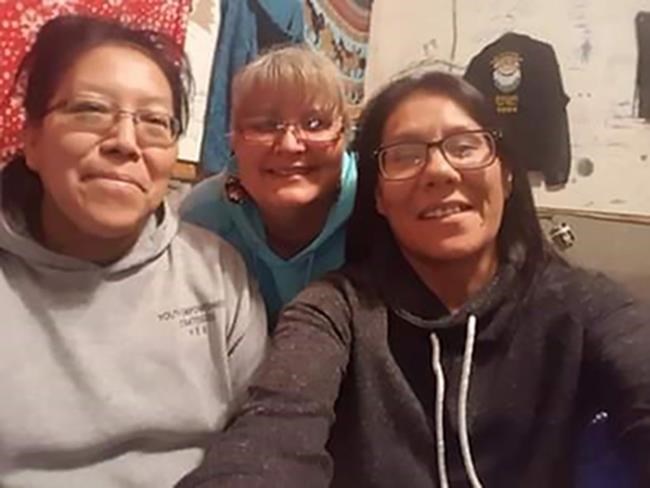
Wanda Plain Eagle, right, takes a selfie with her friend Sissy, left, and her sister Lori in this undated handout photo. Sissy died from an overdose in August as she was getting ready to plan her son's funeral. THE CANADIAN PRESS/HO, Wanda Plain Eagle *MANDATORY CREDIT*

As she walked in the front door that August day, she said: “‘Sissy, we’re going to be late.'”

Plain Eagle looked at the couch and saw her friend. She pulled Sissy off, started performing CPR and yelled out for someone to call 911.

“I knew she was already gone.”

The 44-year-old mother of seven children — Plain Eagle asked her friend not be named — was one of hundreds of opioid overdose deaths in Alberta this year.

Alberta Health reported 449 deaths from apparent unintentional overdoses during the first six months of 2020. Some 301 of those deaths occurred between April and June. Data has not yet been provided for the second half of the year.

Family members said Sissy’s 27-year old son, Brent, died less than a week before his mom.

His grandmother, Myrna Red Young Man, said he had been sexually assaulted and was carrying a lot of pain in the months before his death.

“He was trying to find comfort and someone to talk to,” she said.

Red Young Man said the family was making final arrangements for his funeral when word came that Brent’s mother had fatally overdosed.

She said she believes her daughter-in-law turned to drugs to cope with her son’s death.

“We had to make a double funeral.”

The family doesn’t know the official cause of Brent’s death, but Red Young Man said she knows her grandson was using drugs as he tried to cope with the sex assault.

“I told him I would get him some help,” she said. “But because of this COVID, it’s been hard.”

Experts have said the COVID-19 pandemic is playing a role in overdose deaths, which have grown in communities across the country this year.

An update released by Health Canada Wednesday said there have been 1,628 apparent opioid toxicity deaths between April and June, the highest quarterly count since national surveillance began in 2016.

The report said Western Canada continues to be the hardest hit, but the death rate has also risen in Ontario and other jurisdictions. At least five provinces and territories have observed record-breaking numbers of deaths from April to June, said Health Canada.

Elaine Hyshka, an assistant professor in the School of Public Health at the University of Alberta, said the main factor has been a disruption of traditional supply lines for the illegal drug market because of border closures.

“People have had to scramble to access drugs,” she said. “There is — and continues to be — a high demand for opioids and other substances in the community.”

Hyshka said the drug market was already highly toxic — and it has become even more volatile this year.

“People are not able to predict potency when they purchase illegal drugs and, as a result, they are running into trouble.”

Hyshka said COVID-19 precautions and public health measures have also made it more difficult for people to get help through supervised consumption sites, outreach and addiction services or general health care.

A report released by the province last December showed First Nations people in Alberta had disproportionately higher rates of opioid use.

“The age range tends to be a little wider, including older people, and also more women overdose among First Nations,” explained Hyshka.

The report said First Nations people represented six per cent of the population, but accounted for 13 per cent of all accidental opioid poisoning deaths from 2016 to 2018.

Several members of the Piikani Nation believe the opioid crisis has only worsened during the pandemic.

Dianna North Peigan said she lost her youngest son, Rudy, to an accidental overdose in June.

“I went home and found him,” she said. “I didn’t know the extent of what he was doing.”

North Peigan said it’s been a difficult time.

“I wish it upon nobody to find their son like that,” she said. “He had so much potential.”

She and other members of the First Nation said there have been way too many overdose deaths.

Lori Vrebosch Pratt, who lost her son to an overdose two years ago and has been helping the other women deal with the latest deaths, said the community is deeply shaken.

“For anybody whose been through the loss of a child or the loss of a loved one, you know how it feels,” she said. “I don’t think there is a single family left here now that hasn’t been touched by the death of a person via an overdose.

“It’s absolutely devastating and it’s only getting worse, not better.”

“We’re in a crisis in a pandemic,” added Plain Eagle. “It’s saddening. It’s heartbreaking.”

This report by The Canadian Press was first published Dec. 17, 2020.

Report Error Submit a Tip

More Stories

We don’t vote like our lives depend on it

Judy Waytiuk 5 minute read Preview

We don’t vote like our lives depend on it

Judy Waytiuk 5 minute read 2:00 AM EST

There’s an old saw — we get the government we deserve. It assumes active participation in our elections, full and fair media coverage from which voters can learn and a set of viable, capable candidates from which we can choose.

Arguably, those conditions did not apply this time around in Winnipeg. Our voter turnout was just 38 per cent and Mayor Scott Gillingham’s victory came from just 15 per cent of Winnipeg’s eligible voters. Two supposedly serious competitors embroiled themselves — by choice — in juvenile mudslinging and offered scattered, chaotic policy platforms.

A fourth contender surged from behind in the closing weeks of the campaign — and Noah Redden had spent most of the campaign being thought of as one of the pack of gadflies that emerge to run every time there’s a mayoralty campaign here. Yet he virtually tied Kevin Klein for second place. Had Redden been treated during the campaign as a viable candidate (he was the only one to publish online a detailed, thought-through policy platform), who knows what would have happened?

Absorb those facts.

Read
2:00 AM EST

NDP should heed own advice, bring back 50-50 funding

Mark Hudson 5 minute read 2:01 AM EST

Transit riders have a love-hate relationship with our “people’s limousine.” For many, it’s their only means of mobility. Others ride because they believe urban life is better when people use public transit rather than choking the roads with single-occupancy cars.

At the same time, one of life’s mid-sized stressors is peering into the distance on a cold, snowy Winnipeg morning to see whether your late bus is yet on the horizon and, when it appears, whether it’s full to capacity and going to roll past. It’s the kind of thing that pushes you back into the car, if you have access to one.

We could make a big dent in this daily anxiety, help pay transit workers fairly and do our part to stave off climate disaster by restoring a tried-and-true funding scheme: the 50-50 model. This shared-cost model, in which the provincial government pays half of transit operating costs over and above service revenues, was brought in when I was a kid waiting to board the bus with my parents in the 1970s.

The Progressive Conservative government of Gary Filmon initially ditched it in 1993. New Democrats reinstalled it in 2007, with then-Lt.-Gov. John Harvard announcing in the 2006 throne speech: “Manitoba is committed to increased provincial funding for transit operating costs in Thompson, Flin Flon, Brandon and Winnipeg, restoring the 50-50 funding partnership that was in place prior to the cutbacks of the 1990s.”

Letters, Nov. 3

7 minute read 2:01 AM EST

The times, they aren’t a-changin’

I would like to ask Premier Wab Kinew a very simple question: Why in the world would you want to leave the clocks on permanent daylight time rather than continue changing them twice a year, as Manitobans have been accustomed to doing for decades?

Manitoba is in the geographical middle of Canada. Our time zone should reflect our location and our relationship with the rest of Western Canada.

I simply cannot understand the reasoning behind keeping Manitoba on permanent daylight time. Changing our clocks twice a year has been part of our lives since 1963. Why fix something that has worked for generations?

The AI snake is eating its tail

David Nutbean 5 minute read 2:01 AM EST

Computer technology has become the dominant force in the modern world. New technology subsuming older technology is the raison d’être of modern capitalism.

Pioneers of this new digital age took advantage of the profound difference between what they were building and what came before, advancing their influence and predominance. Little by little, the advantages ate away at the influence of non-digital technology, until the snake consumed most of modern information technology.

And now it is eating itself.

The beginning of the modern era of computing began with the Graphical User Interface (GUI, pronounced “gooey”). Back in the ’80s this was a new commercial technology exclusive to Apple’s Lisa computer and, later, the MacIntosh.

TV that makes the cut

Denise Duguay 3 minute read Preview

TV that makes the cut

Denise Duguay 3 minute read 2:01 AM EST

Ambition is a great motivator in fields as diverse as professional boxing, high-school dance team, photography, animal wrangling and even — stay with me here — bank robbery and alien-summoning?

Sure, some of these are more relatable than others, but the solutions, and the series and movie that contain them, are intriguing. Press play to become a better you.

● The Greatest (docudrama series premières Wednesday, Nov. 4 on Prime Video)

This dramatization of the life of acclaimed boxer and activist Muhammad Ali is billed as the first authorized scripted series on the subject. Its executive producers include his widow, Lonnie Ali, as well as serious name brands Jay-Z and Michael B. Jordan. Newcomer Jaalen Best plays the title role, supported by Giovanni Ribisi (American Hostage) playing Angelo Dundee and Michael Ealy (The Following) as Malcolm X.

Read
2:01 AM EST

Oliveira inks three-year extension with Bombers

Taylor Allen 2 minute read Preview

Oliveira inks three-year extension with Bombers

Taylor Allen 2 minute read Tuesday, Dec. 16, 2025

Brady Oliveira is staying home.

The Winnipeg Blue Bombers announced Monday afternoon the star running back has agreed to a three-year contract extension through the 2028 season.

The 28-year-old was scheduled to become a free agent in February.

“I know what I can bring and I know I’m a calibre of player that can help a team win a championship, so I want to put myself in the best situation to win a championship,” said Oliveira in his end of season press conference in November.

Read
Tuesday, Dec. 16, 2025