Canada to receive early shipment of Moderna’s COVID-19 vaccine before year’s end
Advertisement
Read this article for free:
or
Already have an account? Log in here »
To continue reading, please subscribe:
Digital Subscription
One year of digital access for only $1.44 a week*
- Enjoy unlimited reading on winnipegfreepress.com
- Read the E-Edition, our digital replica newspaper
- Access News Break, our award-winning app
- Play interactive puzzles
*Billed as $5.77 plus GST every four weeks. After 52 weeks, price increases to the regular rate of $19.95 plus GST every four weeks. Offer available to new and qualified returning subscribers only. Cancel any time.
To continue reading, please subscribe:
Add Free Press access to your Brandon Sun subscription for only an additional
$1 for the first 4 weeks*
- Enjoy unlimited reading on winnipegfreepress.com
- Read the E-Edition, our digital replica newspaper
- Access News Break, our award-winning app
- Play interactive puzzles
*Your next Brandon Sun subscription payment will increase by $1.00 and you will be charged $17.95 plus GST for four weeks. After four weeks, your payment will increase to $24.95 plus GST every four weeks.
Read unlimited articles for free today:
or
Already have an account? Log in here »
Hey there, time traveller!
This article was published 15/12/2020 (2138 days ago), so information in it may no longer be current.
OTTAWA – The U.S. biotech firm Moderna is set to start delivering thousands of doses of its COVID-19 vaccine to Canada ahead of schedule this month, as long as it is approved it for use.
Prime Minister Justin Trudeau announced Tuesday in Ottawa that Moderna will deliver up to 168,000 doses by the end of December. That news came a week after a similar deal was reached with Pfizer for early delivery of up to 249,000 doses of the vaccine it produced in collaboration with German partner BioNTech.
“This is the good news we all needed,” Trudeau said. “This pandemic will end. We will get through this. But for now, we need to be incredibly careful.”

Health Canada approved the Pfizer-BioNTech vaccine Dec. 9, two days after the early delivery contract was announced, but it will likely be a little longer than that for Moderna.
Dr. Supriya Sharma, the chief medical adviser at Health Canada, told The Canadian Press the department’s review of Moderna’s vaccine is in the final stages. She said the final clinical data from the Massachusetts-based biotech company were received Dec. 11, and the final data on the manufacturing process is expected before the end of the week.
“It does look promising and it does look positive,” said Sharma.
She said she will know better when the manufacturing data comes in how much longer it could be until a decision is made.
The first 30,000 doses of Pfizer-BioNTech began arriving in Canada this week. Health workers and long-term care residents in Ontario and Quebec are already being vaccinated with most provinces expected to follow suit by the weekend.
Trudeau said another 200,000 doses are coming from Pfizer next week, and the number of sites where inoculations are happening will be expanded from 14 this week, to 70 next week. That will make it easier to start vaccinating residents in long-term care homes, who are considered to be at highest risk of dying from COVID-19.
Pfizer and BioNTech are to deliver four million doses by the end of March and 20 million total by the end of 2021.
Canada has contracted to receive two million doses from Moderna by the end of March, and 40 million by the end of 2021. The first doses were originally not going to arrive until January, but if Health Canada finishes the review earlier, doses will start arriving this month.
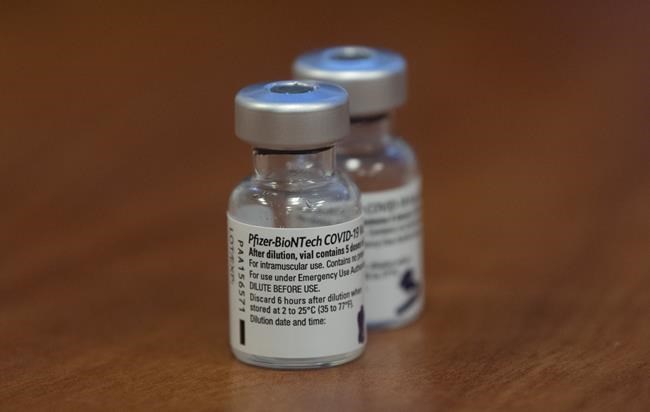
Both Pfizer and Moderna require two doses and use what is known as messenger RNA in their vaccines. It attaches some of the genetic code from the virus that causes COVID-19 to train a human immune system to fight the infection. Both report it prevented illness in more than nine in every 10 patients injected with it.
Moderna’s vaccine can be stored in a regular freezer, rather than the ultralow temperature freezers the Pfizer-BioNTech vaccine needs, which means it is easier to ship to remote communities.
Trudeau said the territories, which asked not to get Pfizer because of the cold-chain requirements, will be prioritized for the deliveries of Moderna. He said supplies, including freezers, are already being shipped so they are ready when the vaccine is.
Maj.-Gen. Dany Fortin, the vice-president of logistics at the Public Health Agency of Canada, said a dry run of the Moderna delivery took place Tuesday.
The first people prioritized to receive COVID-19 vaccines in Canada are residents and workers in long-term care homes, front-line health workers at high-risk for exposure to COVID-19, people over the age of 80 living independently, and adults in remote Indigenous communities. Those groups will be expanded in April, when larger shipments of the vaccines are expected to start arriving. Health Canada said last week it expects to be able to vaccinate every Canadian by the end of September 2021.
The Pfizer-BioNTech vaccine was authorized for use on people over the age of 16, who are not allergic to any of the ingredients. However, people who are pregnant, breastfeeding or have compromised immune systems are warned to talk to their doctor before getting a shot in the arm.

Th National Advisory Committee on Immunization Wednesday recommended more testing before COVID-19 vaccines are routinely offered to people in those groups, or kids under the age of 16.
But the committee’s experts also say if there is evidence the benefits of getting the vaccine outweigh the potential risks of COVID-19, it could be offered to pregnant women, kids as young as 12, or people who are immunosuppressed, with informed consent.
Pregnant women were not specifically included in Pfizer’s clinical trials but almost two dozen women who got the vaccine later became pregnant and reported no complications.
Pfizer tested the vaccine on a small sample of children between 12 and 15 years old in the fall, with no safety concerns reported, and intends to expand trials to children as young as five next year. Moderna is starting a trial on kids as young as 12 in January.
This report by The Canadian Press was first published Dec. 15, 2020.
Related Articles
Booking vaccine appointments 'frustrating' for health-care workers: Roussin


Advertisement Advertise With Us
Advertisement Advertise With Us