First doses of Pfizer COVID-19 vaccine, not yet approved, to land in Canada next week
Advertisement
Read this article for free:
or
Already have an account? Log in here »
To continue reading, please subscribe:
Digital Subscription
One year of digital access for only $1.44 a week*
- Enjoy unlimited reading on winnipegfreepress.com
- Read the E-Edition, our digital replica newspaper
- Access News Break, our award-winning app
- Play interactive puzzles
*Billed as $5.77 plus GST every four weeks. After 52 weeks, price increases to the regular rate of $19.95 plus GST every four weeks. Offer available to new and qualified returning subscribers only. Cancel any time.
To continue reading, please subscribe:
Add Free Press access to your Brandon Sun subscription for only an additional
$1 for the first 4 weeks*
- Enjoy unlimited reading on winnipegfreepress.com
- Read the E-Edition, our digital replica newspaper
- Access News Break, our award-winning app
- Play interactive puzzles
*Your next Brandon Sun subscription payment will increase by $1.00 and you will be charged $17.95 plus GST for four weeks. After four weeks, your payment will increase to $24.95 plus GST every four weeks.
Read unlimited articles for free today:
or
Already have an account? Log in here »
Hey there, time traveller!
This article was published 07/12/2020 (2153 days ago), so information in it may no longer be current.
OTTAWA – A small number of the most vulnerable Canadians could be immunized against COVID-19 before the holidays as the first doses of Pfizer’s vaccine are set to arrive next week.
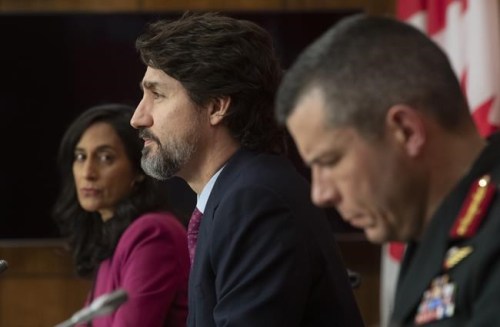
Prime Minister Justin Trudeau said Monday the contract with the U.S. pharmaceutical company and its German partner, BioNTech, was adjusted this week to reflect that up to 249,000 doses of their vaccine will be delivered to Canada before the end of December.
Everything hinges on Health Canada approving the Pfizer vaccine, with a decision expected on that in the coming days. Trudeau said that if approval comes by the end of the week, Canadians will begin getting vaccinated next week.

“It has been a difficult year, and we are not out of this crisis yet,” Trudeau said Monday at a news conference in Ottawa.
“But now, vaccines are coming.”
Maj.-Gen. Dany Fortin, named vice-president of logistics at the Public Health Agency of Canada to oversee the vaccine rollout plan, said once the vaccine is in Canada, it should take a day or two more for it to thaw and be prepared for an injection.
The Public Health Agency of Canada is overseeing the vaccine distribution to the provinces, but provincial governments decide who gets it and when, and puts in place the plan for that to happen.
The National Advisory Committee on Immunizations last week recommended priority be given to residents and workers in long-term care homes, front-line health workers, people over the age of 80 and adults living in Indigenous communities.
Most provinces are following that guidance at this point, however Trudeau said remote locations, including northern Indigenous reserves, won’t be getting the Pfizer vaccine for now because of the need to keep it so cold before it is ready for use.
“It is not easy to roll them out to more remote locations,” he said. “But this process will allow us to stand up our processes for delivering and handling this first vaccine as quickly as possible. There will be more doses of other vaccines at later dates on a priority basis for Indigenous Peoples, particularly those who are in northern and remote (communities).”
Pfizer’s vaccine has to be kept frozen below -70 C until just before it is diluted to be injected into a patient. The vaccine from U.S. biotech firm Moderna, which is on track to be approved in Canada after Pfizer’s, only needs to be kept at -20 C.
Health Canada is also reviewing vaccines from AstraZeneca and Johnson & Johnson, both of which can survive at temperatures of around 4 C.
All but Johnson & Johnson currently require two doses to be effective.
Because of the temperature issue, Pfizer is shipping its doses from its manufacturing plant in Puurs, Belgium directly to 14 receiving sites in each province that are equipped with at least one ultralow temperature freezer.
There are two delivery sites in Ontario, Quebec, British Columbia and Alberta, and one in each of the other six provinces. None of the early shipments are headed for the territories. Fortin said last week all the provinces were asked to have the sites ready to receive vaccine by Dec. 14th.
Canada and the provinces enacted a “dry run” Monday, said Fortin, with empty boxes shipped from Belgium to test Canada’s readiness.
“This is one way this week where we will learn how the process will flow, if adjustments need to be made,” he said.
Pfizer has developed special thermal shipping boxes that can carry the doses, packed on dry ice, for up to 10 days. The shippers can be used as temporary storage on sites where the vaccines are going to be injected as well. In between they must be stored in ultralow temperature freezers.
The vaccine can be kept in a refrigerator, at temperatures between 2 C and 8 C for up to five days, and then at room temperature for no more than two hours.
Each shipping box is equipped with a GPS-enabled thermal tracker to monitor the location and temperature during shipping.
Most provinces indicated they are ready now to receive the vaccine, including having ultralow temperature freezers set up at the receiving sites.
Newfoundland and Labrador Premier Andrew Furey said he anticipates receiving 1,950 doses at the receiving site in St. John’s next week.
Quebec Health Minister Christian Dubé said four shippers with about 4,000 doses are to go to Quebec next week, which will be distributed to long-term care homes and residential seniors’ homes first.
That would be enough to vaccinate about 2,000 people to start, with Dubé saying more doses will arrive between Dec. 21 and Jan. 4, enough to vaccinate between 22,000 and 28,000 people.
Retired Gen. Rick Hiller, who is leading Ontario’s vaccine task force, said a very small number of doses would land in that province next week, but that he anticipates 2.4 million doses in the first three months of next year.
Until Monday, Canada had said it expected to receive six million doses of vaccines between January and March, including four million doses from Pfizer, and another two million doses of the vaccine being made by U.S. biotech firm Moderna.
Trudeau said that plan was fast-tracked, though he denied politics played any role. He said his comments before today, including that Canadians may have to wait for vaccines behind people in the countries where they are being made, were designed “not to get people’s hopes up.”
Canada appears to be on track to be second to get the Pfizer vaccine. The United Kingdom approved it for use there last week, doses have been delivered and the first vaccinations are to start Tuesday.
The United States is set to decide on Pfizer’s approval Friday.

But unlike the U.S. and U.K. and some other countries, Canada will not be giving “emergency use approval” to any vaccines, Trudeau said later Monday in a pre-taped interview broadcast as part of the Wall Street Journal’s CEO Council winter summit.
Such approvals are used to allow unapproved medical products to be used in an emergency.
“We’re not doing any approval for emergency use. We are doing our regular process of approving vaccines,” Trudeau said.
“We’re saying, ‘Do we approve this vaccine. Is it safe for Canadians or not?’ So, it’s the full, regular process.”
This report by The Canadian Press was first published Dec. 7, 2020.
A look at Canadian plans for a COVID-19 vaccine
The federal government is laying plans for the procurement and distribution of COVID-19 vaccines. The approval of a vaccine by Pfizer and BioNTech is said to be imminent. The second vaccine in line for approval in Canada is from Moderna. The Canadian military will have a role to play in vaccine distribution and a dress rehearsal is planned for next week to make sure doses can get to every corner of Canada. Various provinces have started spelling out their plans as well. Here’s a look at what they’ve said so far:
Newfoundland and Labrador
Premier Andrew Furey announced the members of a COVID-19 vaccine logistics team for the province at a news conference on Friday.
The team will include Health Minister John Haggie, Chief Medical Officer of Health Dr. Janice Fitzgerald, Cmdr. David Botting of the Canadian Armed Forces, Indigenous Affairs Minister Lisa Dempster and Municipalities Minister Derek Bennett.
Furey said the team will be ready to administer the vaccine to the province’s most vulnerable people as soon as it becomes available, but did not specify who may fall into that category.
Nova Scotia
The province’s chief medical officer of health says he will release a detailed plan for the distribution of a COVID-19 vaccine once Ottawa shares more information.
Dr. Robert Strang says there is no certainty yet about the availability of a vaccine, but expressed hopes an initial supply will trickle into Nova Scotia early in the new year.
Strang says the plan will include tight control of the supply and clear rules dictating who can be first in line for immunization.
He says he’s waiting for more federal guidance on issues ranging from priority groups to transportation and storage logistics.
Quebec
The province says it will be ready to start rolling out its vaccine plan as of Jan. 1.
Premier Francois Legault says that public health officials have already settled on the list of priority vaccine recipients, but details have not been released.
Legault says the province is also working to put the necessary infrastructure in place to support a vaccine rollout. That includes obtaining fridges capable of maintaining the extremely low temperatures needed for the Pfizer vaccine.
Quebec has also tasked assistant deputy health minister Jerome Gagnonand former provincial public health director Dr. Richard Masse to oversee the province’s vaccination effort.
Ontario
Premier Doug Ford is among the leaders calling on Ottawa to provide more clarity as officials work to develop a provincewide vaccination strategy.
Health Minister Christine Elliott has said Ontario will receive 1.6 million doses of the new vaccine from Pfizer and 800,000 doses from Moderna in early 2021, although federal Health Minister Patty Hajdu said such details were still in the works.
Ford has named former general Rick Hillier, who served as chief of defence staff, to oversee the province’s vaccine rollout.
Nine others were named to the provincial vaccine task force on Friday, including medical experts, the province’s chief coroner, former Toronto police chief Mark Saunders, Ontario Regional Chief RoseAnne Archibald and bioethicist Dr. Maxwell Smith.
The province had initially said it would develop its vaccine plan by year’s end, but earlier this week Ford said the province would be ready even if the vaccines arrive sooner.
He has urged Ottawa to provide detailed information on potential vaccine delivery.
“We need a clear line of sight into the timelines of the shipments,” Ford said.
Manitoba
Government officials say they’ve been assembling the necessary people and equipment to set up a large-scale “super site” to deliver the vaccine as soon as it is available.
Premier Brian Pallister says the province has also purchased the necessary supplies to administer two doses of the vaccine to every person in the province.
The first freezer able to store the Pfizer vaccine at low temperatures has been delivered and installed, with another four on the way.
As the vaccine supply from the federal government expands over the coming months, the province says it will become more widely available in a larger number of sites, similar to a conventional vaccination campaign, such as the annual flu shot.
Alberta
Premier Jason Kenney says Alberta expects to start getting COVID-19 vaccines in the first week of January.
High-risk patients and health workers will get them first.
Kenney says his government has struck an interdepartmental team to roll out the vaccines from 30 different locations in the province.
Dr. Deena Hinshaw, Alberta’s chief medical officer of health, has said the province is expected to receive 680,000 doses of COVID-19 vaccine early in the new year, a figure not yet confirmed by the federal government.
British Columbia
The provincial health officer says seniors in British Columbia’s long-term care homes and hospitals will be the first to get immunized starting in the first week of January with two vaccines.
Dr. Bonnie Henry says vaccines by Pfizer and Moderna will be the first to be rolled out after approval by Health Canada.
Henry says B.C. health officials are working with their federal counterparts on ways to facilitate the delivery of vaccines as they anticipate various challenges that could come up in the immunization process.
More details will be provided about the province’s vaccine plan next week.
Yukon
Premier Sandy Silver says the territory has been in discussions with various levels of government on a vaccine rollout plan.
He says the goal will be to provide vaccines to elderly people and health-care providers.
Silver says rural and remote communities should also get priority status in northern regions, a fact he says he’s emphasized with federal authorities.
The premier says he has joined the other provincial and territorial leaders in pushing for a national strategy to distribute the vaccine.
Silver says the Pfizer vaccine could cause logistical problems for remote communities because of its cold-storage requirements, but those issues may not apply to other vaccines under development.
This report by The Canadian Press was first published Dec. 7, 2020.
Related Articles
Pfizer vaccine moves closer to getting the OK in the US

Advertisement Advertise With Us
Advertisement Advertise With Us