Trudeau says he hopes to see COVID-19 vaccines roll out in Canada in early 2021

Advertisement

Advertise with us

Prime Minister Justin Trudeau said Monday he hopes to see COVID-19 vaccines roll out in Canada early next year, but warned that won't bring an immediate resolution to the pandemic currently seeing a resurgence in several provinces.

Read this article for free:


By clicking the button above, an account will be created and you will begin to receive some of our recommended newsletters. You may opt out of any newsletter by visiting your Email and Communication Preferences page or by clicking "unsubscribe" at the bottom of any email.

or

Already have an account? Log in here »

To continue reading, please subscribe:

Digital Subscription

One year of digital access for only $1.44 a week*

  • Enjoy unlimited reading on winnipegfreepress.com
  • Read the E-Edition, our digital replica newspaper
  • Access News Break, our award-winning app
  • Play interactive puzzles

*Billed as $5.77 plus GST every four weeks. After 52 weeks, price increases to the regular rate of $19.95 plus GST every four weeks. Offer available to new and qualified returning subscribers only. Cancel any time.

To continue reading, please subscribe:

Add Free Press access to your Brandon Sun subscription for only an additional

$1 for the first 4 weeks*

  • Enjoy unlimited reading on winnipegfreepress.com
  • Read the E-Edition, our digital replica newspaper
  • Access News Break, our award-winning app
  • Play interactive puzzles
Start now

*Your next Brandon Sun subscription payment will increase by $1.00 and you will be charged $17.95 plus GST for four weeks. After four weeks, your payment will increase to $24.95 plus GST every four weeks.

Hey there, time traveller!
This article was published 09/11/2020 (2181 days ago), so information in it may no longer be current.

Prime Minister Justin Trudeau said Monday he hopes to see COVID-19 vaccines roll out in Canada early next year, but warned that won’t bring an immediate resolution to the pandemic currently seeing a resurgence in several provinces.

The prime minister said news from Pfizer that one of its vaccine candidates appears very effective in clinical trials is “very encouraging” but won’t help anyone who catches the virus in the meantime.

Speaking in Ottawa, Trudeau said other vaccine candidates have also appeared to progress well, and Canada has secured access to several, given the uncertainty regarding which will be ready first, which will be more effective with certain populations, and other variables.
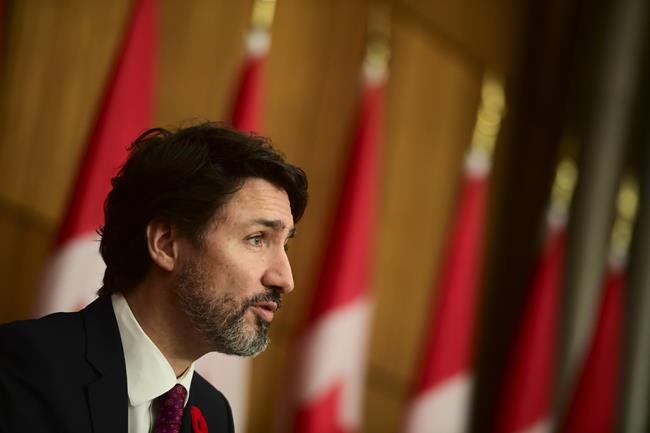
Prime Minister Justin Trudeau speaks during a press conference on broadband internet in Ottawa on Monday, Nov. 9, 2020. THE CANADIAN PRESS/Sean Kilpatrick

When a vaccine is safe to distribute, the government will begin dispensing it to high-priority groups first, he said.

“We hope to see vaccines landing in the early next year but between now and then it’s really, really important that we double down on our efforts,” Trudeau said.

“We need to make sure we are controlling the spread of COVID-19 in the coming months so that when vaccines get here we will be able to act quickly to protect all Canadians.”

His comments came after a weekend that saw the two provinces hardest hit by the pandemic report record-breaking daily case counts.

Quebec and Ontario reported 1,397 and 1,328 new cases respectively on Sunday, followed by 1,169 and 1,242 on Monday.

Health officials in Quebec said Monday that while the situation has improved in some parts of the province, such as Quebec City and Montreal, it is worsening in others – including the Saguenay-Lac-St-Jean area, which currently has more than double the provincial rate of cases per 100,000 people.

Public health authorities reported 94 new cases in the region on Monday, for a total of 312 active cases per 100,000 people.

The region was placed under Quebec’s highest COVID-19 alert level on Nov. 2, and the province’s health minister said it will take some time before any effects from the new restrictions are seen.

In Ontario, Premier Doug Ford was asked Monday whether the ballooning cases in the province pushed him to reconsider its new colour-coded system for pandemic measures, which loosened public health restrictions in all regions but Toronto when it took effect Saturday.

The tiered system places health units in colour-coded categories based on their caseload and transmission levels, and has drawn criticism for allowing activities such as indoor dining in restaurants in all alert levels short of a lockdown.

In Peel Region, the only area currently in the red category, local health officials imposed additional measures over the weekend in order to reduce the risk of transmission.

But Ford defended the system Monday, saying it was built to give each region the flexibility to enact further rules, as Peel did. “That’s the reason we have the framework,” he said.

Toronto, meanwhile, is remaining under a previous, more stringent system until the end of the week, at the request of local officials. The city accounted for 483 of Ontario’s new cases on Monday.

Mayor John Tory said the city would likely follow in Peel Region’s footsteps and impose “an enhanced suite of measures” to stem the spread of the virus, with more details to come Tuesday.

The city’s top doctor, Dr. Eileen de Villa, said the COVID-19 numbers seen over the last few days were among the “most concerning” she’s seen since the start of the pandemic.

Further west, Manitoba reported 365 new COVID-19 cases Monday as it continued to lead the country in per-capita active cases.

Chief public health officer Dr. Brent Roussin said the province is at a critical point in time, pointing to increased strain on the health system.

Roussin said he has talked with Premier Brian Pallister about imposing further restrictions.

Meanwhile, Trudeau said the federal government is already working on the logistics of distributing a COVID-19 vaccine, particularly since the Pfizer candidate needs to be stored at around -75C to remain stable.

Canada has bought the rights to 20 million doses of Pfizer’s vaccine, if it proves effective and Health Canada approves it for use here, and Trudeau said the government would purchase more if the initial round goes well.

The company said in a news release that early results from a large-scale trial show its vaccine is 90 per cent effective at combating the virus.

This report by The Canadian Press was first published Nov. 9, 2020.

Report Error Submit a Tip

More Stories

Meteorologist behind Rob’s Obs is moving weather station to Ontario

Ben Waldman 7 minute read Preview

Meteorologist behind Rob’s Obs is moving weather station to Ontario

Ben Waldman 7 minute read Monday, Jun. 13, 2022

In a Winnipeg winter, there are always at least two certainties: it will be cold, and it will snow. A third certainty: the people will talk endlessly about how frigid the temperature is, and argue about how much snow is cloaking their driveways. Is it colder than it ever has been? Is there more snow today than the same time last year?

Rob Paola likely knows the answers to those questions.

Paola possesses no super powers. He is but a man with a metre stick and 40 years of professional meteorological experience, in the midst of a lifelong love affair with Mother Nature, a most turbulent mistress who rarely, if ever, reciprocates.

Each year when snow begins to fall, Paola heads outside his Charleswood home to figure out how much. He sticks his ruler in the ground, grabs his clipboard, and clicks his pen. In neat script, he records the temperature, what time precipitation began, how deep the powder is stacked. Then, he shares his data and insights online with thousands of followers who want a clear answer to the eternal questions: Why is this happening? When will it stop? How much snow has fallen in the city of Winnipeg?

Read
Monday, Jun. 13, 2022

Wife’s witchy wonderment won’t spell trouble

Maureen Scurfield 6 minute read 2:00 AM CDT

DEAR MISS LONELYHEARTS: My wife believes in magic potions, which used to make me laugh. But since Halloween season started this year, she’s been acting in a way that frightens me. She seems to think she’s a modern-day “witch.” Give me a break!

Now she has three friends who think they are really casting spells when they get together! And this year on Halloween night she’s being formally accepted into their little witchy group meeting at one of their homes, and is getting a new sorceress name. It’s creepy! How do I cope? I’ve had enough of this.

— Seriously Upset, South St. Vital

Dear Upset: Don’t buy into the hocus pocus by being afraid of it and expressing any trepidation to your wife. She needs you to be strong, so she knows she has a solid anchor and can drop out of this witchy group if it becomes too scary or silly for her.

The volatile U.S. midterms

Allan Levine 5 minute read Preview

The volatile U.S. midterms

Allan Levine 5 minute read 2:00 AM CDT

The last time the Democratic Party had 218 or more seats — the number required to control the U.S. House of Representatives — was from 2021 to 2023, following the election of Democrat Joe Biden as president. During that same period, the Democrats also had the edge in the Senate. Despite a 50-50 split with the Republicans, Democrats were able to control the Senate with the help of Vice-President Kamala Harris, who cast the key vote in a tie. From 2023 to 2025, the Democrats had a slim 51 to 49 Senate majority.

If history repeats itself and the latest polls are fairly accurate, on Tuesday, Nov. 3, the Democratic Party will take back the House and (probably) the Senate from the Republicans, who have controlled both legislative bodies since the 2024 election. In the House, the Democrats have to gain at least three more seats. In the Senate, they have to win four more, which is entirely doable, though they almost certainly have to win a seat in Texas, Ohio, Kansas or Alaska, each of which currently has two Republican senators.

The prospect of a Democratic victory has President Donald Trump in a tizzy. For the past two years, he has abused his executive power to impose illegal tariffs on Canada and other countries; started a war with Iran; cozied up to Russian president Vladimir Putin and turned his back on Ukrainian president Volodymyr Zelenskyy; and increased the national debt through questionable tax cuts — to list only a few of his more egregious actions. He has been able to get away with this mainly because Republicans in the Senate and the House refuse to even question his decisions.

With the Democrats in charge, Trump’s brazen actions won’t be completely halted, but he will face significant legislative challenges and obstacles not easily dismissed. His controversial appointees, such as Attorney General Todd Blanche, who perceives himself as Trump’s private lawyer rather than the legal representative of the people, won’t get a free pass in committee hearings.

Read
2:00 AM CDT

Must-see Folk Fest workshops

16 minute read Preview

Must-see Folk Fest workshops

16 minute read Thursday, Jul. 5, 2018

Workshops have always been an integral part of the Winnipeg Folk Festival.

They are magic-moment makers; a curated group of musicians — sometimes friends, sometimes strangers — on one stage playing together, supporting each other, creating something that will only exist for an hour or two. No one knows what will come out of the collaboration, but usually it’s something special.

When the Free Press spoke to Winnipeg Folk Festival artistic director Chris Frayer ahead of the lineup release in early March, he noted he would be paying some extra attention to workshops this year, as some of the special projects occurring during the past couple of festivals had pulled some of his attention away.

And with 37 workshops on the books, it would seem he followed through on his promise.

Read
Thursday, Jul. 5, 2018

Is Canada headed for time chaos this weekend?

Michelle Bastian 5 minute read 2:00 AM CDT

When Manitoba Premier Wab Kinew declared Sept. 17 that the province would remain on permanent daylight time, he suggested it was a historical moment people would share with their “great-great-grandkids.” But, while Sunday, Nov. 1 has been heralded as the date many Canadians will stop changing their clocks, there are rumblings behind the scenes suggesting this will actually cause more trouble than ever before.

There are, of course, the warnings from chrono-biologists and sleep scientists about the damage permanent daylight time will do. The lighter evenings will mean many more dark mornings. But there is another set of problems in the offing in the critical infrastructure that underpins our digital lives.

While it used to be common to spend the Sunday morning after a time change going around our homes updating the clocks, we now wake up to devices that have already adjusted to the new time. These automatic updates occur regularly for daylight time, as well as when we travel to new time zones.

Our clocks are able to change by themselves owing to the hard work of a group of volunteers who were recently named in a list of the people who hold up the internet. This group, led by Paul Eggert, a computer scientist at UCLA, maintains a little-known tool called the Time Zone Database. Since the 1980s, it has kept track of regional, national and international debates about clock time and provided an up-to-date table of what time it should be on our walls.

Security tightens at downtown library

Aldo Santin 5 minute read Preview

Security tightens at downtown library

Aldo Santin 5 minute read Saturday, Feb. 16, 2019

Users of the downtown Millennium Library will be subject to several new security screening measures, more commonly seen at airports and sporting facilities.

City hall announced Friday that effective Feb. 25, all visitors to the Donald Street library will undergo bag checks and be subjected to a hand-held metal detector sweep for alcohol and prohibited weapons. Visitors who refuse to participate will be barred from entering the library.

“The number of incidents (has) increased in the past four to five years, incidences involving violence, threats, alcohol, substance abuse and it was concerning. We met with police and our security contractor. After discussing, we came up with this course of action,” Ed Cuddy, manager of library services, told reporters. “We feel it’s a big change, but we feel it’s justified based on the kind of incidents we’ve been experiencing recently.”

Cuddy wouldn’t elaborate on the nature of the incidents, but did say library workers have not been the victims.

Read
Saturday, Feb. 16, 2019