WEATHER ALERT

Bloc Quebecois leader and caucus isolating after staffer catches COVID-19

Advertisement

Advertise with us

OTTAWA - Bloc Quebecois Leader Yves-Francois Blanchet and almost his entire caucus went into self-isolation Monday after a member of his staff tested positive for COVID-19.

Read this article for free:


By clicking the button above, an account will be created and you will begin to receive some of our recommended newsletters. You may opt out of any newsletter by visiting your Email and Communication Preferences page or by clicking "unsubscribe" at the bottom of any email.

or

Already have an account? Log in here »

To continue reading, please subscribe:

Digital Subscription

One year of digital access for only $1.44 a week*

  • Enjoy unlimited reading on winnipegfreepress.com
  • Read the E-Edition, our digital replica newspaper
  • Access News Break, our award-winning app
  • Play interactive puzzles

*Billed as $5.77 plus GST every four weeks. After 52 weeks, price increases to the regular rate of $19.95 plus GST every four weeks. Offer available to new and qualified returning subscribers only. Cancel any time.

To continue reading, please subscribe:

Add Free Press access to your Brandon Sun subscription for only an additional

$1 for the first 4 weeks*

  • Enjoy unlimited reading on winnipegfreepress.com
  • Read the E-Edition, our digital replica newspaper
  • Access News Break, our award-winning app
  • Play interactive puzzles
Start now

*Your next Brandon Sun subscription payment will increase by $1.00 and you will be charged $17.95 plus GST for four weeks. After four weeks, your payment will increase to $24.95 plus GST every four weeks.

Hey there, time traveller!
This article was published 14/09/2020 (2240 days ago), so information in it may no longer be current.

OTTAWA – Bloc Quebecois Leader Yves-Francois Blanchet and almost his entire caucus went into self-isolation Monday after a member of his staff tested positive for COVID-19.

The test came back positive less than a week after Blanchet and most of his 31 MPs held an in-person caucus meeting.

And it came just as the Liberal government is in the midst of negotiations with opposition parties over how the House of Commons should function when Parliament resumes on Sept. 23.
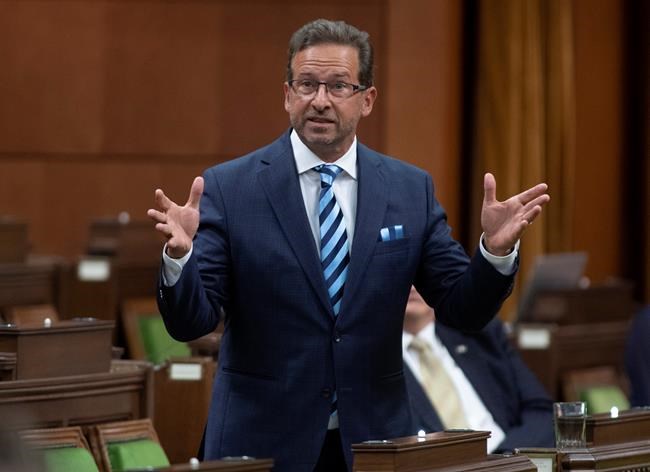
Bloc Quebecois Leader Yves-Francois Blanchet rises during a sitting of the Special Committee on the COVID-19 Pandemic in the House of Commons in Ottawa, Wednesday, Aug. 12, 2020. THE CANADIAN PRESS/Adrian Wyld

The forced isolation of all Bloc MPs underscored the risk of having even a small number of MPs physically present in the chamber.

Bloc spokeswoman Carolane Landry said in a statement that everyone potentially affected by the staffer’s positive test will be screened to ensure they’re healthy and will follow public health guidelines.

In the meantime, she said all their work has been moved online.

The House of Commons has been largely suspended since mid-March, with only periodic, brief sittings to deal with emergency aid legislation to help Canadians weather the pandemic.

The government is now proposing that the chamber resume all its normal business as of Sept. 23, but in a hybrid format, with a small number of MPs sitting in the House and the rest participating virtually, including voting electronically.

Government House leader Pablo Rodriguez said Monday that “definitely the NDP and the Bloc are open” to the proposal.

“We have to find a way to have those regular sittings of the House … but taking into consideration that we can’t be 338 (MPs) in the same room so we have to find a way to vote (electronically), which is the critical part here,” he said outside a cabinet retreat in Ottawa where Trudeau and his ministers were holed up.

Rodriguez said the Commons administration is working on an application to allow for secure, transparent, remote voting but, until that can be tested, he suggested there could be “Zoom votes.” He added that he’s open to other ideas for remote voting that opposition parties might suggest.

However, the Conservatives have indicated they are opposed to electronic voting in any form. They’ve suggested that there are safe ways for all 338 MPs to vote, such as having staggered voting with a limited number of MPs allowed into the chamber at a time.

Intergovernmental Affairs Minister Dominic LeBlanc said the Conservatives are being “completely irresponsible.” What’s happened to the Bloc is a “warning” about what can happen if too many MPs gather together in the same place, he added.

The same could have been said about the cabinet retreat. Most ministers attended in person on Monday, as did some of their staff. While those inside the Global Affairs Canada building where the retreat was held wore masks, not all staffers maintained the two-meters physical distance recommended by public health authorities.

And the ministers’ drivers waiting around outside were not masked, although they stood close together in small clusters chatting to one another.

Ministers said extra precautions were taken to ensure public health protocols were followed for the retreat, which marks the first time since March that most ministers have been in the same room together. Health Minister Patty Hajdu characterized it has another sign of the gradually re-opening economy.

“I think it’s really important that we also have an opportunity to gather and meet in person and you can see that those are the challenges and the balances that employers are making as well in Canadian workplaces all around the country,” she said.

As for Bloc MPs having to go into isolation, Hajdu said: “That is the reality of living with COVID-19.”

Theoretically, all 338 MPs could return to the House of Commons next week but Rodriguez said he’s hoping all parties will agree to limit the number who actually show up for the opening couple of days until they can vote on how the chamber should function going forward.

The Liberals have only a minority of seats and will thus need the support of at least one of the main opposition parties to pass their proposal for hybrid sittings with electronic voting.

This report by The Canadian Press was first published Sept. 14, 2020.

Report Error Submit a Tip

More Stories

Today’s horoscope

Georgia Nicols 4 minute read Preview

Today’s horoscope

Georgia Nicols 4 minute read Yesterday at 2:00 AM EST

MOON ALERT: There are no restrictions to shopping or important decisions today. The moon is in Leo.

ARIES (March 21-April 19)

Avoid disputes about shared property, inheritances, taxes, debt and insurance issues. This might also include shared expenses. Just coast. Parents should be vigilant about their kids. Social plans might suddenly change. It’s a good day to make art.

TAURUS (April 20-May 20)

Read
Yesterday at 2:00 AM EST

Manitoba’s First Nations and the Indian Act

Hersh Seth 6 minute read 2:00 AM EST

On Monday in Ottawa, Manitoba Premier Wab Kinew called for the Indian Act to be abolished. Prime Minister Mark Carney said he was open to working with First Nations to reform or repeal this law, calling it racist.

The act was created in 1876 and still controls Indian status, reserve lands and band governance. It’s understandable why many people want a better relationship.

But repealing a law and building a new relationship are not the same. What would replace the act’s protections? Who decides? How do governments ensure removing federal authority gives First Nations power while the Crown keeps its promises?

Manitoba has faced these questions before. In 1971, First Nations created a document called Wahbung: Our Tomorrows, in response to then-prime minister Pierre Trudeau’s white paper on assimilation. More than 45 years later, elders and knowledge keepers met at Turtle Lodge, north of Winnipeg, to continue the conversation. Manitobans Dave Courchene Sr. and his son, Dave Courchene Jr., are generational links to the broader movement, and their story should be part of this discussion.

The ‘Gang of Nine’ and business as usual at city hall

Editorial 4 minute read Preview

The ‘Gang of Nine’ and business as usual at city hall

Editorial 4 minute read 2:00 AM EST

In the early 1990s, after the province reduced the number of municipal wards in Winnipeg to 15, critics spoke at length of how a theoretical “Gang of Eight” could control all decision making at city hall. In subsequent years, there were various incarnations of a Gang of Eight, although it was never conclusively shown that eight members of city council could consistently stay on the same page long enough to dominate civic affairs.

That is an apt tale to consider now, as Winnipeg city hall welcomes nine rookie councillors, the largest number of non-incumbents elected in more than 30 years.

Theoretically, this new group of councillors could band together and push through various reforms. It’s a highly intriguing scenario for anyone who has watched the city, on occasion, shun riskier strategies in favor of status quo politics.

However, as was the case in the early 1990s, the chances of that happening begin to fall apart once you consider the work of building and sustaining a coalition of rookie councillors who come from a broad array of backgrounds.

Read
2:00 AM EST

China’s electric car sales grow in 2024, as sales of gasoline cars plunge

Ken Moritsugu And Zen Soo, The Associated Press 2 minute read Monday, Jan. 13, 2025

BEIJING (AP) — Sales of all types of electric vehicles rose more than 40% in China last year, while those of gasoline-powered automobiles plunged, industry data showed Monday.

A total of 31.4 million vehicles were sold last year in the world's biggest market by sales, up 4.5% compared from a year earlier, the China Association of Automobile Manufacturers reported. Growth in sales outpaced production, which rose 3.7%.

China's exports of passenger cars jumped almost 20% in 2024, to almost 5 million vehicles. Out of that, exports of what China calls “new energy vehicles,” including battery EVs, fuel-cell cars and plug-in hybrids -- electric vehicles with a small gasoline-powered engine to back up the batteries -- reached 1.28 million. That was a 6.7% increase from 2023.

Domestically, sales of passenger cars rose 13.6% in December, driven in part by rebates for trade-ins, raising sales of all passenger cars in China by 3.1% for the year, to 22.6 million.

Comfort, kindness, acceptance and grandpa’s store

Deborah Schnitzer 5 minute read 2:00 AM EST

My grandfather, Ben W. Kert, had a women’s dress shop along Queen Street in Sault Ste. Marie where a number of Jewish men, many of them “Greenies” from the old country, owned and operated women’s haberdasheries with variable success.

Ben had come from Quebec via Northern Manitoba and Fort Frances, a singular man whose French was as good as his English and whose great heart filled my childhood with glory.

Unlike the other Jewish store owners, Ben W. was born in Trois-Rivières, the only male child who survived with five or six sisters born ahead of him.

Legend has it that my grandfather’s arrival and survival were celebrated with the nickname Sonny. When he left home at 15 (rumour claims his stepmother threw him out) and arrived in Montreal, his first employer would not accept the nickname, so my grandfather invented Ben W. on the spot. The W. never stood for anything. When he died, my mother discovered that his first name was actually Harry.

Russian Olympic biathlon champion loses Sochi doping case

Graham Dunbar, The Associated Press 5 minute read Preview

Russian Olympic biathlon champion loses Sochi doping case

Graham Dunbar, The Associated Press 5 minute read Thursday, Sep. 24, 2020

GENEVA - Two-time Olympic biathlon champion Olga Zaitseva lost her appeal Thursday against disqualification from the 2014 Sochi Olympics for her part in Russia’s state-backed doping program.

The Court of Arbitration for Sport said its judges upheld the International Olympic Committee’s disciplinary ruling of 2017, which used evidence against Zaitseva from Russian whistleblower Grigory Rodchenkov.

Zaitseva’s disqualification from all her Sochi events strips Russia of its silver medal in the women’s biathlon 4x6-kilometre relay. She won — and will retain — her gold medals from the same relay event at the two previous Winter Games in 2006 and 2010.

Her lawyer in Switzerland, Yvan Henzer, said Zaitseva would appeal the CAS ruling at Switzerland’s supreme court. The federal court typically only intervenes if legal process was abused.

Read
Thursday, Sep. 24, 2020