WEATHER ALERT

COVID-19 in schools inevitable, reducing class sizes unrealistic: Kenney

Advertisement

Advertise with us

COVID-19 cases disrupted the reopening of two Alberta schools on Tuesday, but Premier Jason Kenney said his government has accepted that such infections are inevitable and don't warrant closing down all classrooms.

Read this article for free:


By clicking the button above, an account will be created and you will begin to receive some of our recommended newsletters. You may opt out of any newsletter by visiting your Email and Communication Preferences page or by clicking "unsubscribe" at the bottom of any email.

or

Already have an account? Log in here »

To continue reading, please subscribe:

Digital Subscription

One year of digital access for only $1.44 a week*

  • Enjoy unlimited reading on winnipegfreepress.com
  • Read the E-Edition, our digital replica newspaper
  • Access News Break, our award-winning app
  • Play interactive puzzles

*Billed as $5.77 plus GST every four weeks. After 52 weeks, price increases to the regular rate of $19.95 plus GST every four weeks. Offer available to new and qualified returning subscribers only. Cancel any time.

To continue reading, please subscribe:

Add Free Press access to your Brandon Sun subscription for only an additional

$1 for the first 4 weeks*

  • Enjoy unlimited reading on winnipegfreepress.com
  • Read the E-Edition, our digital replica newspaper
  • Access News Break, our award-winning app
  • Play interactive puzzles
Start now

*Your next Brandon Sun subscription payment will increase by $1.00 and you will be charged $17.95 plus GST for four weeks. After four weeks, your payment will increase to $24.95 plus GST every four weeks.

Hey there, time traveller!
This article was published 01/09/2020 (2253 days ago), so information in it may no longer be current.

COVID-19 cases disrupted the reopening of two Alberta schools on Tuesday, but Premier Jason Kenney said his government has accepted that such infections are inevitable and don’t warrant closing down all classrooms.

“We’ve always said that there will be infections in the schools … that’s why we’ve put in place a number of protocols based on the scientific advice of our chief medical officer of health in consultation with superintendents and school boards,” he said.

“We believe it’s a strong plan and we’ll make future adjustments as necessary. We’re all learning through this as we go.”
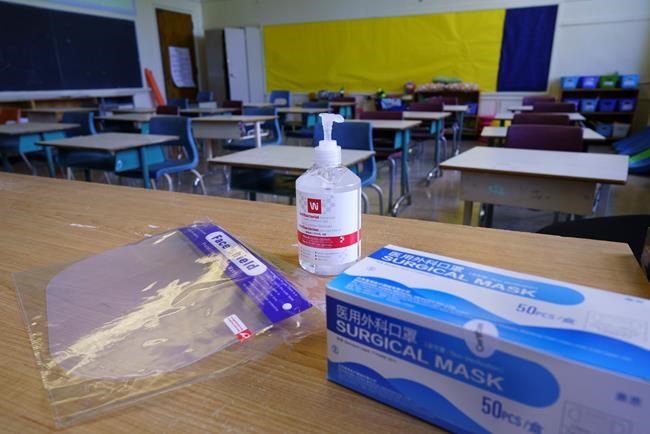
Personal protection equipment is seen on the teacher's desk in classroom in preparation for the new school year at the Willingdon Elementary School in Montreal, on Wednesday, August 26, 2020. THE CANADIAN PRESS/Paul Chiasson

Meadows Ridge School in Okotoks, south of Calgary, did not open as planned after a staff member was diagnosed with COVID-19.

Principal Rebecca Forchuk and Foothills School Division Supt. Chris Fuzessy wrote in a letter Monday that the staff member was last in the school at noon on Friday and that symptoms began that evening. Officials learned of the positive test result at 6 p.m. Monday.

“While Alberta Health Services has indicated the school is safe to remain open, due to the late hour and to allow public health time to complete their contact tracing, we are delaying the start of school for some Meadow Ridge families,” they wrote.

Contact tracing was complete by 10:30 p.m., said school division spokeswoman Candace Denison.

The school said it would inform parents whose children were to start classes Tuesday of new staggered entry dates.

At another school in Okotoks, children burst out of the doors Tuesday afternoon and many immediately tore off their masks.

Dora Helli was picking up her daughter, who’s in Grade 4, and her son, who just started kindergarten, at Westmount School.

She heard about the closure at Meadow Ridge, she said, but it didn’t make her hesitate about sending her kids back to class.

“My kids were really excited. It was a long break but they were ready to come back and see their friends,” she said.

“It’s time to go back to some kind of normal.”

Canyon Meadows School in Calgary opened as planned, but the principal, assistant principal and administrative secretary were forced into a 14-day quarantine after someone at the school tested positive for the novel coronavirus.

In a letter to parents, principal Bobbie Schmidt said it’s believed exposure happened a week ago and that a retired, experienced principal would be on site while the others isolate.

Alberta chief medical officer Dr. Deena Hinshaw said Monday that she was notified over the weekend of a “small number” of schools with COVID-19 cases or exposures in staff, but she did not elaborate.

The Peace River School Division, northwest of Edmonton, posted a notice on its website saying it was delaying the start of its school year until after Labour Day to give teachers more time to get used to safety protocols, plan for at-home learning and to ensure there are enough caretakers and supplies in schools.

The Alberta government cancelled kindergarten-to-Grade-12 classes in mid-March as COVID-19 began to spread in the community.

The province had 1,398 active cases as of Tuesday with 164 new infections. Both Kenney and Hinshaw have said the risk of spread in schools has to be balanced against the significant harms of keeping kids home indefinitely.

Under Alberta’s school reopening plan, staff and students in grades 4 to 12 must cover their faces when they’re in common and shared indoor areas where physical distancing cannot be maintained, like hallways and buses.

The rules are eased for classrooms so that masks don’t get in the way of learning and communication.

Education Minister Adriana LaGrange is to announce Wednesday how $260 million in federal money for schools is to be spent.

Kenney said suggestions that the money should go toward cutting class sizes to allow for more physical distancing are unrealistic. He estimated such a proposal would cost $4 billion.

“The proposals to reduce class sizes in half are actually proposals to keep the schools shut,” he said.

“We appreciate the additional federal funding, but there is no world in which you could reduce class sizes in half and reopen the schools for the current school year … It’s simply fictitious. It has nothing to do with reality.”

Jason Schilling, president of the Alberta Teachers’ Association, said Kenney’s cost estimate is inflated, and the group is not advocating for reducing class sizes by half.

“What we would like to see are more resources and supports provided to school divisions and principals so they have more opportunities to reduce the size of our largest classes, especially at the upper grades,” he said in a statement.

“Too many teachers are already reporting class size assignments in the mid-to-high 30s.”

— With files from Bill Graveland

This report by The Canadian Press was first published Sept. 1, 2020

Report Error Submit a Tip

More Stories

Bloviating ingrate simply doesn’t rate

Maureen Scurfield 5 minute read 2:00 AM EST

DEAR MISS LONELYHEARTS: I was at a party with my younger boyfriend, and I overheard him in another room talking loudly with his friends.

They were all bombed, guzzling beer and rating their girlfriends’ looks. I was listening for my guy to chime in. He finally said I was “a five without makeup, a 6 1/2 with it, but her great personality makes up for the rest.”

I can’t believe he would say that to other people, but he was drinking a lot — disgusting. I’m thinking of leaving him. What do you think?

— ‘Five Without Makeup,’ Osborne Village

New COVID treatment drug painless experience: recovered patient

Malak Abas 5 minute read Preview

New COVID treatment drug painless experience: recovered patient

Malak Abas 5 minute read Tuesday, Feb. 15, 2022

One of the first Manitobans to receive the antiviral COVID-19 pill that became available in the province last month has fully recovered, with no side effects.

Mary McIntosh, 72, lives in Victoria Beach and is among the 83 Manitobans recently issued Pfizer Inc. drug Paxlovid to treat COVID-19.

She reached out to Health Links when she was diagnosed with COVID-19 on Jan. 30. McIntosh has autoimmune hepatitis (a chronic liver disease), thus qualifying her to receive the new treatment.

“I did have to advocate for myself with respect to treatment options,” said McIntosh, who is fully vaccinated against COVID-19, including a booster.

Read
Tuesday, Feb. 15, 2022

Manitoba’s First Nations and the Indian Act

Hersh Seth 6 minute read 2:00 AM EST

On Monday in Ottawa, Manitoba Premier Wab Kinew called for the Indian Act to be abolished. Prime Minister Mark Carney said he was open to working with First Nations to reform or repeal this law, calling it racist.

The act was created in 1876 and still controls Indian status, reserve lands and band governance. It’s understandable why many people want a better relationship.

But repealing a law and building a new relationship are not the same. What would replace the act’s protections? Who decides? How do governments ensure removing federal authority gives First Nations power while the Crown keeps its promises?

Manitoba has faced these questions before. In 1971, First Nations created a document called Wahbung: Our Tomorrows, in response to then-prime minister Pierre Trudeau’s white paper on assimilation. More than 45 years later, elders and knowledge keepers met at Turtle Lodge, north of Winnipeg, to continue the conversation. Manitobans Dave Courchene Sr. and his son, Dave Courchene Jr., are generational links to the broader movement, and their story should be part of this discussion.

Performance (ice-cream) art

Maggie Macintosh 5 minute read Preview

Performance (ice-cream) art

Maggie Macintosh 5 minute read Thursday, Jan. 2, 2020

As 2020 resolutions counter temptation, Teri-Lynn Friesen and Élise Page will be waiting to console those who slip — and they’ll have ice-cream scoops at the ready.

Late last year, the creative duo opened Fête — Winnipeg’s newest coffee and ice-cream parlour, offering an ever-changing menu of 16 made-in-house ice-cream flavours, affogato and, if it’s Sunday morning, pancakes.

There’s also no pressure to pick a flavour at first sight; the shop offers unlimited samples.

“If you gave up coffee, we’re here for you when you need to come back. If you gave up sweets, we’re also here for you,” said Friesen, co-owner of the shop at 300 Assiniboine Ave.

Read
Thursday, Jan. 2, 2020

Letters, Nov. 2

6 minute read 2:00 AM EST

Post-election reflection

The civic election offered both predictable and surprising results. The re-election of Mayor Scott Gillingham and the defeat of Transcona councillor Russ Wyatt were anticipated.

What was surprising was that, in addition to Wyatt, three other incumbents lost their bids for re-election. Devi Sharma (Old Kildonan), Ross Eadie (Mynarski) and Shawn Dobson (St. James) all went down to defeat, and it is clear to me their replacements will bring stronger voices to city hall.

A total of nine new councillors is a seismic shift in Winnipeg civic politics, not seen since the establishment of the 15-member council some 35 years ago. What is most interesting is the political leanings of the new councillors and how they will work with Mayor Gillingham.

The ‘Gang of Nine’ and business as usual at city hall

Editorial 4 minute read Preview

The ‘Gang of Nine’ and business as usual at city hall

Editorial 4 minute read 2:00 AM EST

In the early 1990s, after the province reduced the number of municipal wards in Winnipeg to 15, critics spoke at length of how a theoretical “Gang of Eight” could control all decision making at city hall. In subsequent years, there were various incarnations of a Gang of Eight, although it was never conclusively shown that eight members of city council could consistently stay on the same page long enough to dominate civic affairs.

That is an apt tale to consider now, as Winnipeg city hall welcomes nine rookie councillors, the largest number of non-incumbents elected in more than 30 years.

Theoretically, this new group of councillors could band together and push through various reforms. It’s a highly intriguing scenario for anyone who has watched the city, on occasion, shun riskier strategies in favor of status quo politics.

However, as was the case in the early 1990s, the chances of that happening begin to fall apart once you consider the work of building and sustaining a coalition of rookie councillors who come from a broad array of backgrounds.

Read
2:00 AM EST