Ontario government reveals back-to-school plan

Advertisement

Advertise with us

TORONTO - Most of Ontario's students will return to traditional classrooms full time in September, the province announced Thursday as it released a back-to-school plan critics argue prioritizes cost-savings over kids' health.

Read this article for free:


By clicking the button above, an account will be created and you will begin to receive some of our recommended newsletters. You may opt out of any newsletter by visiting your Email and Communication Preferences page or by clicking "unsubscribe" at the bottom of any email.

or

Already have an account? Log in here »

To continue reading, please subscribe:

Digital Subscription

One year of digital access for only $1.44 a week*

  • Enjoy unlimited reading on winnipegfreepress.com
  • Read the E-Edition, our digital replica newspaper
  • Access News Break, our award-winning app
  • Play interactive puzzles

*Billed as $5.77 plus GST every four weeks. After 52 weeks, price increases to the regular rate of $19.95 plus GST every four weeks. Offer available to new and qualified returning subscribers only. Cancel any time.

To continue reading, please subscribe:

Add Free Press access to your Brandon Sun subscription for only an additional

$1 for the first 4 weeks*

  • Enjoy unlimited reading on winnipegfreepress.com
  • Read the E-Edition, our digital replica newspaper
  • Access News Break, our award-winning app
  • Play interactive puzzles
Start now

*Your next Brandon Sun subscription payment will increase by $1.00 and you will be charged $17.95 plus GST for four weeks. After four weeks, your payment will increase to $24.95 plus GST every four weeks.

Hey there, time traveller!
This article was published 30/07/2020 (2283 days ago), so information in it may no longer be current.

TORONTO – Most of Ontario’s students will return to traditional classrooms full time in September, the province announced Thursday as it released a back-to-school plan critics argue prioritizes cost-savings over kids’ health.

Elementary students and many high schoolers will be in school five days a week in standard class sizes, while secondary students at two dozen boards that are higher risk will only attend class half the time in an effort to curb the spread of COVID-19.

Those high schoolers will have a maximum class size of 15, and will receive “curriculum-linked independent work” on days when they are not in school.
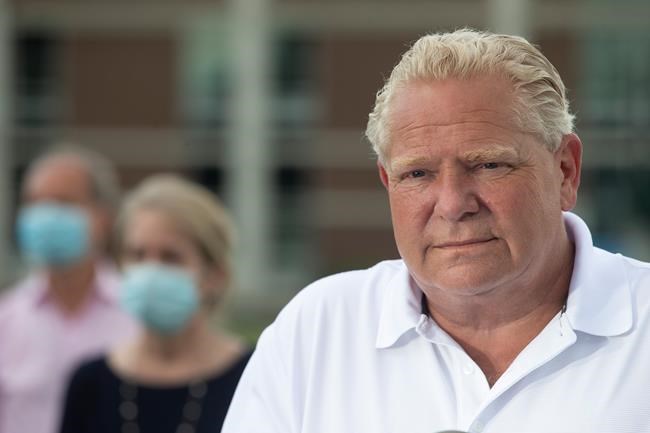
Ontario Premier Doug Ford takes a question from the media during an announcement in Ajax, Ont., on Tuesday, July 28, 2020. THE CANADIAN PRESS/Chris Young

“We’re taking every step and every precaution to be ready for September,” Premier Doug Ford said. “While we’re facing an unprecedented situation, we’re prepared for anything, armed with the best medical advice available to protect your child at school.”

Opposition parties staunchly disagreed with that characterization.

Marit Stiles, education critic for the Opposition NDP, said the Tories were cutting corners in order to save money and argued that failing to reduce cohort-size for elementary students was a dangerous oversight.

“Many, many classrooms are packed to the rafters,” she said. “We hear stories all the time about teachers not being able to fit enough desks into the classroom to manage the existing cohort, so how can we possibly expect students to be at a distance and to remain at that distance?”

Liberal Leader Steven Del Duca agreed, pointing to a SickKids report released Wednesday, which recommended that the province prioritize smaller class sizes.

It also recommended that elementary-aged kids be kept one metre apart from each other, and high schoolers be kept two metres apart.

While Education Minister Stephen Lecce said the aim is to keep students one metre apart from each other, a guidance document says only that schools should promote “as much distancing as possible.”

Instead of strictly enforcing physical distancing, the document says schools will be leaning more heavily on other public health measures, including keeping students separated into designated groups — or “cohorts” — and encouraging hand hygiene.

The plan gives parents the option to keep their kids out of class, and says boards must make it possible for students to learn remotely.

It says students in grades 4 through 12 must wear masks in class, while younger kids are encouraged to do so in indoor common areas.

Lecce said that’s because the latest science suggests older kids are more likely to spread the virus than their younger counterparts.

That’s also why some boards can only have high schoolers in class part time, he said.

The goal is also to keep everyone out of school when they’re sick, Lecce said.

“We will also be supporting public health efforts by continuing to promote our screening protocols so that students and staff do not show up to school if they have any symptoms of COVID-19, even if they are mild,” he said.

Should a student or staff member develop symptoms while in school, they are to be immediately separated from others until they can get home — and not on student or public transit.
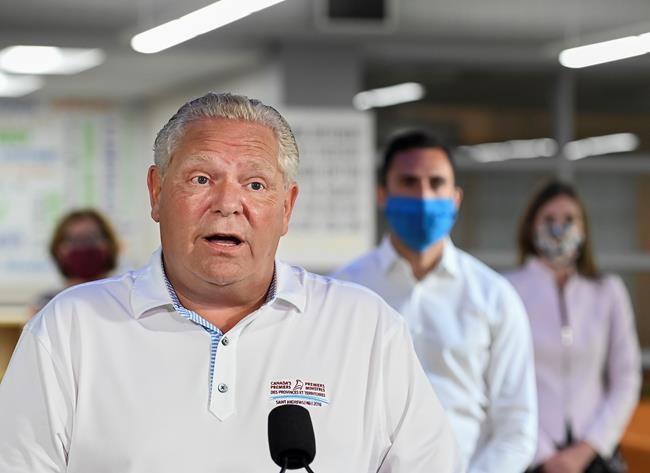
Ontario Premier Doug Ford makes an announcement regarding the governments plan for a safe reopening of schools in the fall due to the COVID-19 pandemic at Father Leo J Austin Catholic Secondary School in Whitby, Ont., on Thursday, July 30, 2020. THE CANADIAN PRESS/Nathan Denette

Anyone with symptoms is to be tested. If they test positive, they can only return to class once they’re given the go-ahead by public health officials, the document says. Those who test negative after an initial positive test can only return once they’ve been symptom-free for 24 hours.

Lecce added that teachers who are immunocompromised or feel unsafe returning to class for other reasons can focus their efforts on teaching students who are opting for remote learning.

The government also announced $309 million in funding to make the plan work, including $60 million for personal protective equipment and $80 million for extra staffing.

In a joint statement, the province’s four major teachers’ unions said that simply isn’t enough money to ensure a safe return to class for staff and students.

“The premier promised Ontarians he ‘will spare no expense’ to keep people safe, yet he and … Lecce are betraying that promise to students, educators, parents and communities with this ill-prepared plan,” said Sam Hammond, president of the Elementary Teachers’ Federation of Ontario.

The highly anticipated announcement came just six weeks before back-to-school season and a week before the province’s 72 school boards were initially asked to submit their plans for the academic year.

The government further announced Thursday that day-care centres across the province will be allowed to return to their full capacity on September 1, in time for back-to-school.

The announcements came as Ontario logged fewer than 100 new cases of COVID-19 for a second day in a row, with 89 new cases reported on Thursday.

Health Minister Christine Elliott said 28 of the province’s 34 public health units are reporting five or fewer cases, with 17 reporting no new ones.

She said the number of people in hospital, in intensive care and on a ventilator all went down, and the province was able to complete more than 27,600 tests the previous day.

This report by The Canadian Press was first published July 30, 2020.

Report Error Submit a Tip

More Stories

A timeline of the WE Charity controversy

The Canadian Press 9 minute read Wednesday, Aug. 19, 2020

OTTAWA - A timeline of events regarding the Canada Student Service Grant program, based on public documents, events and statements from cabinet ministers, government officials, and WE Charity:

March 6, 2020: WE Charity staff prepare a concept paper on service learning for public servants at Employment and Social Development Canada.

April 5: Finance Minister Bill Morneau and Prime Minister Justin Trudeau talk over the phone about how to help students whose summer job and volunteer opportunities were vanishing due to the COVID-19 pandemic. Finance Department officials are tasked with considering options the next morning.

April 7: Small Business Minister Mary Ng and WE co-founder Craig Kielburger have an introductory phone call in which Ng asks WE to send what it calls a ``pre-established proposal'' to help young people launch businesses.

Pair preps for weekend test in Kelowna

Laurie Nealin 6 minute read Preview

Pair preps for weekend test in Kelowna

Laurie Nealin 6 minute read Yesterday at 6:40 PM CDT

KELOWNA, B.C. — Their first spin around the ice at Skate Canada International on Thursday was a mix of business and pleasure for Winnipeg pair skaters Ava Kemp and Yohnatan Elizarov.

Job one for the practice session was to get accustomed to the size and feel of the ice surface at Propsera Place while test-driving the lifts, throws and jumps they’ll perform Friday in their senior ISU Grand Prix competition debut.

“The big thing is the patterns (skating into elements) because these boards are very narrow but very long — it’s NHL size — so when you’re setting up elements you need to make sure you’re using the full length or else you’re going to run into the boards,” Elizarov explained in a post-skate chat with media.

“The second thing is the ice which is sometimes really soft or really hard. This ice is really soft.”

Read
Yesterday at 6:40 PM CDT

Science-art collaboration injects dose of emotion into cold, hard truths

Sarah Lawrynuik 5 minute read Preview

Science-art collaboration injects dose of emotion into cold, hard truths

Sarah Lawrynuik 5 minute read Wednesday, Apr. 28, 2021

Looking at spreadsheets and map plots of trees is far beyond Rhian Brynjolson’s typical day as a visual artist, but she became entranced and inspired by data collected by Canadian scientists for a new art project.

Her hope is to try and bring the numbers, map dots and statistics to life in a new way to help the public better connect to climate science.

Falcon Lake’s Brynjolson is one of 12 Canadian artists who participated in an art-science collaboration exhibit, co-ordinated by the Global Water Futures program out of the University of Saskatchewan. The project saw the artists paired with researchers and scientists across the country who then engaged in conversations to try to inspire a new angle to their art.

“The whole idea behind it is: water is life,” says Louise Arnal, the project lead, and a post-doctoral fellow at the Centre for Hydrology and Coldwater Laboratory.

Read
Wednesday, Apr. 28, 2021

Health officials ponder next steps as COVID cases surge in Southern Health region

Katie May 5 minute read Preview

Health officials ponder next steps as COVID cases surge in Southern Health region

Katie May 5 minute read Wednesday, Nov. 3, 2021

Public-health officials say they're trying to avoid ordering another lockdown in southern Manitoba, where COVID-19 infection rates are surging.

Deputy chief provincial public health officer Dr. Jazz Atwal told a news conference Wednesday he doesn't anticipate more lockdowns and suggested he will prioritize keeping schools open when considering future restrictions.

But he couldn't say what the next step will be in an area of the province where hospitalizations among unvaccinated residents are on the rise.

Average daily case counts in the southern part of the province are higher now than they were before lockdown measures went into effect last November, and officials are still figuring out what to do.

Read
Wednesday, Nov. 3, 2021

Record number of women elected in Manitoba municipal elections

Chris Kitching 5 minute read Preview

Record number of women elected in Manitoba municipal elections

Chris Kitching 5 minute read Yesterday at 3:33 PM CDT

A record number of women were elected to municipal office in Manitoba in elections held across the province Wednesday.

The Association of Manitoba Municipalities said 213 of 339 women candidates were voted in, accounting for almost 25 per cent of elected municipal officials — up from 20 per cent in 2022.

Portage la Prairie Mayor Sharilyn Knox, who applauded the increase, said there has been progress to reduce barriers that impede women’s participation in local government, “but I don’t think we’re where we need to be yet.”

“I think representation matters. When women see other women sitting around council tables, chairing meetings and taking on leadership roles, it helps them see themselves doing the same thing,” she said.

Read
Yesterday at 3:33 PM CDT

Manitoba family adopts Ukrainian children just before Russian invasion

Chris Kitching 7 minute read Preview

Manitoba family adopts Ukrainian children just before Russian invasion

Chris Kitching 7 minute read Wednesday, Mar. 30, 2022

When Trish Braun sees horrific images of Russia’s attack on Ukraine, the Manitoba mother is thankful she had enough time to flee from the country with her three adopted children.

Other Canadian families weren’t as fortunate, as Ukraine halted intercountry adoptions due to the Kremlin’s unprovoked invasion and war.

“I’m so thankful we were able to get out, but lots (of Ukrainians) don’t have the option of getting to leave,” said Braun, who lives in Grunthal, about 50 kilometres southeast of Winnipeg. “It’s hard to adjust to life here while our hearts are over there.”

Just days before Russia began its assault, Braun was staying in the Odesa region with the three Ukrainian children — siblings Daniel, 16, Lewis, 10, and Paige, 6 — that she and her husband, Mike, 43, had adopted from an orphanage.

Read
Wednesday, Mar. 30, 2022