Protect migrant workers or face consequences, Ford and Trudeau warn farmers
Advertisement
Read this article for free:
or
Already have an account? Log in here »
To continue reading, please subscribe:
Digital Subscription
One year of digital access for only $1.44 a week*
- Enjoy unlimited reading on winnipegfreepress.com
- Read the E-Edition, our digital replica newspaper
- Access News Break, our award-winning app
- Play interactive puzzles
*Billed as $5.77 plus GST every four weeks. After 52 weeks, price increases to the regular rate of $19.95 plus GST every four weeks. Offer available to new and qualified returning subscribers only. Cancel any time.
To continue reading, please subscribe:
Add Free Press access to your Brandon Sun subscription for only an additional
$1 for the first 4 weeks*
- Enjoy unlimited reading on winnipegfreepress.com
- Read the E-Edition, our digital replica newspaper
- Access News Break, our award-winning app
- Play interactive puzzles
*Your next Brandon Sun subscription payment will increase by $1.00 and you will be charged $17.95 plus GST for four weeks. After four weeks, your payment will increase to $24.95 plus GST every four weeks.
Read unlimited articles for free today:
or
Already have an account? Log in here »
Hey there, time traveller!
This article was published 22/06/2020 (2323 days ago), so information in it may no longer be current.
TORONTO – Ontario farmers who employ temporary foreign workers received a warning Monday from Premier Doug Ford and Prime Minister Justin Trudeau: Protect those workers from COVID-19 or face consequences.
The strongly worded messages came amid outbreaks on farms that have seen hundreds of migrant workers testing positive for COVID-19 and the Windsor-Essex region held back from moving to Stage 2 of reopening.
Three workers have died from the disease.
Ford, who last week pleaded with farmers to bring their workers to get tested, repeated the appeal Monday — this time singling out some farmers in Windsor-Essex who he said “brushed off” his first request.
“We’ll give it another shot,” Ford said. “I’ll go to the extreme, whatever tool I have, to protect the people of Windsor, and the food supply chain, and the farmers, and the workers.”
Ontario’s labour minister said the province will increase inspections of farms this week, including the migrant workers’ living conditions, in partnership with the federal government and local health units.
“We are stepping up our efforts to work with the agricultural community to help them adjust to the new realities where temporary foreign workers are working and living very closely together,” Monte McNaughton said. “The consequences are serious.”
Advocates have said the cramped “bunkhouses” migrant workers share on farms have contributed to the spread of the novel coronavirus, and they have called on the province to include those spaces in workplace spot checks.
Approximately 20,000 migrant workers come to Ontario each year to work on farms and in greenhouses — many of them from Mexico, Guatemala and the Caribbean. This year, they were required to self-isolate for 14 days upon arrival.
Ford’s announcement came just hours after Trudeau said some farmers were not following strict federal rules designed to protect workers.
“Anyone doing work, let alone essential work as part of our food chain, needs to feel protected,” Trudeau said. “Obviously, in the case of these three tragic deaths, that wasn’t the case. We are ensuring that changes are made and that there will be consequences.”
The province has struggled to contain the outbreaks in the Windsor-Essex and Haldimand-Norfolk regions, where dozens of workers have been exposed to the virus.
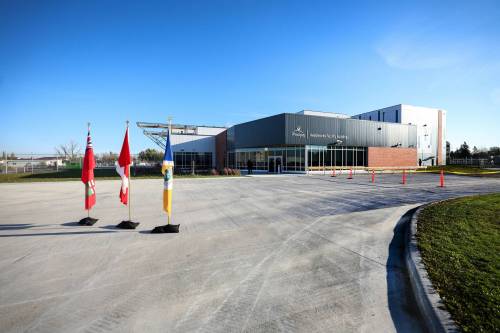
Last week, a temporary centre set up in Leamington, Ont., to test the Windsor-Essex region’s 8,000 workers was shuttered after it tested roughly 10 per cent of the population — prompting hospital officials to call it an inefficient use of resources.
Ford said Monday the province will send mobile testing units to farms to alleviate some of the fears farmers and workers have of testing, but he again appealed for co-operation.
“I’m going to tell it the way it is, farmers just aren’t co-operating,” he said. “They aren’t sending out the people to get tested. We’ve got to bang our heads off the wall and figure out why. It’s good for the farmers, good for your workers, good for the food supply chain on safety.”
The Windsor-Essex County Health Unit said Monday that 31 of the region’s 32 new cases come from the agricultural sector.
Two migrant workers have died in the region due to COVID-19 since the start of the pandemic. The Haldimand-Norfolk Health Unit reported a migrant worker at a local farm had also died from the illness.
That farm currently has 199 infected migrant workers and 18 other people associated with the farm who tested positive for COVID-19, the health unit said.
The president of the Ontario Federation of Agriculture said Monday he was concerned about Ford’s warning of “extreme” actions if farmers don’t co-operate.
Keith Currie said the OFA has been working with the Ontario government and supports increased testing.
“We need to continue to push our members to just suck it up and go get the testing done,” he said. “Then you know where you’re at because the last thing we need is some of these folks to have a huge outbreak at harvest time. Then the whole year is gone.”
In addition to the increased inspections, the province’s chief medical officer of health suggested Monday that local health units tighten regulations on farm workforces.
Farms are filling current labour gaps using a mix of temporary foreign workers, local workers and employment agency workers, which heightens the risk of transmission, Dr. David Williams said.
He recommended increased employee screening and isolation protocols, and said any domestic worker coming onto a farm must have tested negative for the virus 48 hours prior to starting work.
“We need to have much more control, much more regulation and registration and more assurances of the safety before you bring other people in and contaminate what was already a fairly clean workforce,” Williams said.
Green party Leader Mike Schreiner said the pandemic has exposed the inequality between how we treat migrant workers and local workers. He said the province must change the “two-tier system” to prioritize migrant worker safety.
“It is not fair that seasonal workers might be afraid to report an illness or might be living and working in unsafe conditions that they cannot speak out about,” he said.
This report by The Canadian Press was first published June 22, 2020.