‘Defunding’ police, funding mental health resources will save lives: experts

Advertisement

Advertise with us

TORONTO - The death of a Toronto woman who fell from her 24th-floor balcony while police were in her home has renewed calls for an overhaul of how society deals with people in mental health crises.

Read this article for free:


By clicking the button above, an account will be created and you will begin to receive some of our recommended newsletters. You may opt out of any newsletter by visiting your Email and Communication Preferences page or by clicking "unsubscribe" at the bottom of any email.

or

Already have an account? Log in here »

To continue reading, please subscribe:

Digital Subscription

One year of digital access for only $1.44 a week*

  • Enjoy unlimited reading on winnipegfreepress.com
  • Read the E-Edition, our digital replica newspaper
  • Access News Break, our award-winning app
  • Play interactive puzzles

*Billed as $5.77 plus GST every four weeks. After 52 weeks, price increases to the regular rate of $19.95 plus GST every four weeks. Offer available to new and qualified returning subscribers only. Cancel any time.

To continue reading, please subscribe:

Add Free Press access to your Brandon Sun subscription for only an additional

$1 for the first 4 weeks*

  • Enjoy unlimited reading on winnipegfreepress.com
  • Read the E-Edition, our digital replica newspaper
  • Access News Break, our award-winning app
  • Play interactive puzzles
Start now

*Your next Brandon Sun subscription payment will increase by $1.00 and you will be charged $17.95 plus GST for four weeks. After four weeks, your payment will increase to $24.95 plus GST every four weeks.

Hey there, time traveller!
This article was published 04/06/2020 (2339 days ago), so information in it may no longer be current.

TORONTO – The death of a Toronto woman who fell from her 24th-floor balcony while police were in her home has renewed calls for an overhaul of how society deals with people in mental health crises.

Some experts believe “defunding” police — taking some of the taxpayer money going to law enforcement and putting it towards mental health services — is one way to avoid deadly interactions between officers and people struggling with mental illness.

The blowback follows the death last week of Regis Korchinski-Paquet, a 29-year-old woman whose family asked police to take her to a mental health hospital. Police have said they were responding to an assault call, but the family has questioned the role of Toronto officers in her death. The province’s police watchdog has taken over the case.
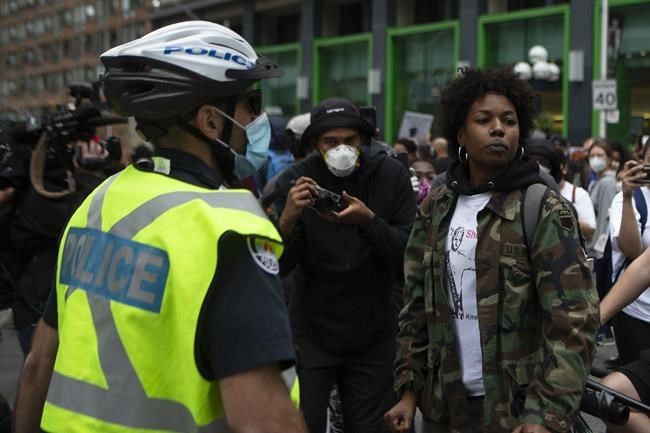
Demonstrators take part in a rally protesting the death of Regis Korchinski-Paquet in downtown Toronto on May 30, 2020. The death of a Toronto woman who fell from her 24th-floor balcony while police were in her home has renewed calls for an overhaul of how society deals with people in mental health crises. THE CANADIAN PRESS/Chris Young

“I think it’s unfortunate we’ve come to a place in our society that police become first responders to people who are experiencing a mental health crisis,” said Akwasi Owusu-Bempah, an assistant professor of sociology at the University of Toronto Mississauga.

“What we should do is take back that money, to defund police, and give it over to mental health professionals who are better equipped to help these people.”

He suggested there should be another number to call, rather than 911, for those in crisis, so mental health care workers can intervene, rather than armed officers.

Toronto police respond to about 30,000 mental health calls every year, out of nearly one million calls that the force responds to, said spokeswoman Meaghan Gray.

The force’s mobile crisis intervention teams, where a trained officer and a mental health nurse respond to those in crisis, attend 6,000 of those calls each year. Those teams do not go to calls where a weapon may be involved.

“We have expanded the program over the years and will continue to do so with the resources that are available to us,” Gray said.

“However, it is important to note that all police officers are trained to respond to mental health issues.”

That annual training consists of courses on communication and de-escalation techniques, she said.

“The Toronto Police Service believes that mental health is a complex issue that requires the involvement of multiple entities, including but not limited to community support, public health, and all levels of government, to render any meaningful change,” Gray said.

There have been a number of high-profile cases over the past decade that involved the deaths of people in crises at the hands of police.

Dr. Patrick Baillie, a psychologist and lawyer, has spent 25 years working with Alberta Health Services and the Calgary police and is usually on call 24 hours a day to help the force deal with those in crisis.

Baillie supports the call for more mental health resources to help those in crisis and let police focus on enforcing the law.

“We have made police officers into the people who respond to all sorts of forms of social difficulty,” he said. “At what point do you say, these things aren’t policing?”

About 10 days ago, Baillie said he received a call from a police negotiator who was stationed outside a man’s home in Calgary with the tactical squad.

A man had been yelling randomly from his porch. When his neighbours told him to shut up, Baillie said, the man made some sort of threat then returned inside. He said police were working on getting a warrant so they could send in the tactical team.

“They tell me the rest of the story: he’s a known police hater, he’s paranoid, …and the police and crisis team has dealt with him before,” he said.

Baillie told police to leave the man alone.

“I said ‘if the neighbours call again, just call me and I’ll go for a drive,'” Baillie said.

No one called. When he checked in on Monday, police told him they went back and said the man was fine and the mental health crisis team took over to help him.

“You’re looking for community support and community intervention rather than law enforcement,” he said.

“If you have a sufficient number of mental health experts available to police, you can have better outcomes.”

Camille Quenneville, the CEO of the Canadian Mental Health Association’s Ontario division, pointed to two crisis centres in the province that are having promising results.

One is in London, Ont., that operates 24 hours per day, she said.

“This is a place where police can take somebody in crisis,” she said. “They immediately get their mental health needs looked after.”

The centres allow people in crisis to avoid emergency rooms and provide specialized mental health services around the clock.

Ideally, she said, the mental health system needs to be revamped so people aren’t in crisis to begin with. But that would require significant investment in mental health care, she said.

And as people spend months cooped up in their homes due to the COVID-19 pandemic, things will likely get worse, Quenneville said.

“The mental health crisis isn’t looming, it’s here now and we need to act,” she said.

Syrus Marcus Ware, of Black Lives Matter — Toronto, says now is the time to find alternatives to calling police when someone is in the throes of a mental break.

He points to the Gerstein Centre — a 24-hour community-based mental-health crisis centre with its own mobile crisis response team — as one of those alternatives.

“We don’t have to call police if we’re struggling, we can figure out a better way, but we need more of these programs.”

This report by The Canadian Press was first published June 4, 2020.

Report Error Submit a Tip

More Stories

Overhaul response to those in crisis, experts say

Liam Casey, The Canadian Press 6 minute read Preview

Overhaul response to those in crisis, experts say

Liam Casey, The Canadian Press 6 minute read Thursday, Jun. 4, 2020

TORONTO - The death of a Toronto woman who fell from her 24th-floor balcony while police were in her home has renewed calls for an overhaul of how society deals with people in mental health crises.

Some experts believe "defunding" police — taking some of the taxpayer money going to law enforcement and putting it towards mental health services — is one way to avoid deadly interactions between officers and people struggling with mental illness.

The blowback follows the death last week of Regis Korchinski-Paquet, a 29-year-old woman whose family asked police to take her to a mental health hospital. Police have said they were responding to an assault call, but the family has questioned the role of Toronto officers in her death. The province's police watchdog has taken over the case.

"I think it's unfortunate we've come to a place in our society that police become first responders to people who are experiencing a mental health crisis," said Akwasi Owusu-Bempah, an assistant professor of sociology at the University of Toronto Mississauga.

Read
Thursday, Jun. 4, 2020

Longtime councillor Eadie ‘knew it was going to be close,’ but expected to finish on top in Mynarski

Scott Billeck 5 minute read Preview

Longtime councillor Eadie ‘knew it was going to be close,’ but expected to finish on top in Mynarski

Scott Billeck 5 minute read Updated: 1:56 PM CDT

Ross Eadie knew his re-election bid would be close, but he didn’t anticipate losing in the neighbourhoods where he grew up.

The 16-year Mynarski councillor, who was defeated Wednesday by political newcomer Natalie Smith, said Thursday the result was difficult to accept because some of his strongest losses were in Luxton, St. John’s Park and surrounding neighbourhoods.

“I knew it was going to be close,” Eadie said. “But I thought it was going to be close with me in first place.”

“I really lost it where I live. So that’s the worst part of it.”

Read
Updated: 1:56 PM CDT

Three’s company for new netminder Daws

Mike McIntyre 6 minute read Preview

Three’s company for new netminder Daws

Mike McIntyre 6 minute read 5:09 PM CDT

TAMPA — Nico Daws is still trying to catch his breath.

An unexpected piece of the Connor Hellebuyck blockbuster. A chaotic crash course in his latest hockey home. Joining a fragile club mired in a prolonged losing streak. And now, hitting the road for four tough tests, including one where he will find himself as the last line of defence.

It’s been quite the ride for the newest Winnipeg Jets netminder, who took some time Thursday morning to reflect on the experience.

“A whirlwind of a week. I haven’t even really had time to sit down and digest it,” said Daws.

Read
5:09 PM CDT

City rec facilities crumbling

Ryan Thorpe 6 minute read Preview

City rec facilities crumbling

Ryan Thorpe 6 minute read Monday, Oct. 22, 2018

Throughout Winnipeg, decades-old community assets — pools, arenas and recreation and leisure centres — are deteriorating so quickly that service disruptions are inevitable.

Meanwhile, the city’s community services department, which is responsible for managing those assets, operates with an annual deficit of roughly $80 million, meaning there are scant resources to do little more than bail water on a sinking ship.

Soon, Winnipeggers will have a choice: fewer community services or higher costs.

“It poses a huge challenge because we have very limited dollars that we have to invest in our existing facilities. We also have growing demands for new amenities in new areas. We have to be very strategic,” said Ken McKim, manager of asset management for the department.

Read
Monday, Oct. 22, 2018

Two government bills left on table as NDP ends third year of term

Carol Sanders 4 minute read Preview

Two government bills left on table as NDP ends third year of term

Carol Sanders 4 minute read 6:59 PM CDT

Year 3 of the NDP government’s four-year mandate ended Thursday with more than 50 bills expected to become law and two that didn’t make it to the finish line.

“We’re on the final stages of passing 52 amazing bills,” government house leader Nahanni Fontaine said after the final question period of the 43rd legislature.

Most were passed before the house rose for the summer break, including getting rid of the provincial sales tax on pop, chips and packaged foods that took effect July 1. A handful of health-care bills that aim to restrict mandatory overtime, create a patient safety charter, establish nurse-to-patient ratios and do away with sick-note requirements for employees — unless they miss more than seven consecutive days or 10 in a year — were also passed.

Under rules of the legislature, the Progressive Conservatives held back three government bills until the fall session to allow for further debate before passage by the NDP majority Thursday. The most contentious was Bill 13, the Residential Tenancies Amendment Act, that aims to strengthen renter protections and increase maximum fines for landlords in breach of the act.

Read
6:59 PM CDT

Carrying a torch for tiki

Eva Wasney 5 minute read Preview

Carrying a torch for tiki

Eva Wasney 5 minute read Monday, Nov. 15, 2021

A paper tiki mask is the only indication that the door it’s affixed to leads somewhere other than a dive bar. Ring the doorbell and walk through the kitchen, however, and you’ll be transported to an island-themed lounge that’s equal parts kitschy and comfortable.

“This is just from people’s houses, like my mom’s,” says Allan Pineda, pointing to the wood carvings, water-buffalo horns and rattan furniture decorating the room. “A lot of the stuff you see in here, you’d see in a Filipino’s house back in the day — like second-wave immigrants in the ‘60s and ‘70s, they’d bring this stuff home (from the Philippines).”

Pineda is a local chef and part of the team behind the Bahay Kubo Tiki Bar, a pop-up Filipino drinking and dining experience hosted weekly at an undisclosed Winnipeg establishment.

The details are hush-hush because the temporary eatery is meant to operate like a speakeasy. The dinners are an offshoot of Baon Manila Nights, which Pineda started as a way to highlight Winnipeg’s Filipino culinary scene.

Read
Monday, Nov. 15, 2021