Questions raised by Nova Scotia’s go-slow approach to economic recovery

Advertisement

Advertise with us

HALIFAX - Nova Scotia was the last province in Canada to report cases of COVID-19, and it now has the dubious distinction of being one of the last jurisdictions to present a formal plan for reopening its economy.

Read this article for free:


or

Already have an account? Log in here »

To continue reading, please subscribe:

Subscribe and receive a limited-edition Free Press branded hat or tote.

Digital Subscription

One year of digital access for only $205*

  • Enjoy unlimited reading on winnipegfreepress.com
  • Read the E-Edition, our digital replica newspaper
  • Access News Break, our award-winning app
  • Play interactive puzzles

*First annual payment billed as $205.00 + GST for one year. This annual subscription will automatically renew at $233.00 + GST every 52 weeks (10% off the regular annual price of $259.35). Offer available to new and qualified returning subscribers only. Cancel any time.

To continue reading, please subscribe:

Add Free Press access to your Brandon Sun subscription for only an additional

$1 for the first 4 weeks*

  • Enjoy unlimited reading on winnipegfreepress.com
  • Read the E-Edition, our digital replica newspaper
  • Access News Break, our award-winning app
  • Play interactive puzzles
Start now

*Your next Brandon Sun subscription payment will increase by $1.00 and you will be charged $17.95 plus GST for four weeks. After four weeks, your payment will increase to $24.95 plus GST every four weeks.

Hey there, time traveller!
This article was published 20/05/2020 (2323 days ago), so information in it may no longer be current.

HALIFAX – Nova Scotia was the last province in Canada to report cases of COVID-19, and it now has the dubious distinction of being one of the last jurisdictions to present a formal plan for reopening its economy.

As health authorities reported one new death linked to the virus and one newly confirmed infection on Wednesday, the province’s chief medical officer of health made it clear he would not waver from his cautious, go-slow approach.

“We understand that there are significant impacts from our public health measures (on the economy),” Dr. Robert Strang told a news conference in Halifax, where he sat more than two metres from Premier Stephen McNeil.
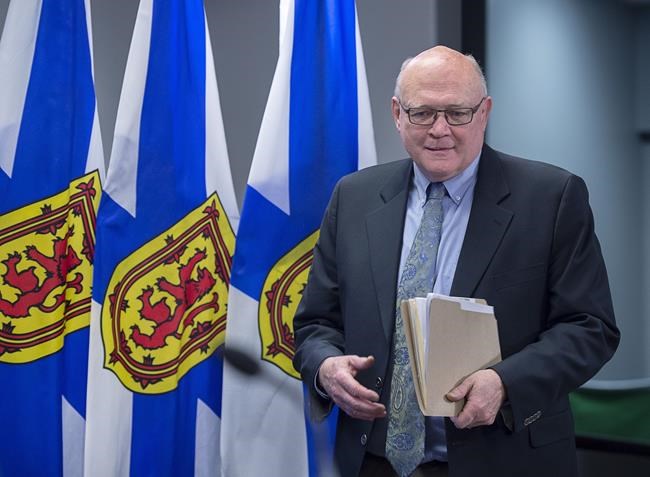
Dr. Robert Strang, chief medical officer of health, arrives to deliver an update on health system preparations in Nova Scotia for the coronavirus that causes COVID-19, in Halifax on Friday, March 6, 2020. Nova Scotia was the last province in Canada to report cases of COVID-19, and it now has the dubious distinction of being one of the last jurisdictions to present a formal plan for reopening its economy. THE CANADIAN PRESS/Andrew Vaughan

“But all you have to do is look around the world at other countries, like Germany, which opened up much more aggressively. They have had to step back and re-tighten things down.”

Strang has said the province is following federal health guidelines and he has stressed that the number of new COVID-19 cases caused by community transmission must drop to few or no cases for at least two weeks — ideally 28 days — before an economic recovery plan is implemented.

The province’s latest COVID-19 fatality was reported at the Northwood long-term care facility in Halifax, which is the scene of the province’s worst outbreak. A total of 57 people in Nova Scotia have died from the virus —51 of them at Northwood.

As of Thursday, Nova Scotia had 1,045 confirmed cases of the infectious illness, with 956 people recovered and eight still in hospital, four of them in intensive care.

In terms of deaths and infections, Nova Scotia’s numbers are worse than those reported in Saskatchewan, Manitoba and all of the other Atlantic provinces.

Meanwhile, the province is conducting consultations with business and labour leaders, who have been told that a wider reopening of the economy won’t happen until early next month — at the earliest.

Kevin Quigley, director of the Halifax-based MacEachen Institute for Public Policy and Governance, said the Nova Scotia government has done a good job of earning public trust by demonstrating openness, knowledge and concern about the risks the province is facing.

However, the Dalhousie University professor said he’s at a loss to explain why a plan for economic recovery has yet to be released.

“I still wonder why the other provinces have felt it’s important to issue plans with milestones,” Quigley said in an interview Wednesday. “Why isn’t there a road map for this, and what are the performance metrics? The other provinces seem to be doing that.”

The premier said his government wants to make sure businesses across the province are ready to get back to work as soon as Strang says it is safe to do so.

“The day that we are confident enough to open the economy, businesses in this province should be ready to start on Day 1,” he said. “We’re working as hard as we can to ensure that once we see this virus has been flattened, that those sectors are ready to open.”

Dr. Susan Kirkland, head of Dalhousie’s Department of Community Health and Epidemiology, said Strang’s approach has been rational and reasonable.

“Nova Scotia was one of the last provinces to have cases — and we’ve had quite a number over the course of this first wave — and I think that’s it’s quite prudent to ensure that we have our cases under control before we start to open the economy widely,” said Kirkland, a member of the federal COVID-19 immunity task force.

“The challenge is that if we open up too quickly, we will just be back in the same state we were, and then we go back into lockdown and that doesn’t help the economy. A very slow, very phased approach is actually the most appropriate approach.”

She pointed to Quebec, which moved quickly to open its economy, but had to roll back certain measures, including a plan to reopen schools.

“It’s a very tough call,” Kirkland said. “In smaller places (like Nova Scotia) we’re less equipped to deal with a massive surge.”

Nova Scotia was the last province to report cases of COVID-19 on March 15, and the provincial government declared a state of emergency on March 22.

However, parks and trails have been open for several weeks, and on Friday the government introduced a “family bubble” policy, allowing two households to come together without physical distancing.

Public beaches reopened Saturday, along with many outdoor activities, with the proviso that social distancing and hygiene be maintained.

This report by The Canadian Press was first published May 20, 2020.

Report Error Submit a Tip

More Stories

Eliminating short-term sick notes ‘big step forward’: Doctors Manitoba

Matthew Frank 2 minute read Preview

Eliminating short-term sick notes ‘big step forward’: Doctors Manitoba

Matthew Frank 2 minute read 1:39 PM CDT

Manitoba doctors will no longer be required to issue sick notes for short-term employee absences due to illness or injury, starting Thursday.

The new provincial legislation, which officially passed in June, will only allow employers to request the medical documents when an employee has been absent for more than a week or if they’ve called in sick 10 or more times in a calendar year.

Dr. Nichelle Desilets, Doctors Manitoba board chair, said the legislation will free up time for physicians to concentrate on medical appointments.

“What may be a small change in the labour code can be a big step forward on improving access to medical care for all Manitobans and using our health care resources wisely,” she said during a news conference Tuesday.

Read
1:39 PM CDT

Plenty of losses all around

Gwynne Dyer 4 minute read Wednesday, Jul. 15, 2026

The last time oil-tankers were being shot up in the Persian Gulf, back in the 1980s, it was Saddam Hussein’s brutal tyranny in Iraq versus Ayatollah Khomeini’s revolutionary Islamist regime in Iran.

The United States backed Saddam because he was just another murderous thug, whereas the new regime in Tehran was an actual threat to American interests. It had overthrown Iran’s American-backed puppet king and wanted to spread its Islamist ideology across the region.

So, of course, Ronald Reagan’s administration chose Saddam’s side. It sent Iraq arms by clandestine means (because Congress wouldn’t authorize it) and even provided targeting information for Iraqi poison gas attacks on Iran. The Americans chose the “lesser evil,” but at least they knew it was evil.

Once in a while they would even say it out loud, quoting U.S. diplomat Henry Kissinger: “It’s a shame that both sides can’t lose.” But they never did anything about it, and after eight years of slaughter, the war ended in a no-score draw.

Accused grandparent scammer charged with sex crimes involving minor

Free Press staff 3 minute read 12:11 PM CDT

An Edmonton man accused of defrauding several Winnipeg seniors in so-called grandparent scams has also been charged for allegedly sexually assaulting a teenage girl in the city.

Winnipeg Police Service financial crime investigators were alerted after three city residents, all in their 80s, were defrauded of more than $37,000 in August after receiving calls from someone posing as a grandchild who claimed to need cash to pay for bail, police said Tuesday.

The first victim received several phone calls between Aug. 17 and 22 from a caller who claimed the victim’s grandson had been arrested and needed cash bail. The victim agreed to pay and handed over cash and gold and silver coins to a man who showed up at their door four separate times.

On Aug. 18, another adult received a call from someone claiming to be their grandson who needed cash for bail and the victim obliged, paying a man who went to their home to pick up money.

City considers first-come, first-served Transit Plus

Kevin Rollason 5 minute read Preview

City considers first-come, first-served Transit Plus

Kevin Rollason 5 minute read Friday, Sep. 11, 2020

The city's much-maligned Transit Plus, which is for people with disabilities, could soon do away with a system that prioritizes jobs and medical trips over recreation and visits with friends, in favour of first-come, first-served bookings.

While the city says the changes could mean Transit Plus users would no longer be guaranteed to get to work or medical appointments, several disability advocates are in favour of the move. They don't believe any trip should take priority over another.

Natalie Pirson has used Transit Plus, and the former Handi Transit system, for more than 20 years. She is pleased with the proposed changes, which will be discussed by the city's public works committee next week. Pirson was quick to point out the city will have to do more than change the booking system.

"I rely on Transit Plus for every aspect of my life," Pirson said on Thursday.

Read
Friday, Sep. 11, 2020

State of the Nations event to highlight Indigenous mining plans

Gabrielle Piché 3 minute read Preview

State of the Nations event to highlight Indigenous mining plans

Gabrielle Piché 3 minute read Yesterday at 7:37 PM CDT

A first-ever conference aims to connect Indigenous leaders with businesses as local mining ambitions grow.

The Manitoba Prospectors and Developers Association expects to rally a half-dozen chiefs to present on their communities’ mineral development projects.

The Nov. 16 event — called the State of the Nations — comes as the province promises to triple critical mineral production.

“We want to see those minerals being developed and being able to be exported,” said Renée Greyeyes, the prospectors association’s chief executive.

Read
Yesterday at 7:37 PM CDT

The inaugural Editor’s Note

1 minute read Tuesday, May. 26, 2026