Health researcher hopes COVID-19 means new policies for Indigenous peoples

Advertisement

Advertise with us

SASKATOON - A health researcher studying COVID-19 as part of a national immunity task force hopes the pandemic elevates concern for persistent health issues, such as inadequate housing, for Indigenous people in Canada.

Read this article for free:


By clicking the button above, an account will be created and you will begin to receive some of our recommended newsletters. You may opt out of any newsletter by visiting your Email and Communication Preferences page or by clicking "unsubscribe" at the bottom of any email.

or

Already have an account? Log in here »

To continue reading, please subscribe:

Digital Subscription

One year of digital access for only $1.44 a week*

  • Enjoy unlimited reading on winnipegfreepress.com
  • Read the E-Edition, our digital replica newspaper
  • Access News Break, our award-winning app
  • Play interactive puzzles

*Billed as $5.77 plus GST every four weeks. After 52 weeks, price increases to the regular rate of $19.95 plus GST every four weeks. Offer available to new and qualified returning subscribers only. Cancel any time.

To continue reading, please subscribe:

Add Free Press access to your Brandon Sun subscription for only an additional

$1 for the first 4 weeks*

  • Enjoy unlimited reading on winnipegfreepress.com
  • Read the E-Edition, our digital replica newspaper
  • Access News Break, our award-winning app
  • Play interactive puzzles
Start now

*Your next Brandon Sun subscription payment will increase by $1.00 and you will be charged $17.95 plus GST for four weeks. After four weeks, your payment will increase to $24.95 plus GST every four weeks.

Hey there, time traveller!
This article was published 17/05/2020 (2361 days ago), so information in it may no longer be current.

SASKATOON – A health researcher studying COVID-19 as part of a national immunity task force hopes the pandemic elevates concern for persistent health issues, such as inadequate housing, for Indigenous people in Canada.

“This pandemic has opened the eyes for a lot of people across Canada,” said Dr. Carrie Bourassa, scientific director of the Institute of Indigenous Peoples’ Health.

“I would like to think that what these … studies will do is change a lot of policies for Canadians and for Indigenous people.
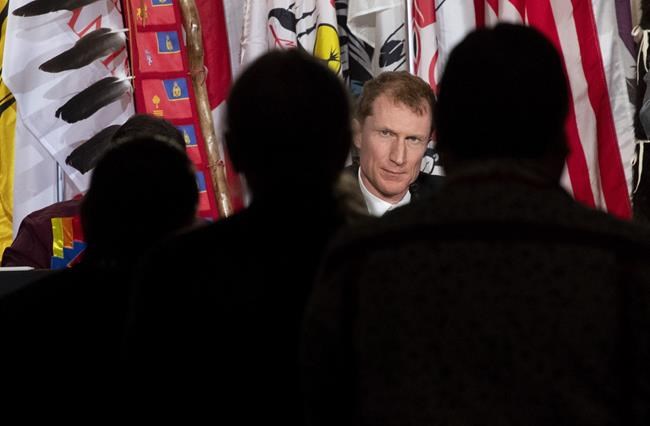
Indigenous Services Minister Marc Miller listens to chiefs as they line up to speak during a session at the AFN Special Chiefs Assembly in Ottawa, Tuesday, Dec. 3, 2019. THE CANADIAN PRESS/Adrian Wyld

“I hope that this will also raise the bar and help people to understand that equity has not been reached for Indigenous peoples in Canada.”

Bourassa was recently tapped to come up with a plan to engage First Nations, Metis and Inuit people in studies about how the virus has spread and who is immune. The Anishinaabe-Metis professor at the University of Saskatchewan said an Indigenous advisory circle will soon be announced for the two-year project.

It’s critical Indigenous people are included in such studies, she said, because they could be more susceptible to the virus, given factors such as overcrowded housing and poor access to healthy food and clean water.

“Those are now huge mitigating risk factors,” she said. “It gets exasperated in times of a pandemic.”

The federal government has reported at least 190 confirmed cases of COVID-19 on reserves in Britsh Columbia, Alberta, Saskatchewan, Ontario and Quebec.

Communities in Saskatchewan’s far north, including La Loche, a Dene village 600 kilometres northwest of Saskatoon, have been dealing with an outbreak after the virus travelled there with someone who had been at an oilsands work camp in northern Alberta.

Indigenous Services Minister Marc Miller has said that coming out of the pandemic there will be a need to come up with a clear plan to address realities such as overcrowding, historic under-funding of health services and a high rates of diabetes.

Bourassa said access to health care is a major issue, including future access to a potential vaccine.

“It’s often the case that marginalized populations don’t get access to treatment.”

— By Stephanie Taylor in Regina

This report by The Canadian Press was first published May 17, 2020

Report Error Submit a Tip

More Stories

Sarault wins silver medal in 1,000-metre

The Canadian Press 2 minute read Saturday, Feb. 8, 2020

DRESDEN, Germany - Canadian Courtney Sarault won a silver medal in the women's 1,000-metre event at the ISU short track World Cup on Saturday.

Sarault, from Moncton, N.B., took second place with a time of 1:55.143 — finishing behind South Korea's Kim Ji Yoo (1:54.955) and ahead of World Cup overall standings leader Suzanne Schulting of the Netherlands. (1:55.167).

"Going into the final, I didn't feel amazing, but I was trying to stay positive, and hoping to come out of it with a podium," said Sarault.

Meanwhile, Canada's Kim Boutin had her string of podium results come to an end at eight events.

Newspaper websites display fewer stories, more curation

5 minute read Tuesday, Feb. 10, 2026

A city subcommittee was provided with a routine update on the status of an ongoing administrative process Thursday, in accordance with standard reporting procedures.

With the start of 2022 comes a new framework for Manitoba’s real estate industry

Ben Waldman 6 minute read Preview

With the start of 2022 comes a new framework for Manitoba’s real estate industry

Ben Waldman 6 minute read Monday, Jan. 10, 2022

New year, new rules for Manitoba real estate.

On Jan. 1, the Real Estate Services Act came into effect in the province, bringing with it an updated regulatory framework for the local industry to follow, along with some key changes for parties on either side of a real estate transaction.

One of the most notable changes to consumers is likely the introduction of a service agreement requirement: any buyers, sellers, or renters of residential or commercial properties are now required to sign such an agreement with a realtor prior to any services being rendered. But there are other moves that will impact real estate business moving forward.

The regulatory Manitoba Securities Commission’s real estate division consulted with industry groups such as the Manitoba Real Estate Association in drafting the legislation, which replaces the Real Estate Brokers Act, and which the commission’s website says “reflects the changing face” of the provincial real estate landscape.

Read
Monday, Jan. 10, 2022

Today’s horoscope

Georgia Nicols 4 minute read Preview

Today’s horoscope

Georgia Nicols 4 minute read 2:01 AM EST

MOON ALERT: Tricky. Avoid shopping (except food and gas) until 6:30 a.m., then again, after 9:45 p.m. The moon is in Virgo.

ARIES (March 21-April 19)

Your work routine might be interrupted, or something related to your health or even your pet might create an unexpected hiccup. Nevertheless, this is a productive day. Review your values and guard against impetuous actions.

TAURUS (April 20-May 20)

Read
2:01 AM EST

Notable quotes from the 2020 Tokyo Olympics

The Canadian Press 3 minute read Thursday, Aug. 5, 2021

TOKYO - Here are some notable quotes from Canadians at the 2020 Tokyo Olympics on Aug. 5, 2021.

"It's really special. It's one of those things where when you're younger, you set little dreams and goals. I just remember watching guys like Donovan Bailey and Catriona Le May Doan when I was a kid, celebrating and winning gold medals, and sitting on the couch watching it with my mom, telling her, 'I want to do that one day.' It's really cool coming out here and finally live that dream."

--Canadian Damian Warner, who won gold and set an Olympic record in the decathlon. Warner finished the 10-discipline event with 9,018 points, bettering the previous Olympic record of 8,893 points.

-----

We don’t vote like our lives depend on it

Judy Waytiuk 5 minute read Preview

We don’t vote like our lives depend on it

Judy Waytiuk 5 minute read 2:00 AM EST

There’s an old saw — we get the government we deserve. It assumes active participation in our elections, full and fair media coverage from which voters can learn and a set of viable, capable candidates from which we can choose.

Arguably, those conditions did not apply this time around in Winnipeg. Our voter turnout was just 38 per cent and Mayor Scott Gillingham’s victory came from just 15 per cent of Winnipeg’s eligible voters. Two supposedly serious competitors embroiled themselves — by choice — in juvenile mudslinging and offered scattered, chaotic policy platforms.

A fourth contender surged from behind in the closing weeks of the campaign — and Noah Redden had spent most of the campaign being thought of as one of the pack of gadflies that emerge to run every time there’s a mayoralty campaign here. Yet he virtually tied Kevin Klein for second place. Had Redden been treated during the campaign as a viable candidate (he was the only one to publish online a detailed, thought-through policy platform), who knows what would have happened?

Absorb those facts.

Read
2:00 AM EST