Learning to live with COVID-19 requires permanent fixes to vulnerable settings

Advertisement

Advertise with us

OTTAWA - Canada's chief public health officer warned Monday there is still a lot we don't know about the virus that causes COVID-19, but said stopping this pandemic or preventing a future one will require more than just physical distancing and handwashing.

Read this article for free:


or

Already have an account? Log in here »

To continue reading, please subscribe:

Subscribe and receive a limited-edition Free Press branded hat or tote.

Digital Subscription

One year of digital access for only $205*

  • Enjoy unlimited reading on winnipegfreepress.com
  • Read the E-Edition, our digital replica newspaper
  • Access News Break, our award-winning app
  • Play interactive puzzles

*First annual payment billed as $205.00 + GST for one year. This annual subscription will automatically renew at $233.00 + GST every 52 weeks (10% off the regular annual price of $259.35). Offer available to new and qualified returning subscribers only. Cancel any time.

To continue reading, please subscribe:

Add Free Press access to your Brandon Sun subscription for only an additional

$1 for the first 4 weeks*

  • Enjoy unlimited reading on winnipegfreepress.com
  • Read the E-Edition, our digital replica newspaper
  • Access News Break, our award-winning app
  • Play interactive puzzles
Start now

*Your next Brandon Sun subscription payment will increase by $1.00 and you will be charged $17.95 plus GST for four weeks. After four weeks, your payment will increase to $24.95 plus GST every four weeks.

Hey there, time traveller!
This article was published 27/04/2020 (2303 days ago), so information in it may no longer be current.

OTTAWA – Canada’s chief public health officer warned Monday there is still a lot we don’t know about the virus that causes COVID-19, but said stopping this pandemic or preventing a future one will require more than just physical distancing and handwashing.

Dr. Theresa Tam said we simply do not know yet whether someone who has had COVID-19 will be immune from getting it again, or how long that immunity will last. The World Health Organization warned last week it is premature to give the all-clear for resuming normal activities to people who have recovered from COVID-19, because there is some evidence that some patients have contracted the novel coronavirus a second time.

Tam said Monday these are critical questions the immunity task force she is part of seek to answer as Canada tries to make critical decisions about how to lift the extreme restrictions on public gatherings without throwing the door wide open for the virus to spread rapidly amongst the population.
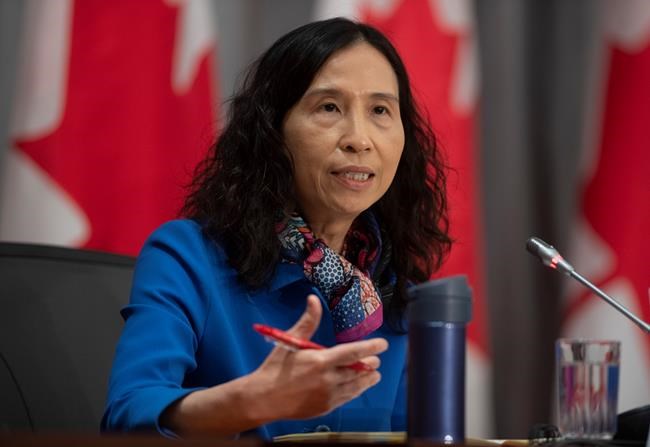
Chief Public Health Officer Theresa Tam responds to a question during a news conference in Ottawa, Monday, April 27, 2020. THE CANADIAN PRESS/Adrian Wyld

But Tam said what she does know is that to stop COVID-19, and to prepare better for the next wave of this or another global virus, Canada has got to do something immediately to address the “social, cultural and economic” conditions she said contributed to allowing COVID-19 to disproportionately affect vulnerable populations and essential workers.

“The bad bugs are not going away so if we are to end the tragedy of increased disease and death rates in vulnerable populations we need to make things right, right now,” Tam said during her regular briefing in Ottawa.

“This is not just someone else’s problem or someone else’s sorrow. Inequities touch us all,” she said. “They affect the health and social well-being of all Canadians just as they diminish our humanity.”

While many communities appear to have community transmission under control, the virus is continuing to wreak tragic consequences in group housing settings, like long-term care homes, homeless shelters and prisons.

At least half the Canadians who have died of this disease so far lived in long-term care homes, and in Ontario and Quebec, more than three in four deaths are linked to the facilities. Both provinces have requested help from the military because it’s not only those living in these homes who were vulnerable, but also those looking after them. Ontario reported on the weekend that 1,181 staff in long-term care homes are sick. Quebec says 4,000 health workers have tested positive, and another 5,500 are in isolation.

Prime Minister Justin Trudeau said last week there will be tough questions to face about how Canada’s seniors were not better protected from the virus, and how it got so bad that we need to send in the military to help.

Wages could be part of the issue in recruiting and maintaining qualified staff — both Ontario and Quebec boosted hourly wages for essential workers this month. Quebec Premier Francois Legault also pointed fingers at private operators, saying last week he was considering making all care homes public. He also said the facilities needed more workers and more space to keep residents apart to prevent the virus from spreading like wildfire.

The Canadian Red Cross was moving some long-term care residents with COVID-19 in one part of Montreal to a local arena for treatment.

Tam said the idea of moving sick patients elsewhere is being discussed in other areas too but she said it is complicated by the high level of care many of those patients require.

Ontario NDP MP Charlie Angus said the changes to come after the COVID-19 crisis has passed must include a full rethink of the pillars of globalization and privatization upon which Canada’s economy has been built.

“What is staggering about this virus is that all the myths about our economy crumbled almost overnight,” said Angus. “Millions of people, within one week, didn’t have enough money to pay the rent.”

Global supply chains for critical medical equipment failed us and our allies were taking equipment we ordered right out from under us, said Angus.

The NDP is kicking off a task force this week to consult with the public and some of Canada’s leading experts on economics and finance, to ask and try and find answers to what went so wrong and how we fix it.

This report by The Canadian Press was first published April 27, 2020.

Report Error Submit a Tip

More Stories

Don’t delete organ concert tickets when scrubbing digital life

Jen Zoratti 6 minute read Preview

Don’t delete organ concert tickets when scrubbing digital life

Jen Zoratti 6 minute read Yesterday at 2:01 AM CDT

There is an organ in Germany that is playing one composition until 2640.

What’s billed as the world’s slowest concert features a piece by American composer John Cage, and was back in the news because it had its first chord change in two years. It’s already been playing for 25 years; only 614 more to go.

Organ music at the end of the world.

The real take-home for me, however, is the fact that there are already “inheritable” tickets for the final Sept. 4, 2640, event being sold for 2,640 euros (US$3,045).

Read
Yesterday at 2:01 AM CDT

Manitoba makes clean sweep at Canadian junior curling championships

Jason Bell 7 minute read Preview

Manitoba makes clean sweep at Canadian junior curling championships

Jason Bell 7 minute read Sunday, Jan. 26, 2020

CALL it — most appropriately — a Manitoba sweep. Or, perhaps, a buffalo stampede.

The curling-crazed province flexed its mighty rock-tossing muscle again Sunday in Langley, B.C., as Manitoba teams charged off with victories at the Canadian junior curling championships.

Altona’s Mackenzie Zacharias was the class of the women’s draw from the very moment the first stones were delivered last Saturday, capping a perfect week with a resounding 10-3 triumph over Abby Marks of Alberta in the morning championship contest.

She celebrated the achievement with her younger sister, Emily, who plays second, along with third Karlee Burgess and lead Lauren Lementine.

Read
Sunday, Jan. 26, 2020

Célébrer des employés qui mettent la main à la pâte

Jaider Cabarcas 7 minute read Preview

Célébrer des employés qui mettent la main à la pâte

Jaider Cabarcas 7 minute read Yesterday at 2:01 AM CDT

L’immigration francophone joue un rôle grandissant dans la vitalité de Saint-Pierre-Jolys. À la Boulangerie Saint-Pierre, des employés venus de plusieurs pays contribuent à la croissance de l’entreprise tout en s’intégrant à la vie du village. Une diversité que l’entreprise souhaite célébrer avec une nouvelle murale.

La Boulangerie Saint-Pierre, à Saint-Pierre-Jolys, connaît une importante expansion depuis quelques années. Pour Jocelyn Gagné, propriétaire de l’entreprise familiale, cette croissance repose largement sur le travail de ses employés, dont plusieurs sont des immigrants francophones. C’est pour souligner leur contribution que la boulangerie, en collaboration avec l’artiste franco-manitobain Gérald Laroche, a entrepris la création d’une murale qui ornera bientôt sa façade.

Jocelyn Gagné, qui travaille dans l’entreprise depuis l’âge de 13 ans, alors que ses parents étaient propriétaires, constate bien que la société a changé à travers les années. “On est rendu dans près de 150 magasins, on a grandi pas mal vite dans la dernière année. On a beaucoup plus d’employés que dans le temps de mes parents.” Avec une telle croissance, le besoin d’engager davantage de main-d’œuvre est venu naturellement.

Un Folklorama à l’année longue

Read
Yesterday at 2:01 AM CDT

Long-term water advisory lifted for First Nation

The Canadian Press 4 minute read Preview

Long-term water advisory lifted for First Nation

The Canadian Press 4 minute read Wednesday, Sep. 15, 2021

SHOAL LAKE, ONTARIO, CANADA - Angelina McLeod spent most of her life in Shoal Lake 40 First Nation watching her uncles and her father, Alfred Redsky, a former chief, fight for clean drinking water and a better way of life.

The moment came Wednesday when, for the first time in nearly 25 years, the water flowing through the community's taps was deemed safe to drink.

"It was like I was there seeing it for them," McLeod said in a phone interview.

McLeod's father died in 2013. She kept up his fight as a documentarian and eventual councillor for the Anishinaabe community on the Manitoba-Ontario boundary.

Read
Wednesday, Sep. 15, 2021

Today’s horoscope

Georgia Nicols 4 minute read Preview

Today’s horoscope

Georgia Nicols 4 minute read 2:00 AM CDT

MOON ALERT: There are no restrictions to shopping or important decisions today. The moon is in Libra.

ARIES (March 21-April 19)

The day is a mixed bag. For the most part, it’s romantic, friendly, congenial and a great time to socialize with others and enjoy playful activities with kids. Nevertheless, you might meet a real sourpuss or someone who is a wet blanket. Keep things light!

TAURUS (April 20-May 20)

Read
2:00 AM CDT

Privy Council clerk Wernick to quit

Joan Bryden, The Canadian Press 7 minute read Preview

Privy Council clerk Wernick to quit

Joan Bryden, The Canadian Press 7 minute read Monday, Mar. 18, 2019

OTTAWA - The SNC-Lavalin affair claimed its fourth resignation Monday as Michael Wernick announced he will step down as the country's top public servant, having concluded he's lost the trust of opposition parties.

Opposition parties have been calling for the clerk of the Privy Council's resignation since he first vehemently rejected allegations that he and others improperly pressured former attorney general Jody Wilson-Raybould to halt a criminal prosecution of SNC-Lavalin. Wernick's combative testimony to the House of Commons justice committee was denounced as partisan and unbecoming of a senior bureaucrat.

Also on Monday, the Liberals who make up a majority on that committee said publicly that they believe it has done all it can, or should, to investigate the affair.

In a letter to Prime Minister Justin Trudeau on Monday, Wernick said he will retire before this fall's federal election campaign kicks off. He noted that the clerk is supposed to be "an impartial arbiter of whether serious foreign interference" occurs during the campaign, as part of a new federal watchdog panel, and is also supposed to be ready to help whichever party is elected to form government — two roles he no longer believes he can fulfil.

Read
Monday, Mar. 18, 2019