COVID expected to kill thousands just in Ontario even with stiff restrictions

Advertisement

Advertise with us

TORONTO - As known COVID-19 cases rose nationally and almost all construction in the country's economic heartland was idled on Friday, health authorities in Ontario said the death toll in that province alone could be kept below a still-staggering 15,000 — if stringent isolation measures prove effective in curbing the pandemic.

Read this article for free:


By clicking the button above, an account will be created and you will begin to receive some of our recommended newsletters. You may opt out of any newsletter by visiting your Email and Communication Preferences page or by clicking "unsubscribe" at the bottom of any email.

or

Already have an account? Log in here »

To continue reading, please subscribe:

Digital Subscription

One year of digital access for only $1.44 a week*

  • Enjoy unlimited reading on winnipegfreepress.com
  • Read the E-Edition, our digital replica newspaper
  • Access News Break, our award-winning app
  • Play interactive puzzles

*Billed as $5.77 plus GST every four weeks. After 52 weeks, price increases to the regular rate of $19.95 plus GST every four weeks. Offer available to new and qualified returning subscribers only. Cancel any time.

To continue reading, please subscribe:

Add Free Press access to your Brandon Sun subscription for only an additional

$1 for the first 4 weeks*

  • Enjoy unlimited reading on winnipegfreepress.com
  • Read the E-Edition, our digital replica newspaper
  • Access News Break, our award-winning app
  • Play interactive puzzles
Start now

*Your next Brandon Sun subscription payment will increase by $1.00 and you will be charged $17.95 plus GST for four weeks. After four weeks, your payment will increase to $24.95 plus GST every four weeks.

Hey there, time traveller!
This article was published 03/04/2020 (2401 days ago), so information in it may no longer be current.

TORONTO – As known COVID-19 cases rose nationally and almost all construction in the country’s economic heartland was idled on Friday, health authorities in Ontario said the death toll in that province alone could be kept below a still-staggering 15,000 — if stringent isolation measures prove effective in curbing the pandemic.

In a sobering presentation, a top health official said the coronavirus might have killed as many as 100,000 people in Ontario had economy-crushing restrictions not been imposed.

“If we do everything that we can think of — everything that already has been done stays in place (and) all of the other measures which are being considered (are) put in place — I think we could reduce the death toll in Ontario to somewhere between 3,000 and 15,000,” said Dr. Peter Donnelly, head of Public Health Ontario.
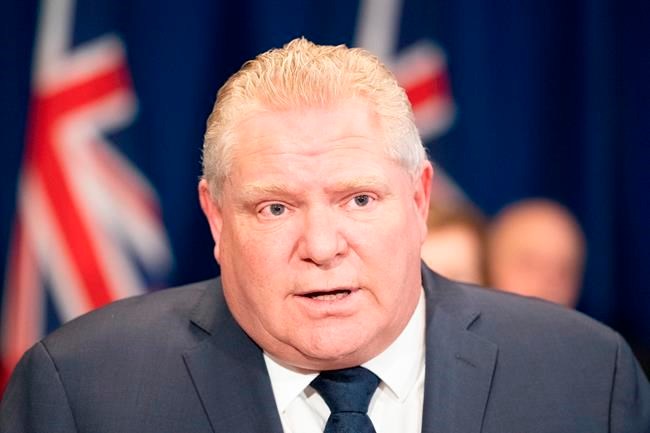
Ontario Premier Doug Ford answers questions during the daily briefing on the COVID-19 pandemic at Queen's Park in Toronto on Thursday April 2, 2020. THE CANADIAN PRESS/Frank Gunn

The latest data indicate more than 12,000 Canadians have contracted the virus. Of those, about 180 have died, but the numbers could be higher given gaps in reporting.

Ontario released its worst-case projections for the COVID-19 as its known caseload — and those of other provinces — climbed again. The province has now seen 3,255 cases and 67 deaths.

Given the “extremely serious” situation, Premier Doug Ford announced a halt to almost all industrial construction.

“We’ve told the vast majority of Ontario’s work force to stay home,” a grim Ford said. “Lives are on the line.”

The pandemic and the unprecedented stay-at-home measures to fight it have taken a brutal toll on the economy and jobs, with no sign of near-term improvement.

Prime Minister Justin Trudeau announced the latest in a string of federal measures to cushion the blow: More aid to low-income people will flow through the GST credit this month, rather than in May. Qualifying adults will receive up to $300, plus $150 for each child.

Trudeau also said the military would move into northern Quebec, at the province’s request, to help remote communities cope.

Canada’s top public health official, Dr. Theresa Tam, noted a sharp increase in deaths but said the health-care system was coping. The national death rate stands at about one per cent of those testing positive.

British Columbia, with 31 deaths, had previously projected its worst case would see a shortage of about 182 intensive care beds and at least 38 ventilators. But it also said distancing measures appeared to have mitigated that threat. Donnelly said Ontario was more closely tracking the hard-hit United States than B.C.

Quebec, which reported 25 more deaths on Friday for a total of 61 and a caseload of more than 6,000, said medical authorities would present COVID projections on Tuesday. New Brunswick, Nova Scotia and Prince Edward Island said they would also do so next week.

Overall mortality among those 80 years and older in Ontario has reached 20 per cent in coronavirus cases. A hard-hit nursing home in Bobcaygeon, Ont., reported four more resident deaths on Friday, bringing the toll to 20 at the 65-bed facility.

Experts advise frequent hand-washing and staying at least two metres from others to save the health-care system from overload. Front-line doctors have expressed worry about having to choose who lives and who dies if crucial ventilators run short.

In a tribute to health-care personnel, all ships in B.C. waters planned to sound their horns at 7 p.m. local time. Toronto’s CN Tower has been lighting up blue in a similar show of solidarity.

Health Minister Patty Hajdu late Thursday stood by her earlier estimate that between 30 per cent and 70 per cent of Canadians will likely become infected.

“Having 70 per cent of people get COVID is not the end of the world,” Hajdu said. “It is, though, if it all happens at once. And that’s what we’re trying to prevent.”

Globally, the pandemic has infected more than one million people and killed more than 58,000, according to the latest official figures. Italy, with almost 15,000 deaths and Spain with about 11,000, have been hit hardest. The United States, however, leads the world in cases — a quarter of a million to date — and has reported more than 6,000 deaths.

—with files from Canadian Press reporters across the country.

This report by The Canadian Press was first published April 3, 2020.
Report Error Submit a Tip

More Stories

COVID expected to kill thousands in Ontario

Colin Perkel, The Canadian Press 4 minute read Preview

COVID expected to kill thousands in Ontario

Colin Perkel, The Canadian Press 4 minute read Friday, Apr. 3, 2020

TORONTO - As known COVID-19 cases rose nationally and almost all construction in the country's economic heartland was idled on Friday, health authorities in Ontario said the death toll in that province alone could be kept below a still-staggering 15,000 — if stringent isolation measures prove effective in curbing the pandemic.

In a sobering presentation, a top health official said the coronavirus might have killed as many as 100,000 people in Ontario had economy-crushing restrictions not been imposed.

"If we do everything that we can think of — everything that already has been done stays in place (and) all of the other measures which are being considered (are) put in place — I think we could reduce the death toll in Ontario to somewhere between 3,000 and 15,000," said Dr. Peter Donnelly, head of Public Health Ontario.

The latest data indicate more than 12,000 Canadians have contracted the virus. Of those, about 180 have died, but the numbers could be higher given gaps in reporting.

Read
Friday, Apr. 3, 2020

Three in-custody fatalities trigger inquests

Free Press staff 2 minute read Preview

Three in-custody fatalities trigger inquests

Free Press staff 2 minute read Yesterday at 1:50 PM CDT

The province’s chief medical examiner has called inquests into the deaths of three men, including two who died by suicide in correctional facilities earlier this year.

Craig Flett, 32, was found hanging in his cell in the Stony Mountain Institution prison on Feb. 10 this year.

Corrections officers were able to cut him down and tried to resuscitate him, but he later died of a brain injury. Flett was serving a life sentence at the time.

Sebastian Atkinson, a 25-year-old inmate at the Winnipeg Remand Centre, was found hanging in his cell by a linen sheet tied to a metal bar about five feet from the floor.

Read
Yesterday at 1:50 PM CDT

Security tightens at downtown library

Aldo Santin 5 minute read Preview

Security tightens at downtown library

Aldo Santin 5 minute read Saturday, Feb. 16, 2019

Users of the downtown Millennium Library will be subject to several new security screening measures, more commonly seen at airports and sporting facilities.

City hall announced Friday that effective Feb. 25, all visitors to the Donald Street library will undergo bag checks and be subjected to a hand-held metal detector sweep for alcohol and prohibited weapons. Visitors who refuse to participate will be barred from entering the library.

“The number of incidents (has) increased in the past four to five years, incidences involving violence, threats, alcohol, substance abuse and it was concerning. We met with police and our security contractor. After discussing, we came up with this course of action,” Ed Cuddy, manager of library services, told reporters. “We feel it’s a big change, but we feel it’s justified based on the kind of incidents we’ve been experiencing recently.”

Cuddy wouldn’t elaborate on the nature of the incidents, but did say library workers have not been the victims.

Read
Saturday, Feb. 16, 2019

Submit a news tip

1 minute read Monday, Mar. 16, 2026

Submit a news tip

Meteorologist behind Rob’s Obs is moving weather station to Ontario

Ben Waldman 7 minute read Preview

Meteorologist behind Rob’s Obs is moving weather station to Ontario

Ben Waldman 7 minute read Monday, Jun. 13, 2022

In a Winnipeg winter, there are always at least two certainties: it will be cold, and it will snow. A third certainty: the people will talk endlessly about how frigid the temperature is, and argue about how much snow is cloaking their driveways. Is it colder than it ever has been? Is there more snow today than the same time last year?

Rob Paola likely knows the answers to those questions.

Paola possesses no super powers. He is but a man with a metre stick and 40 years of professional meteorological experience, in the midst of a lifelong love affair with Mother Nature, a most turbulent mistress who rarely, if ever, reciprocates.

Each year when snow begins to fall, Paola heads outside his Charleswood home to figure out how much. He sticks his ruler in the ground, grabs his clipboard, and clicks his pen. In neat script, he records the temperature, what time precipitation began, how deep the powder is stacked. Then, he shares his data and insights online with thousands of followers who want a clear answer to the eternal questions: Why is this happening? When will it stop? How much snow has fallen in the city of Winnipeg?

Read
Monday, Jun. 13, 2022

Trump touts USMCA win in state of the union

James McCarten, The Canadian Press 6 minute read Preview

Trump touts USMCA win in state of the union

James McCarten, The Canadian Press 6 minute read Tuesday, Feb. 4, 2020

WASHINGTON - President Donald Trump declared his scorched-earth political style an unmitigated success Tuesday in a fiercely partisan, made-for-TV state of the union speech that made it clear he expects to be back in the White House next year on the strength of the U.S. economy and his trade deals with Canada, Mexico and China.

Trump, addressing a joint session of Congress in the very chamber where House Democrats voted to impeach him less than two months ago, became only the second president in American history — Bill Clinton was the first — to deliver a state of the union while standing trial in the Senate.

Unrepentant, he pointedly refused to shake the offered hand of House Speaker Nancy Pelosi on the dais before singing the praises of what he billed as "the great American comeback," pointing to strong job growth, a soaring stock market and low unemployment as evidence of his leadership. And when he was done, Pelosi ripped up the speech in full view of the television cameras.

"America's enemies are on the run, America's fortunes are on the rise, and America's future is blazing bright. The years of economic decay are over," Trump declared, taking full credit for the country's "roaring economy," including what he billed as seven million new jobs and the lowest jobless rate in half a century — a "blue-collar boom" that he's counting on to help his re-election chances in November.

Read
Tuesday, Feb. 4, 2020