Benefit to COVID-19 impacted workers may be model for future: Qualtrough

Advertisement

Advertise with us

OTTAWA - The newly created benefit for workers whose livelihoods are affected by COVID-19 may be a model for how the federal government helps unemployed Canadians in the future, Employment Minister Carla Qualtrough said Thursday.

Read this article for free:


or

Already have an account? Log in here »

To continue reading, please subscribe:

Subscribe and receive a limited-edition Free Press branded hat or tote.

Digital Subscription

One year of digital access for only $205*

  • Enjoy unlimited reading on winnipegfreepress.com
  • Read the E-Edition, our digital replica newspaper
  • Access News Break, our award-winning app
  • Play interactive puzzles

*First annual payment billed as $205.00 + GST for one year. This annual subscription will automatically renew at $233.00 + GST every 52 weeks (10% off the regular annual price of $259.35). Offer available to new and qualified returning subscribers only. Cancel any time.

To continue reading, please subscribe:

Add Free Press access to your Brandon Sun subscription for only an additional

$1 for the first 4 weeks*

  • Enjoy unlimited reading on winnipegfreepress.com
  • Read the E-Edition, our digital replica newspaper
  • Access News Break, our award-winning app
  • Play interactive puzzles
Start now

*Your next Brandon Sun subscription payment will increase by $1.00 and you will be charged $17.95 plus GST for four weeks. After four weeks, your payment will increase to $24.95 plus GST every four weeks.

Hey there, time traveller!
This article was published 26/03/2020 (2363 days ago), so information in it may no longer be current.

OTTAWA – The newly created benefit for workers whose livelihoods are affected by COVID-19 may be a model for how the federal government helps unemployed Canadians in the future, Employment Minister Carla Qualtrough said Thursday.

Dubbed the Canada Emergency Response Benefit, the $2,000-a-month taxable benefit will be available to any worker who earned $5,000 in the previous year and whose income drops to zero due to COVID-19.

Qualtrough says the government opted for the single benefit because the decades-old employment insurance system wasn’t designed to handle an economic shock where millions of workers wouldn’t qualify for assistance.

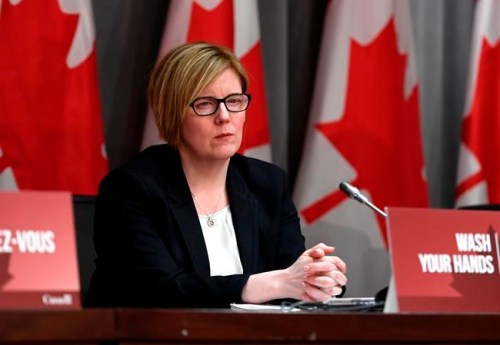
Minister of Employment, Workforce Development and Disability Inclusion Carla Qualtrough listens during a press conference on COVID-19 at West Block on Parliament Hill in Ottawa, on Wednesday, March 25, 2020. THE CANADIAN PRESS/Justin Tang

Funded partially outside the EI system, the new benefit has pushed direct financial aid in the economic package to $52 billion, out of the $107 billion overall total.

Qualtrough said close to 10 per cent of EI-eligible workers have applied for help in just over a week and the labour crunch is likely to get worse.

That works out to approximately 1.5 million workers.

But there are still more than five million workers — or almost one-quarter of the overall Canadian workforce — who aren’t eligible for EI, including because they may be self-employed, a gig worker, or don’t have enough qualifying hours.

“What we’re going to show through the CERB is that we can actually have a really straightforward income-support system at the federal level,” Qualtrough said in a telephone interview with The Canadian Press.

“This could be the impetus to really, radically simplify how people access income support from the federal government.”

That’s a discussion her department has been having for some time, and the pandemic will fuel those talks, she said, but it’s a conversation that won’t be settled quickly.

Instead, Qualtrough said the government is focused on the labour situation right now — one she warned would get worse before it improves.

With the benefit about to be introduced, the government warned Thursday of a text scam that may be praying on concerned workers by asking them to reply or click on a link to get the CERB, which isn’t officially available yet.

“I want to remind everyone that the government’s website is the best place to find reliable information on everything we’re doing,” Prime Minister Justin Trudeau said.

Trying to contain the spread of the novel coronavirus has forced governments to order businesses closed and companies to ask employees to work from home. The uncertainty has many small- and medium-sized businesses wondering if they’ll reopen once the economic storm has passed.

An analysis published Thursday by the Canadian Centre for Policy Alternatives estimated that nearly two millions workers are at the greatest risk of being laid off by the end of the month. If three-quarters of those workers lost their jobs by March 31, the national unemployment rate would rise to 13.9 per cent — the worst it’s been in 70 years, wrote David Macdonald, the centre’s senior economist.

The government is urging any worker eligible for EI who loses their job due to COVID-19 to apply now for help. And for those who don’t qualify, Qualtrough said they should sign up for an online account through the Canada Revenue Agency to prepare for the new benefit being made available next month.

To qualify, an affected worker will have to reside in Canada and have earned $5,000 in the previous 12 months — including new parents who earned EI parental benefits —and have had their income dried up because of COVID-19. An online portal is supposed to be up on April 6, with the first automatic payments arriving 10 days after people apply.

Those who receive the benefit will have to reaffirm their eligibility every four weeks.

The benefit will be taxed, like EI payments, and the government will square up any issues during tax time next year.

“If we find out that you weren’t truthful or that you had income you didn’t declare, that will actually be swept up at the back end,” Qualtrough said.

This report by The Canadian Press was first published March 26, 2020.

Report Error Submit a Tip

More Stories

COVID-19 tracking apps raise concerns: watchdogs

Nick Wells, The Canadian Press 6 minute read Preview

COVID-19 tracking apps raise concerns: watchdogs

Nick Wells, The Canadian Press 6 minute read Saturday, May. 2, 2020

VANCOUVER - Privacy watchdogs are voicing concerns over proposals across the country to implement smartphone apps to help track COVID-19.

New Brunswick, Manitoba, Newfoundland and Labrador, and Saskatchewan are among the provinces looking at or planning on creating smartphone apps that would track a user's whereabouts.

Alberta is the first province to launch an app.

Known as contact tracing, the apps track those who the user comes in to contact with, commonly by monitoring a device's Bluetooth signal.

Read
Saturday, May. 2, 2020

Dark money drags democracy toward the abyss

Russell Wangersky 6 minute read Saturday, Sep. 12, 2026

There’s an object lesson playing out to the south of us, and not exactly the one you may be thinking about.

It’s not the obvious one of “don’t elect a federal leader who has a clear history of caring about his own grievances before he thinks about the needs of his citizens,” or more simply, “don’t elect someone who is less an agent of change than he is an agent of chaos.”

No, the lesson playing out to the south of us — one likely to have an impact on U.S. midterm elections later this fall as well as the last U.S. presidential election — is that there is a clear danger in allowing dark money to fuel political campaigns.

There are estimates that political action campaigns — or PACs — will once again dump billions of U.S. dollars into the mix, funding advertising campaigns and other political campaign efforts, and steamrolling less-funded efforts.

Canada overlooks scores of workers

Krista Carr and Jonathan Lai 4 minute read Wednesday, Jul. 22, 2026

Canada has a labour shortage and a labour surplus at the same time. Canada’s labour force shortages are no longer a temporary challenge. Across the country, “help wanted” signs are everywhere.

A report this spring by RBC Economics said the situation will be exacerbated by retirements and changes in immigration policy.

Employers across the country say they can’t find enough workers. There is a solution, however, that continues to be overlooked. Roughly three-quarters of working-age Canadians with an intellectual disability or autism remain unemployed or underemployed despite being ready, willing and able to work. These two realities should not exist side by side.

For decades, many employers have overlooked this talented and motivated group of workers, often due to misconceptions about workplace accommodations or assumptions about productivity. The result is a labour market that is leaving approximately 500,000 capable individuals on the sidelines while businesses simultaneously report difficulty finding reliable employees.

The port of Churchill — but done right

Editorial 4 minute read Preview

The port of Churchill — but done right

Editorial 4 minute read Saturday, Sep. 12, 2026

The seagoing grain carrier wasn’t christened with a champagne bottle. There was no confetti or streamers. Nevertheless, the Aug. 31 event marking the first shipment of grain to be loaded at the Port of Churchill since 2020 was celebrated like the launch of a brand new vessel.

The presence of the federal minister of northern and arctic affairs, provincial cabinet ministers and leaders and elders from several northern First Nations signalled that the fast-tracked process of refurbishing and buffing up Manitoba’s deep-water seaport gem is gaining momentum.

For OneNorth, the partnership of 29 First Nations and 12 northern communities which owns the Port of Churchill and the Hudson Bay Railway (both operated by the Arctic Gateway Group) the event heralded a new beginning. It’s been eight years since OneNorth purchased the port and railroad, and six years since grain was moved by rail through Manitoba and then by ship to European markets. Two more grain shipments, plus shipments of potash and critical minerals, will continue through the fall.

When Prime Minister Mark Carney solicited the premiers to suggest “nation-building” projects following his election in 2025, Premier Wab Kinew pitched a Manitoba trade corridor that would move wheat, critical minerals, potash and energy (oil or liquid natural gas) through the Port of Churchill.

Read
Saturday, Sep. 12, 2026

Beware invasive, ‘frightening’ waterhemp

Laura Rance-Unger 4 minute read Preview

Beware invasive, ‘frightening’ waterhemp

Laura Rance-Unger 4 minute read Saturday, Aug. 29, 2026

There’s a threat lurking on the edge of Manitoba farmers’ fields this fall that’s even scarier than the escalating trade war with their biggest customer.

Provincial extension advisers are warning farmers to watch for a weed known as “tall waterhemp,” which, true to its name, may already be towering above ready-to-harvest crops.

Those wispy tentacles waving in the breeze look pretty innocuous from a distance. But this highly invasive member of the pigweed family produces hundreds of thousands of seeds that are just itching for dispersal through farmers’ combines and across their fields.

Each of those tiny seeds — one small pill container filled halfway holds 44,000 — can produce plants with stems the width of saplings and heights of two to five metres. One or two plants can quickly turn into a patch. If waterhemp takes over a field, it can choke out the growing crop and cut yields by more than 90 per cent.

Read
Saturday, Aug. 29, 2026

Sinclair named Canada’s columnist of the year

5 minute read Preview

Sinclair named Canada’s columnist of the year

5 minute read Saturday, May. 4, 2019

Winnipeg Free Press Indigenous writer Niigaan Sinclair has been named Canada’s best columnist, winning a distinguished National Newspaper Award, which was presented at a gala in Toronto Friday evening.

Sinclair, who is Anishinaabe, joined the Free Press as a regular columnist in June 2018. Sinclair, who is on sabbatical from his job as an associate professor at the University of Manitoba, writes about Indigenous issues.

In accepting the award, Sinclair said it was his childhood dream to write for the Free Press. He said Winnipeg is the centre of reconciliation in Canada, calling it “the most imperfect city, but the most perfect.”

“I’m honoured to receive the National Newspaper Award for column writing, the same award Richard Wagamese received in 1990. It’s a testament to the incredible support and belief the Free Press has in me, and also how critically important the conversations and issues in Winnipeg are for the national stage.”

Read
Saturday, May. 4, 2019