Why the feds aren’t closing the door on non-essential businesses

Advertisement

Advertise with us

OTTAWA - While Canada's response to the COVID-19 outbreak has taken off drastically in the last week, some have found it lopsided across the country.

Read this article for free:


By clicking the button above, an account will be created and you will begin to receive some of our recommended newsletters. You may opt out of any newsletter by visiting your Email and Communication Preferences page or by clicking "unsubscribe" at the bottom of any email.

or

Already have an account? Log in here »

To continue reading, please subscribe:

Digital Subscription

One year of digital access for only $1.44 a week*

  • Enjoy unlimited reading on winnipegfreepress.com
  • Read the E-Edition, our digital replica newspaper
  • Access News Break, our award-winning app
  • Play interactive puzzles

*Billed as $5.77 plus GST every four weeks. After 52 weeks, price increases to the regular rate of $19.95 plus GST every four weeks. Offer available to new and qualified returning subscribers only. Cancel any time.

To continue reading, please subscribe:

Add Free Press access to your Brandon Sun subscription for only an additional

$1 for the first 4 weeks*

  • Enjoy unlimited reading on winnipegfreepress.com
  • Read the E-Edition, our digital replica newspaper
  • Access News Break, our award-winning app
  • Play interactive puzzles
Start now

*Your next Brandon Sun subscription payment will increase by $1.00 and you will be charged $17.95 plus GST for four weeks. After four weeks, your payment will increase to $24.95 plus GST every four weeks.

Hey there, time traveller!
This article was published 18/03/2020 (2420 days ago), so information in it may no longer be current.

OTTAWA – While Canada’s response to the COVID-19 outbreak has taken off drastically in the last week, some have found it lopsided across the country.

In Ontario and Alberta, dine-in restaurants and bars are closed by provincial decree, while Quebec has shut down bars but ordered restaurants to limit the number of customers.

Other provinces have made no such order.

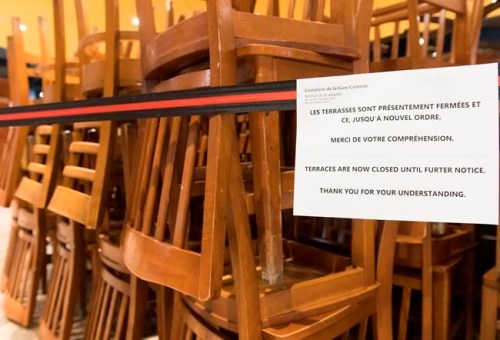
A sign notifying customers of a closed terrace is shown at food court in Montreal, Wednesday, March 18, 2020, as COVID-19 cases rise in Canada and around the world. THE CANADIAN PRESS/Graham Hughes

Even in a single city like Ottawa, there’s variation between which businesses have stayed open and which have shuttered to the public.

Businesses need more federal direction to avoid confusion, the Canadian Chamber of Commerce said Wednesday.

“One of the things businesses are looking for is more coherence,” said Perrin Beatty, president of the Canadian Chamber of Commerce.

Right now in Canada, the Public Health Agency of Canada and federal health minister provide advice to the provinces, but each province and territory is ultimately responsible for making its own decisions.

Beatty said the situation can be particularly vexing for companies that operate across jurisdictions.

“As rate of infection is growing, the same rules increasingly should apply across the board,” he said.

For some, without specific advice from the federal government, it can be a difficult financial proposition to voluntarily shut their doors, he said.

Federal authorities say that have been co-ordinating with provincial counterparts, but that local context is important.

“We very much recognize … that there are specific conditions in specific cities, specific provinces,” said Deputy Prime Minister Chrystia Freeland.

“That’s why we have public health officers also at the provincial and the city level.”

The provinces’ decisions about whether to close non-essential businesses comes down to the reality on the ground, including the number of cases of COVID-19 in the region and whether the area is seeing community transmission.

Chief public health officer Dr. Theresa Tam said it may also come down to a particular health system’s ability to deal with an outbreak. A weaker health system may take a more cautious approach, for example, she said.

Beatty suggested a national message might still be more helpful, even if it leaves room for exceptions. At least then the information would be coming from one source, he explained.

He did complement the federal government though on its open lines of communication with the business community.

And to some extent, he said it will be up to businesses to do the right thing for their customers and employees.

This report by The Canadian Press was first published March 18, 2020.

Report Error Submit a Tip

More Stories

Bob Saget, beloved TV dad of 'Full House,' dead at 65

Lynn Elber, The Associated Press 6 minute read Preview

Bob Saget, beloved TV dad of 'Full House,' dead at 65

Lynn Elber, The Associated Press 6 minute read Monday, Jan. 10, 2022

LOS ANGELES (AP) — Bob Saget, the actor-comedian known for his role as beloved single dad Danny Tanner on the sitcom “Full House” and as the wisecracking host of “America’s Funniest Home Videos,” died while on a stand-up tour. He was 65.

Deputies in Orange County, Florida, were called Sunday about an “unresponsive man” in a hotel room at the Ritz-Carlton in Orlando and found Saget dead, according to a sheriff’s statement on Twitter. Detectives found “no signs of foul play or drug use in this case.”

Saget was in Florida as part of his “I Don't Do Negative Comedy Tour.” After warm audience receptions to his gigs Friday in Orlando and Saturday in the Ponte Vedra Beach resort area, he celebrated online.

“I’m back in comedy like I was when I was 26. I guess I’m finding my new voice and loving every moment of it,” he posted Saturday on Instagram.

Read
Monday, Jan. 10, 2022

Expect a reasonable approach to keep Manitoba’s minimum wage out of cellar

Tom Brodbeck 5 minute read Preview

Expect a reasonable approach to keep Manitoba’s minimum wage out of cellar

Tom Brodbeck 5 minute read Tuesday, May. 31, 2022

The devil will be in the details when it comes to how much the Stefanson government will increase the minimum wage in 2022 under proposed legislation that’s expected to become law this week.

My prediction: government will boost the base wage by at least $1.10 an hour this year.

As expected, the Stefanson government plans to alter its inflation-based formula for setting the minimum wage, which now stands at $11.95 an hour. Normally, the base wage is indexed to the previous year’s rate of inflation. That’s sound policy during normal times. However, with inflation growing at rates not seen in more than 30 years, an immediate adjustment is required to ensure minimum-wage earners don’t lose purchasing power.

Conservative governments in Saskatchewan, Ontario and New Brunswick have all announced significant increases to their base wages in 2022, putting pressure on the Stefanson government to follow suit. Failure to do so would see Manitoba’s minimum wage (previously scheduled to rise 40 cents an hour to $12.35 on Oct. 1) rank lowest in the country.

Read
Tuesday, May. 31, 2022

Businesses want national message on closures

Laura Osman, The Canadian Press 3 minute read Preview

Businesses want national message on closures

Laura Osman, The Canadian Press 3 minute read Wednesday, Mar. 18, 2020

OTTAWA - While Canada's response to the COVID-19 outbreak has taken off drastically in the last week, some have found it lopsided across the country.

In Ontario and Alberta, dine-in restaurants and bars are closed by provincial decree, while Quebec has shut down bars but ordered restaurants to limit the number of customers.

Other provinces have made no such order.

Even in a single city like Ottawa, there's variation between which businesses have stayed open and which have shuttered to the public.

Read
Wednesday, Mar. 18, 2020

The Leaf at Assiniboine Park welcomes first visitors

Ryan Thorpe 5 minute read Preview

The Leaf at Assiniboine Park welcomes first visitors

Ryan Thorpe 5 minute read Saturday, Dec. 3, 2022

The parking lot was full and Winnipeggers came out in droves Saturday morning for the public opening of The Leaf, the new indoor horticultural attraction at Assiniboine Park.

Read
Saturday, Dec. 3, 2022

Oleksiak makes history with seventh Olympic medal

The Canadian Press 8 minute read Preview

Oleksiak makes history with seventh Olympic medal

The Canadian Press 8 minute read Sunday, Aug. 1, 2021

TOKYO - The Canadian women finished their impressive medal haul in the pool – including a record-setting performance from Penny Oleksiak – and Andre De Grasse finally got Canada's men on the board with his second consecutive Olympic bronze in the men's 100 metres.

After finishing third in the medley relay, Maggie Mac Neil draped a bronze medal brimming with significance around Oleksiak's neck as their teammates Kylie Masse and Sydney Pickrem celebrated on the podium.

"Most decorated," they chanted in unison with their arms around each other during post-ceremony interviews with reporters.

On the final day of swimming competition at the Tokyo Olympics, Toronto's Oleksiak took her place at the top among Canada's greatest Olympians. In helping the medley relay team win bronze, she earned her seventh career Olympic medal, and at just 21 became the most decorated Canadian Olympian of all time.

Read
Sunday, Aug. 1, 2021

Third fire hits troubled Manitoba Housing apartment block

Malak Abas 4 minute read Preview

Third fire hits troubled Manitoba Housing apartment block

Malak Abas 4 minute read Yesterday at 3:19 PM EST

Residents of a North End Manitoba Housing apartment block with a long history of trouble say they’re shaken after the building was hit with its third fire in eight months Friday night.

An apartment complex at 145 Powers St. was evacuated by firefighters after a fire broke out at around 7:45 p.m.

When longtime resident Sharon Markwell heard the fire alarm go off, she chalked it up to a false alarm — kids will get into the building and pull the fire alarm around once or twice a month, she said — until smoke began billowing into the hallway of her fifth-floor apartment.

“Once I realized that I could smell smoke very, very strongly, and the smoke was seeping into my room, into my apartment, I said to myself, ‘This is no false alarm. This is the real thing,’” Markwell, 64, told the Free Press Sunday.

Read
Yesterday at 3:19 PM EST