Ontario reports more cases of COVID-19, announces $100M contingency fund

Advertisement

Advertise with us

TORONTO - Ontario reported five more cases of COVID-19 Wednesday, bringing the total to 42, as the government announced a $100-million contingency fund to deal with the global pandemic in this province, where it will likely continue spreading.

Read this article for free:


By clicking the button above, an account will be created and you will begin to receive some of our recommended newsletters. You may opt out of any newsletter by visiting your Email and Communication Preferences page or by clicking "unsubscribe" at the bottom of any email.

or

Already have an account? Log in here »

To continue reading, please subscribe:

Digital Subscription

One year of digital access for only $1.44 a week*

  • Enjoy unlimited reading on winnipegfreepress.com
  • Read the E-Edition, our digital replica newspaper
  • Access News Break, our award-winning app
  • Play interactive puzzles

*Billed as $5.77 plus GST every four weeks. After 52 weeks, price increases to the regular rate of $19.95 plus GST every four weeks. Offer available to new and qualified returning subscribers only. Cancel any time.

To continue reading, please subscribe:

Add Free Press access to your Brandon Sun subscription for only an additional

$1 for the first 4 weeks*

  • Enjoy unlimited reading on winnipegfreepress.com
  • Read the E-Edition, our digital replica newspaper
  • Access News Break, our award-winning app
  • Play interactive puzzles
Start now

*Your next Brandon Sun subscription payment will increase by $1.00 and you will be charged $17.95 plus GST for four weeks. After four weeks, your payment will increase to $24.95 plus GST every four weeks.

Hey there, time traveller!
This article was published 11/03/2020 (2424 days ago), so information in it may no longer be current.

TORONTO – Ontario reported five more cases of COVID-19 Wednesday, bringing the total to 42, as the government announced a $100-million contingency fund to deal with the global pandemic in this province, where it will likely continue spreading.

Health officials said a recent case of a Sudbury, Ont., man who was confirmed to have the novel coronavirus after attending a large mining convention in Toronto doesn’t appear to be evidence of community spread, but that is likely a matter of if — not when.

“Unfortunately it probably is an inevitability,” said Ontario’s associate chief medical officer of health Dr. Barbara Yaffe. “Certainly the last 24 hours there’s been an up-tick in numbers of cases and cases with different characteristics than before, which is concerning. We’re very carefully monitoring it.”
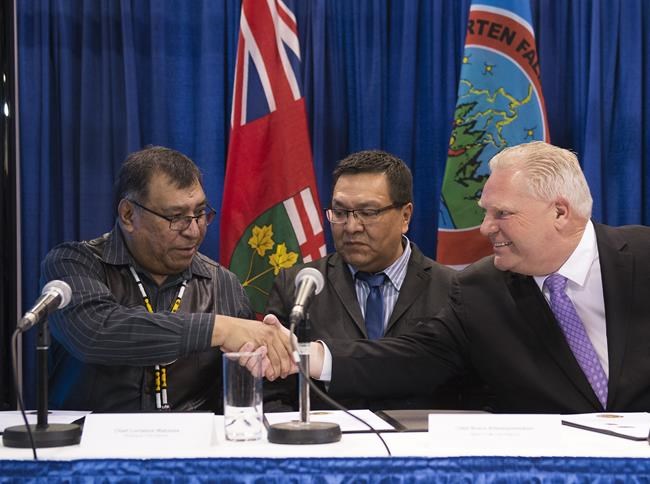
Ontario Premier Doug Ford shakes hands with Chief Cornelius, Wabasse Webequie First Nation, left, and Chief Bruce Achneepineskum, Marten Falls First Nation, centre, after signing a new deal in the ring of fire in Northern Ontario at the Prospectors and Developers Association of Canada's annual convention in Toronto on Monday, March 2, 2020. The Ontario government says Premier Ford is in good health and not experiencing any COVID-19 symptoms after attending a conference where one attendant had the virus. THE CANADIAN PRESS/Nathan Denette

The man in his 50s from Sudbury attended the Prospectors and Developers Association in Canada convention on March 2 and 3 in Toronto, but it is not yet clear if he recently travelled outside the country or was in close contact with another confirmed case. He is an employee of the Ministry of Northern Development and Mines and its Sudbury office has been shut down, the government said.

Yaffe said it’s likely the man acquired the virus at the convention, which was attended by more than 20,000 people from many different countries.

“Although the risk in general is low, it seems that’s probably where he got it,” she said. “We can’t say exactly from whom, but to me it’s linked to a particular activity in a particular site, so it’s not a general community transmission.”

Toronto Public Health is also conducting a detailed investigation of the man’s activities while he was in Toronto.

Laurentian University in Sudbury, Ont., which had a “major presence” at the conference, is moving all of its classes online starting Thursday, the school announced.

Premier Doug Ford and Prime Minister Justin Trudeau also attended the PDAC mining convention on March 2.

Ford’s office said the premier is in good health and not experiencing any COVID-19 symptoms, and he has not been contacted through the process of contact-tracking for the infected man.

Trudeau said he has not been tested for the virus, but is following recommendations of the chief public health officer to keep himself and his family safe.

One of the other new cases reported Wednesday is in a woman in her 30s from Halton Region, who recently returned from the United States and works as a doctor at the Juravinski Cancer Centre in Hamilton. The hospital said she saw patients on March 9 before visiting the Juravinski Hospital emergency department, and had interacted with colleagues and staff. Those people are being contacted, the hospital said in a statement.

The other new cases are a man in his 30s who lives in Toronto and recently travelled to the U.S., a woman in her 30s in York Region who recently travelled to Egypt, a man in his 40s in Ottawa who recently travelled to Austria, and a woman in her 40s who lives in Toronto and recently travelled to the U.S. All of the new cases are in self-isolation.

Health Minister Christine Elliott said Ontario is in the “containment” stage at the moment, though at some point the province probably will have to deal with community spread.

“It is likely that we will move to the next stage, but we have a plan in place to deal with it, as we have a plan in place to deal with any scenario that presents itself,” she said.

Ford announced that Ontario has set aside a $100-million contingency fund to deal with COVID-19, and Elliott said the money will likely go toward buying more equipment such as testing kits and personal protective gear, as well as hiring more health-care staff, if needed.

That is in addition to a $1-billion package the federal government announced to help the country’s health-care system and economy cope with the novel coronavirus.

The World Health Organization declared COVID-19 a pandemic Wednesday.

Ontario will have dedicated assessment centres set up within days and is looking at being able to diagnose people at home, as well as whether restrictions should be in place around large gatherings, Elliott said. It’s also putting plans in place in case any hospitals have to be shut down because of coronavirus cases, she said.

Ford said he looks forward to discussing COVID-19 plans with the federal government and the country’s other premiers at this week’s first ministers’ meeting.

Five of Ontario’s cases have been resolved, meaning the patients have tested negative for the virus in two tests at least 24 hours apart.

Most people diagnosed with COVID-19 experience mild or moderate symptoms, such as fever and cough, and the vast majority of those who contract the virus recover.

This report by The Canadian Press was first published March 11, 2020.

Report Error Submit a Tip

More Stories

Director Schrader returns to silver screen with complex view of religion and belief

Alison Gillmor 4 minute read Preview

Director Schrader returns to silver screen with complex view of religion and belief

Alison Gillmor 4 minute read Thursday, Jun. 14, 2018

Bleak, wintry and rigorously controlled — until it’s not — this Book of Job-like drama from American filmmaker Paul Schrader looks at the challenges of faith.

The 71-year-old Schrader, known for scripting four Martin Scorsese films (including Taxi Driver and Raging Bull) and for directing his own (including American Gigolo, Affliction and Auto Focus), grew up in a strict Calvinist home — he famously did not see a film until he was 17 — and has always been drawn to stories of agonizing and uncertain redemption.

As the Rev. Toller (Ethan Hawke) wrestles with what it means to lead a righteous life in our badly broken world, his spiritual fate remains in doubt. It is certain, however, that First Reformed marks a cinematic rebirth for Schrader after recent disasters like The Canyons and Dog Eat Dog. Serious, complex and moving, this is not a perfect film, but even its flaws are powerful.

Toller is a solitary man who has come to the ministry late in life, after a family tragedy and a failed marriage. First Reformed, a historic church in upstate New York that was once a stop on the Underground Railroad, has since been reduced to an austerely beautiful tourist shop, more of a museum than a place of worship.

Read
Thursday, Jun. 14, 2018

2026 Winnipeg election results: Mayor and council

1 minute read Preview

2026 Winnipeg election results: Mayor and council

1 minute read Thursday, Oct. 22, 2026

Complete results for the 2022 election races for Winnipeg mayor and city councillors.

Read
Thursday, Oct. 22, 2026

Longtime councillor Eadie ‘knew it was going to be close,’ but expected to finish on top in Mynarski

Scott Billeck 5 minute read Preview

Longtime councillor Eadie ‘knew it was going to be close,’ but expected to finish on top in Mynarski

Scott Billeck 5 minute read Updated: 1:56 PM CDT

Ross Eadie knew his re-election bid would be close, but he didn’t anticipate losing in the neighbourhoods where he grew up.

The 16-year Mynarski councillor, who was defeated Wednesday by political newcomer Natalie Smith, said Thursday the result was difficult to accept because some of his strongest losses were in Luxton, St. John’s Park and surrounding neighbourhoods.

“I knew it was going to be close,” Eadie said. “But I thought it was going to be close with me in first place.”

“I really lost it where I live. So that’s the worst part of it.”

Read
Updated: 1:56 PM CDT

Multi-year budget to force councillors, bureaucrats to focus on the big picture

Aldo Santin 12 minute read Preview

Multi-year budget to force councillors, bureaucrats to focus on the big picture

Aldo Santin 12 minute read Tuesday, Feb. 26, 2019

City hall is putting the final touches on the 2019 preliminary budget -- but the real tough job will start after that.

The city is committed to developing a four-year budget beginning with 2020, and having it in place by the end of this year.

It's a process that is filled with uncertainties, trying to balance four successive annual budgets at the same time, using assumptions on revenues and expenses that can change without notice: a provincial government that has frozen funding to city hall at 2016 levels and is reluctant to disclose annual funding commitments or share in unexpected revenues; erratic fuel prices; a possible change in government in Ottawa, which could bring new spending priorities. And in the middle of that four-year span, another civic election where new members of council may have other priorities than those laid out by the current crop of office holders.

Municipal governments across Manitoba are required to approve their annual operating and capital budgets by the end of March each year. But the criticism of decision-making at city hall has been that all the decisions are made on a year-to-year basis, keeping voters happy with an eye on the next election.

Read
Tuesday, Feb. 26, 2019

Waiting for Cormier verdict the ‘calm before the storm’

Katie May 6 minute read Preview

Waiting for Cormier verdict the ‘calm before the storm’

Katie May 6 minute read Thursday, Feb. 22, 2018

As the jury room door closed behind the seven women and four men who are now deliberating on the evidence against Tina Fontaine’s accused killer, Thelma Favel rose from the chair she’s occupied for most of Raymond Cormier’s second-degree murder trial.

Almost every day over the past three weeks, Favel, the woman who raised 15-year-old Tina, has sat right up front, directly across from the jury box, listening, sobbing and soaking in disturbing details of the teen’s last days that have come to light over the course of Cormier’s second-degree murder trial.

On Wednesday afternoon, after Court of Queen’s Bench Chief Justice Glenn Joyal instructed the jury and sent them off to be sequestered until they decide whether 56-year-old Raymond Cormier is guilty of killing Tina, Favel got up and hugged Crown prosecutor Breta Passler. It was one of many moments, this one shielded from jurors, that have long since proven the emotional impact of the case and the lasting power of Tina’s legacy.

Tina’s death sparked a public outcry that renewed calls for a national inquiry into disproportionately high rates of missing and murdered Indigenous women and girls across Canada, and the criminal trial for the man accused of killing her hasn’t happened in a vacuum.

Read
Thursday, Feb. 22, 2018

‘All females are at risk’: serial sex offender released from prison

Erik Pindera 4 minute read Preview

‘All females are at risk’: serial sex offender released from prison

Erik Pindera 4 minute read 1:43 PM CDT

Law enforcement are warning the public that a dangerous sex offender with a lengthy history of abusing women is expected to live in Winnipeg after his release from prison.

Douglas Wayne Bowman, 62, left prison on Thursday after serving a lengthy sentence for two sexual assaults he committed at knifepoint, said the Manitoba Integrated High Risk Sex Offender Unit, a joint force of the Winnipeg Police Service and RCMP that keeps an eye on certain sex criminals.

Bowman was handed the 14-year sentence in 2018, less six years time served, and designated a dangerous offender. Criminals deemed dangerous offenders are given indefinite federal sentences until parole officials decide it is safe enough to release them.

Now that he’s leaving prison, Bowman will be subject to a 10-year long-term supervision order, which allows corrections and parole officials to continue to monitor him in the community even though his sentence is complete.

Read
1:43 PM CDT