Morneau talks up fiscal room to react to impacts of COVID-19 as concerns mount

Advertisement

Advertise with us

OTTAWA - Finance Minister Bill Morneau sought to ease the concerns over the novel coronavirus outbreak on a day where financial markets dropped along with the price of oil, and the Liberals said they were preparing help for a worst-case economic scenario.

Read this article for free:


By clicking the button above, an account will be created and you will begin to receive some of our recommended newsletters. You may opt out of any newsletter by visiting your Email and Communication Preferences page or by clicking "unsubscribe" at the bottom of any email.

or

Already have an account? Log in here »

To continue reading, please subscribe:

Digital Subscription

One year of digital access for only $1.44 a week*

  • Enjoy unlimited reading on winnipegfreepress.com
  • Read the E-Edition, our digital replica newspaper
  • Access News Break, our award-winning app
  • Play interactive puzzles

*Billed as $5.77 plus GST every four weeks. After 52 weeks, price increases to the regular rate of $19.95 plus GST every four weeks. Offer available to new and qualified returning subscribers only. Cancel any time.

To continue reading, please subscribe:

Add Free Press access to your Brandon Sun subscription for only an additional

$1 for the first 4 weeks*

  • Enjoy unlimited reading on winnipegfreepress.com
  • Read the E-Edition, our digital replica newspaper
  • Access News Break, our award-winning app
  • Play interactive puzzles
Start now

*Your next Brandon Sun subscription payment will increase by $1.00 and you will be charged $17.95 plus GST for four weeks. After four weeks, your payment will increase to $24.95 plus GST every four weeks.

Hey there, time traveller!
This article was published 09/03/2020 (2426 days ago), so information in it may no longer be current.

OTTAWA – Finance Minister Bill Morneau sought to ease the concerns over the novel coronavirus outbreak on a day where financial markets dropped along with the price of oil, and the Liberals said they were preparing help for a worst-case economic scenario.

Morneau only said the government was “looking at taking some initiatives this week” to help affected workers and families, ensure businesses make it through financial challenges, and keep Canada’s health-care system healthy.

He stressed the economy and federal finances can weather the storm from COVID-19 and a sudden plunge in oil prices.
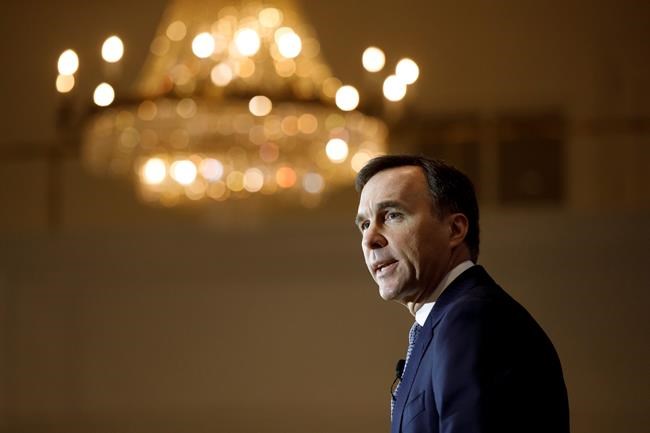
Canada's Minister of Finance Bill Morneau speaks to the Canadian Club of Canada in Toronto, Friday, March 6, 2020. THE CANADIAN PRESS/Cole Burston

Morneau suggested any federal stimulus spending won’t be tied to the budget, for which he did not provide a date.

“We need to be thinking about how we respond to events appropriately and that will not necessarily be just about the budget,” Morneau said after markets closed Monday.

“There are sectors of our economy that are going to go through real challenges because of the changes right now … and we’ll be looking at how we can make sure that we are appropriately dealing with those challenges.”

The federal government can increase spending by an estimated $41 billion and keep the debt-to-GDP ratio declining, the parliamentary budget officer said in a report last month. BMO Economics said in a note that “Canada’s healthy federal balance sheet will be useful” with pressure to increase spending.

Then over the weekend came an oil price war between Saudi Arabia and Russia that lowered the price of crude below federal budget projections.

Federally, the parliamentary budget officer has previously estimated a US$15 decline in crude prices would shave $4 billion off the budget for the fiscal year beginning April 1.

The Liberal government’s economic update from late last year projected the price of West Texas Intermediate at US$57 a barrel for this calendar year. On Monday, it ended trading around US$31, a difference of US$16.

As prices dropped, TD Economics said in a research note that the outlooks for Alberta, Saskatchewan and Newfoundland and Labrador were likely to be “downgraded significantly” for the year.

“Days like today are not easy,” said Natural Resources Minister Seamus O’Regan of the impact to provincial budgets, adding: “This is of great concern.”

Even more bleak was a report from the United Nations Conference on Trade and Development that warned the COVID-19 should “will trigger a recession in some countries” and decelerate growth globally.

Deputy Prime Minister Chrystia Freeland said in question period the government was “planning for worst-case scenarios.”

How the government responds should be assessed by whether the measures are temporary, timely, and targeted, said Mostafa Askari, chief economist at the Institute of Fiscal Studies and Democracy — a think tank run by former parliamentary budget officer Kevin Page.

Business and labour groups have urged the government to ease access to employment insurance sick leave benefits, which the government appears open to doing, along with tax credits and other breaks as part of the federal response.

Waiving the waiting period to receive EI payments would help workers who find themselves suddenly under quarantine, or encourage them to self-isolate to contain the spread of the disease, said Dan Kelly, president of the Canadian Federation of Independent Business.

Likewise, reducing the number of hours necessary to qualify for payments would provide benefits to low-income workers who can’t afford to take time off for illness, said Hassan Yussuff, president of the Canadian Labour Congress.

“You’re going to have to find a way to help them get some income because in absence of that, they are going to go to work because they don’t know what else to do. They need the money to pay their bills.”

He added that his group has asked the government to consider having banks and credit card companies relax payment schedules for those whose earnings are affected by COVID-19.

NDP Leader Jagmeet Singh said the government needs to make sure affected workers who don’t qualify for EI can also benefit for financial help.

Trevin Stratton, chief economist at the Canadian Chamber of Commerce, said any tax credits and tax-filing extensions for affected businesses could help companies weather the economic storm by giving them short-term cash flow help.

This report by The Canadian Press was first published March 9, 2020.

Report Error Submit a Tip

More Stories

Record number of women elected in Manitoba municipal elections

Chris Kitching 5 minute read Preview

Record number of women elected in Manitoba municipal elections

Chris Kitching 5 minute read Yesterday at 3:33 PM CDT

A record number of women were elected to municipal office in Manitoba in elections held across the province Wednesday.

The Association of Manitoba Municipalities said 213 of 339 women candidates were voted in, accounting for almost 25 per cent of elected municipal officials — up from 20 per cent in 2022.

Portage la Prairie Mayor Sharilyn Knox, who applauded the increase, said there has been progress to reduce barriers that impede women’s participation in local government, “but I don’t think we’re where we need to be yet.”

“I think representation matters. When women see other women sitting around council tables, chairing meetings and taking on leadership roles, it helps them see themselves doing the same thing,” she said.

Read
Yesterday at 3:33 PM CDT

Science-art collaboration injects dose of emotion into cold, hard truths

Sarah Lawrynuik 5 minute read Preview

Science-art collaboration injects dose of emotion into cold, hard truths

Sarah Lawrynuik 5 minute read Wednesday, Apr. 28, 2021

Looking at spreadsheets and map plots of trees is far beyond Rhian Brynjolson’s typical day as a visual artist, but she became entranced and inspired by data collected by Canadian scientists for a new art project.

Her hope is to try and bring the numbers, map dots and statistics to life in a new way to help the public better connect to climate science.

Falcon Lake’s Brynjolson is one of 12 Canadian artists who participated in an art-science collaboration exhibit, co-ordinated by the Global Water Futures program out of the University of Saskatchewan. The project saw the artists paired with researchers and scientists across the country who then engaged in conversations to try to inspire a new angle to their art.

“The whole idea behind it is: water is life,” says Louise Arnal, the project lead, and a post-doctoral fellow at the Centre for Hydrology and Coldwater Laboratory.

Read
Wednesday, Apr. 28, 2021

Fact Check

1 minute read Thursday, Nov. 30, 2023

Fact Check

Having problems with the form?Contact Us Directly |

Opera singer David Daniels no longer in singers’ union following sexual assault guilty plea

The Associated Press 2 minute read Preview

Opera singer David Daniels no longer in singers’ union following sexual assault guilty plea

The Associated Press 2 minute read Thursday, Dec. 21, 2023

NEW YORK (AP) — Countertenor David Daniels is no longer a member of the union for singers following his guilty plea to a charge of sexual assault.

The 57-year-old and his husband, Scott Walters, pleaded guilty to sexual assault of an adult, a second-degree felony, in Houston's Harris County District Court on Aug. 4. Their accuser was aspiring opera singer Sam Schultz.

They both were sentenced to eight years’ probation and required to register as sex offenders.

American Guild of Musical Artists spokesperson Alicia Cook said Wednesday that Daniels is no longer a member of the union.

Read
Thursday, Dec. 21, 2023

Health officials ponder next steps as COVID cases surge in Southern Health region

Katie May 5 minute read Preview

Health officials ponder next steps as COVID cases surge in Southern Health region

Katie May 5 minute read Wednesday, Nov. 3, 2021

Public-health officials say they're trying to avoid ordering another lockdown in southern Manitoba, where COVID-19 infection rates are surging.

Deputy chief provincial public health officer Dr. Jazz Atwal told a news conference Wednesday he doesn't anticipate more lockdowns and suggested he will prioritize keeping schools open when considering future restrictions.

But he couldn't say what the next step will be in an area of the province where hospitalizations among unvaccinated residents are on the rise.

Average daily case counts in the southern part of the province are higher now than they were before lockdown measures went into effect last November, and officials are still figuring out what to do.

Read
Wednesday, Nov. 3, 2021

Trump touts USMCA win in state of the union

James McCarten, The Canadian Press 6 minute read Preview

Trump touts USMCA win in state of the union

James McCarten, The Canadian Press 6 minute read Tuesday, Feb. 4, 2020

WASHINGTON - President Donald Trump declared his scorched-earth political style an unmitigated success Tuesday in a fiercely partisan, made-for-TV state of the union speech that made it clear he expects to be back in the White House next year on the strength of the U.S. economy and his trade deals with Canada, Mexico and China.

Trump, addressing a joint session of Congress in the very chamber where House Democrats voted to impeach him less than two months ago, became only the second president in American history — Bill Clinton was the first — to deliver a state of the union while standing trial in the Senate.

Unrepentant, he pointedly refused to shake the offered hand of House Speaker Nancy Pelosi on the dais before singing the praises of what he billed as "the great American comeback," pointing to strong job growth, a soaring stock market and low unemployment as evidence of his leadership. And when he was done, Pelosi ripped up the speech in full view of the television cameras.

"America's enemies are on the run, America's fortunes are on the rise, and America's future is blazing bright. The years of economic decay are over," Trump declared, taking full credit for the country's "roaring economy," including what he billed as seven million new jobs and the lowest jobless rate in half a century — a "blue-collar boom" that he's counting on to help his re-election chances in November.

Read
Tuesday, Feb. 4, 2020