What if Canada gets an outbreak of the new coronavirus? A look at pandemic plans

Advertisement

Advertise with us

OTTAWA - Canada has a leg up on preparing for a potential outbreak of the novel coronavirus because the country already has a detailed pandemic plan, according to federal Health Minister Patty Hajdu.

Read this article for free:


By clicking the button above, an account will be created and you will begin to receive some of our recommended newsletters. You may opt out of any newsletter by visiting your Email and Communication Preferences page or by clicking "unsubscribe" at the bottom of any email.

or

Already have an account? Log in here »

To continue reading, please subscribe:

Digital Subscription

One year of digital access for only $1.44 a week*

  • Enjoy unlimited reading on winnipegfreepress.com
  • Read the E-Edition, our digital replica newspaper
  • Access News Break, our award-winning app
  • Play interactive puzzles

*Billed as $5.77 plus GST every four weeks. After 52 weeks, price increases to the regular rate of $19.95 plus GST every four weeks. Offer available to new and qualified returning subscribers only. Cancel any time.

To continue reading, please subscribe:

Add Free Press access to your Brandon Sun subscription for only an additional

$1 for the first 4 weeks*

  • Enjoy unlimited reading on winnipegfreepress.com
  • Read the E-Edition, our digital replica newspaper
  • Access News Break, our award-winning app
  • Play interactive puzzles
Start now

*Your next Brandon Sun subscription payment will increase by $1.00 and you will be charged $17.95 plus GST for four weeks. After four weeks, your payment will increase to $24.95 plus GST every four weeks.

Hey there, time traveller!
This article was published 26/02/2020 (2442 days ago), so information in it may no longer be current.

OTTAWA – Canada has a leg up on preparing for a potential outbreak of the novel coronavirus because the country already has a detailed pandemic plan, according to federal Health Minister Patty Hajdu.

It includes lessons learned from the 2003 outbreak of SARS in Ontario and the 2009 H1N1 influenza pandemic.

So what is supposed to happen if the virus starts spreading in Canada? Here’s a simplified look:

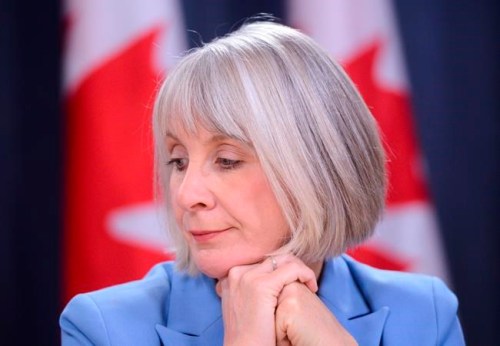
Patty Hajdu, Minister of Health, makes an announcement regarding a Bill entitled
Patty Hajdu, Minister of Health, makes an announcement regarding a Bill entitled "An Act to amend the Criminal Code (medical assistance in dying)" during a press conference at the National Press Theatre in Ottawa on Monday Feb. 24, 2020. THE CANADIAN PRESS/Sean Kilpatrick

—Some steps in the plan are already underway, like stepping up surveillance of the disease in Canada and globally, and alerting the public to the potential outbreak. The government has also increased lab capacity to accommodate tests for the virus and put out guidelines for health providers and public-health advice. It has also begun funding rapid research into the virus.

—A priority is to figure out how bad things are, and how bad they’re likely to get based on how easily the illness spreads and how sick it makes people who catch it. H1N1 flu, for example, had moderate transmissibility and wasn’t terribly severe, as influenza viruses go. That put the impact on par with a bad flu season. The 1918 “Spanish flu,” on the other hand, made people very sick and was very easily transmitted. Unusually, it was exceptionally deadly to young adults, putting extreme pressure on a patchwork health system and killing an estimated 50,000 Canadians.

Once everyone has a handle on those two factors, it becomes easier to predict what the impact is going to be on individual patients, the health system, society and the economy, which allows the federal and provincial governments to prepare.

—So far the confirmed cases of the new coronavirus, or COVID-19, in Canada have been found in people who have recently travelled out of the country and their very close contacts. If the virus starts spreading locally, provinces and territories are expected to ramp up capacity to deal with an increase of cases.

—If cases spread at the local level, governments might also consider things like school closures and gathering volunteers to open reception centres for people who are sick and need help but not necessarily hospitalization.

—If things get worse, then it’s time to triage. If the virus overtakes the capacity of provincial health-care systems, they are supposed to increase their surge capacity as much as possible. If that doesn’t work, they have to decide who needs the services most. That’s also when public-health agencies will consider cancelling major gatherings like festivals and sports events.

—If a vaccine becomes available the pandemic plan says the provinces and the federal government should decide who is going to get it first, based on who’s most at risk, and start immunizing people as quickly as possible.

—The plan also outlines what happens when the pandemic dies down and things start to get back to normal. First is to prepare for a possible resurgence and restock supplies. Health systems should also put together immunization programs, if a vaccine exists, and evaluate the psychological effect of the outbreak on the public.

—When it really is over, it’s time to look back and evaluate how it went, so the plan can be updated for the next health crisis.

This report by The Canadian Press was first published Feb. 26, 2020.

Report Error Submit a Tip

More Stories

Finance minister has impossible choice as federal budget looms

Dan Lett 5 minute read Preview

Finance minister has impossible choice as federal budget looms

Dan Lett 5 minute read 3:24 PM EST

It’s federal budget week, and that means every newspaper columnist, self-proclaimed think tank subject matter expert and opposition critic has suggestions for what Ottawa “must” do.

In no particular order: Finance Minister François-Philippe Champagne “must” provide tax cuts for small business to survive, provide tax cuts for big business to become bigger and wealthier, massively increase transfer payments to the provinces, make life more affordable for average people and undertake enormous, strategic investments in the economy to make Canada less reliant on the United States.

If you’re wondering how any finance minster can do all of that, all at once, the answer is they can’t. But that’s the nature of pre-budget submissions: do what we want, even if it makes it impossible for you to do the things that other people think must be done.

That is not to say all budget submissions are worthless. It’s just that you can’t cut government taxes and levies on businesses while also providing more robust investment in industries, infrastructure and people — and still have any hope of containing the debt.

Read
3:24 PM EST

‘Mom and dad’ Pereira and Michaud lead Team Canada at Kelowna Grand Prix

Laurie Nealin 5 minute read Preview

‘Mom and dad’ Pereira and Michaud lead Team Canada at Kelowna Grand Prix

Laurie Nealin 5 minute read Wednesday, Oct. 28, 2026

Lia Pereira and Trennt Michaud’s spirits couldn’t be higher as they begin their fourth ISU Grand Prix season this weekend at Skate Canada International as Team Canada’s top medal prospects.

Fresh off a decisive victory at Nebelhorn Trophy in Germany last month, the reigning world pair skating bronze medallists were riding a wave of confidence and excitement — and feeling “a mom and dad energy” — as they contemplated the assignment ahead in Kelowna, B.C.

“To go out and win our first Challenger (event) was a great confidence boost in our back pocket,” said Pereira, who admitted to a case of jitters before taking the ice in Oberstdorf.

“No matter how many years you do this, you still always get the first competition nerves. We’re just glad we were able to remind ourselves how to handle that and put out two great skates.”

Read
Wednesday, Oct. 28, 2026

International doctors in MB face ongoing harassment, discrimination: report

Nicole Buffie 5 minute read Preview

International doctors in MB face ongoing harassment, discrimination: report

Nicole Buffie 5 minute read 6:26 PM EST

Discrimination and harassment are a serious concern for international doctors in Manitoba, a new report by the College of Physicians and Surgeons says.

The report titled “Strengthening Integration into Practice,” shows 64 per cent of international doctors reported some form of discrimination or harassment in the workplace, both from patients and their families, and from other physicians.

In response to feedback from international doctors and surveys, the College formed a working group to look into the issue further and develop policies and training to guide new and practicing physicians.

The College conducted a survey on the issue last fall. Most of the respondents who reported discrimination or harassment cited those attitudes were based on race, ethnicity, place or origin and religion.

Read
6:26 PM EST

Butterworth dips under Olympic standard in 800

The Canadian Press 7 minute read Preview

Butterworth dips under Olympic standard in 800

The Canadian Press 7 minute read Friday, Jun. 25, 2021

MONTREAL - After years of flirting with the two-minute barrier, Lindsey Butterworth finally smashed it -- in emphatic fashion.

The 27-year-old from North Vancouver, B.C., kicked hard down the final straightaway to win the women's 800 metres at the Olympic track and field trials on Friday.

Crossing the finish line, she looked at the time, and both hands flew to her mouth in delight. Butterworth won in one minute 59.19 seconds, dipping under the automatic Olympic standard of 1:59.50 -- and shattering that elusive two-minute mark, finally.

"I just saw the time and was in shock and happiness," Butterworth said.

Read
Friday, Jun. 25, 2021

Cottage communities constrained by COVID

Cassandra Szklarski, The Canadian Press 6 minute read Preview

Cottage communities constrained by COVID

Cassandra Szklarski, The Canadian Press 6 minute read Friday, May. 1, 2020

TORONTO - A springtime trickle of Manitobans entering Ontario to visit their lakeside cottages alarmed Kenora Mayor Daniel Reynard a month ago.

Now that Manitoba is poised to restart some non-essential services Monday, Reynard fears an even bigger influx — this time sun-seekers expecting amenities that are simply unavailable.

The message in Ontario is still one of restraint: Avoid non-essential travel, and do not visit your cottage. Provincial travel is not prohibited, but vacationers and day-trippers will find little to do.

Restaurants are closed, as are all beaches, golf courses, parks, trails and marinas.

Read
Friday, May. 1, 2020

What Canada has planned if coronavirus hits

Laura Osman, The Canadian Press 4 minute read Preview

What Canada has planned if coronavirus hits

Laura Osman, The Canadian Press 4 minute read Wednesday, Feb. 26, 2020

OTTAWA - Canada has a leg up on preparing for a potential outbreak of the novel coronavirus because the country already has a detailed pandemic plan, according to federal Health Minister Patty Hajdu.

It includes lessons learned from the 2003 outbreak of SARS in Ontario and the 2009 H1N1 influenza pandemic.

So what is supposed to happen if the virus starts spreading in Canada? Here's a simplified look:

—Some steps in the plan are already underway, like stepping up surveillance of the disease in Canada and globally, and alerting the public to the potential outbreak. The government has also increased lab capacity to accommodate tests for the virus and put out guidelines for health providers and public-health advice. It has also begun funding rapid research into the virus.

Read
Wednesday, Feb. 26, 2020