New threats emerge in outbreak while China voices optimism

Advertisement

Advertise with us

BEIJING - Chinese health officials expressed new optimism Thursday over the deadly virus outbreak while authorities in South Korea’s fourth-largest city urged residents to hunker down as fears nagged communities far from the illness’ epicenter.

Read this article for free:


or

Already have an account? Log in here »

To continue reading, please subscribe:

Subscribe and receive a limited-edition Free Press branded hat or tote.

Digital Subscription

One year of digital access for only $205*

  • Enjoy unlimited reading on winnipegfreepress.com
  • Read the E-Edition, our digital replica newspaper
  • Access News Break, our award-winning app
  • Play interactive puzzles

*First annual payment billed as $205.00 + GST for one year. This annual subscription will automatically renew at $233.00 + GST every 52 weeks (10% off the regular annual price of $259.35). Offer available to new and qualified returning subscribers only. Cancel any time.

To continue reading, please subscribe:

Add Free Press access to your Brandon Sun subscription for only an additional

$1 for the first 4 weeks*

  • Enjoy unlimited reading on winnipegfreepress.com
  • Read the E-Edition, our digital replica newspaper
  • Access News Break, our award-winning app
  • Play interactive puzzles
Start now

*Your next Brandon Sun subscription payment will increase by $1.00 and you will be charged $17.95 plus GST for four weeks. After four weeks, your payment will increase to $24.95 plus GST every four weeks.

Hey there, time traveller!
This article was published 20/02/2020 (2387 days ago), so information in it may no longer be current.

BEIJING – Chinese health officials expressed new optimism Thursday over the deadly virus outbreak while authorities in South Korea’s fourth-largest city urged residents to hunker down as fears nagged communities far from the illness’ epicenter.

The confidence voiced by China’s government came as it reported a reduced number of new infections. But doubts remained about the true trajectory of the epidemic as China again changed its method of counting and new threats emerged outside the country.

“The downward trend will not be reversed,” insisted Ding Xiangyang, deputy chief secretary of the State Council and a member of the central government’s supervision group.

Workers put up government propaganda to fight against the viral outbreak in Beijing, China on Thursday, Feb. 20, 2020. A viral outbreak that began in China has infected more than 75,000 people globally. The World Health Organization has named the illness COVID-19, referring to its origin late last year and the coronavirus that causes it. (AP Photo/Ng Han Guan)

Whatever promises were aired where the illness poses its biggest threat, countries around the world continued to grapple with the rippling effects. The latest front in the widening global fight against COVID-19 emerged in Daegu, South Korea, where the city’s 2.5 million residents were urged to stay inside, wearing masks even indoors to stem further infection.

Mayor Kwon Young-jin made a nationally televised appeal for those preventative measures, warning that a rash of new cases could overwhelm the health system. He pleaded for help from the country’s central government.

Daegu and surrounding towns reported 35 new cases of the coronavirus on Thursday.

The flare-up came more than 1,400 kilometres (900 miles) from COVID-19’s epicenter across the Yellow Sea in China’s Hubei province and its capital of Wuhan, a sign of the risks the virus potentially poses to communities across the region and beyond.

“Everything that is not known about this is causing concern,” said Dr. David Heymann, a professor of infectious disease epidemiology at the London School of Hygiene and Tropical Medicine.

Though all but about 1,000 of more than 75,000 reported cases of COVID-19 have been recorded in China, scattered cases have erupted elsewhere.

Iran announced three more infections Thursday, a day after it reported its first two deaths stemming from the virus, and South Korea reported its first fatality. Japan said two former passengers of the Diamond Princess cruise ship had died of the illness, bringing the death toll there to three.

A total of 11 deaths have been confirmed outside mainland China, including two in Hong Kong and one each in France, the Philippines and Taiwan.

The trajectory of the outbreak remained clouded by China’s zigzagging daily reports of new cases and shifting ways of tallying them.

The number of new cases in China declined again Thursday, to 394, a notable shift from the 1,749 figure released a day earlier. Another 114 deaths in China were linked to the virus.

But those statistics came after yet another change in how cases are counted.

Last week, China’s National Health Commission said officials in Hubei would record new infections without waiting for laboratory test results, relying instead on doctors’ diagnoses and lung imaging. But on Thursday it returned to its prior way of counting, a decision sure to aggravate observers who say consistency is key to understanding COVID-19’s path.
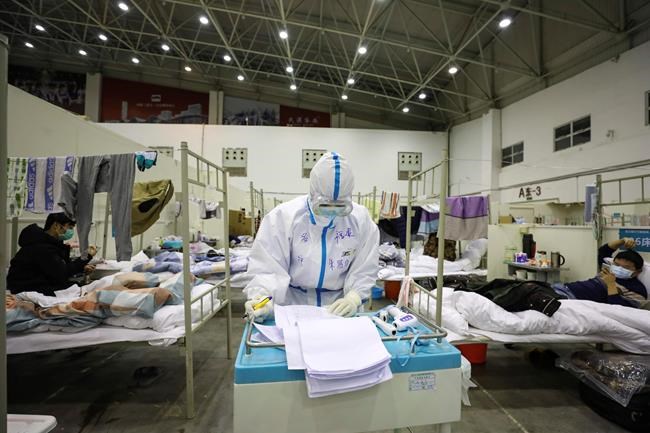
In this Feb. 18, 2020, photo, a medical staff member works near COVID-19 patients recuperating in a temporary hospital converted from an exhibition center in Wuhan in central China's Hubei province. The hospital, one of the dozen of its kind built in Wuhan, hosts COVID-19 patients with mild symptoms. (Chinatopix via AP)

The health commission said it was reducing its count of infections by 279 after lab tests found they had wrongly been included in the tally.

Feng Yong, an official for health matters at the Chinese diplomatic mission in Geneva, said the reason for the reversal was that the country’s laboratory capacity had improved dramatically so all patients can now be tested.

Last week, when the methodology was changed, “we did not have enough capacity to give laboratory tests,” Feng told The Associated Press. “So that’s the reason we included all the suspected cases, in order to let them get treatment.”

“Now we have the laboratory capacity, so now they can adjust the case definition again,” he said.

Cities in Hubei with a combined population of more than 60 million have been under lockdown since the Lunar New Year holiday. Authorities halted nearly all transportation and movement except for quarantine efforts, medical care, and delivery of food and basic necessities. “Wartime” measures were implemented in some places, with residents prevented from even leaving their apartments.

The stringent moves have followed public fury over Hubei authorities’ handling of the outbreak at its outset. The risk of human-to-human transmission was played down and doctors who tried to warn the public were reprimanded by police. Wuhan residents reported overcrowding in hospitals and futile attempts to seek treatment.

Many countries have also set up border screenings and airlines have cancelled flights to and from China to prevent further spread of the disease, which has been detected in about two dozen countries.

___

Associated Press journalists Jamey Keaten in Geneva; Marilynn Marchione in Milwaukee, Wisconsin; Aniruddha Ghosal in New Delhi; Katie Tam in Hong Kong and researcher Yu Bing in Beijing contributed to this report.

Report Error Submit a Tip

More Stories

‘Prevention and protection’: police set to return to buses, stops

Maggie Macintosh 3 minute read Friday, May. 22, 2026

Undercover and uniformed police officers are returning to Winnipeg Transit buses this weekend.

The Winnipeg Police Service, citing the success of the fall pilot project, announced Friday that regular patrols will resume monitoring activity on and around buses, stops and transit hubs.

“Everyone — riders, operators, and transit staff — deserves to feel safe. Violent and disruptive conduct will not be tolerated,” police said in a news release.

It described the initiative as one “rooted in prevention and protection.”

‘Heartbreaking loss’: Sandy Bay First Nation offers condolences after apparent dog attack.

Morgan Modjeski 3 minute read Preview

‘Heartbreaking loss’: Sandy Bay First Nation offers condolences after apparent dog attack.

Morgan Modjeski 3 minute read Sunday, Jul. 19, 2026

Leaders with the Sandy Bay Ojibway First Nation are offering their condolences after an animal rescue worker died following an apparent dog attack in the community and say the “stray and aggressive” animals are a longstanding issue.

Amanda Nobiss, 37, was volunteering in the community on the shores of Lake Manitoba with K9 Advocacy. Her remains were discovered on Friday morning.

The Manitoba First Nations Police Service said in a news release that it had been contacted by a friend of Amanda’s who was trying to locate her, around 12:45 a.m.

Using her cellphone location, police determined she appeared to be in Sandy Bay, said the release. Resources were dispatched to the area, including a drone, but due to the large radius of the cellphone “ping,” no one was located until 6 a.m.

Read
Sunday, Jul. 19, 2026

Manitoba government cuts Crown utility fees, could keep energy rates low

Steve Lambert, The Canadian Press 3 minute read Preview

Manitoba government cuts Crown utility fees, could keep energy rates low

Steve Lambert, The Canadian Press 3 minute read Wednesday, Nov. 23, 2022

WINNIPEG - The Manitoba government is sharply cutting fees it charges its Crown-owned energy utility in a move that could keep electricity rates down with an election less than a year away.

The Progressive Conservative government is halving two fees paid annually by Manitoba Hydro to the province — one for water rental and one for guaranteeing the utility's debt. The changes are retroactive to April 1.

The move will save the Crown corporation almost $190 million a year and help stabilize its finances, Finance Minister Cameron Friesen said Wednesday.

"Now is the time to act for a number of reasons, including rising interest rates and the high level of debt carried by Hydro," said Friesen, who is the minister responsible for the utility.

Read
Wednesday, Nov. 23, 2022

Impacted student athletes seek BU apology in soccer coach harassment case

Maggie Macintosh 6 minute read Preview

Impacted student athletes seek BU apology in soccer coach harassment case

Maggie Macintosh 6 minute read Tuesday, Apr. 26, 2022

Despite pleas from former student athletes at Brandon University who hung up their cleats because of a soccer coach’s misconduct — including suggestive messages, personal and sexual harassment, and blackmail — the school has yet to issue a public apology for internal failures that have caused harm.

“We feel unheard and not protected by a school that should protect us,” said one of a handful of young women who reported concerns about Jesse Roziere. “When you do choose to come forward and start this whole process, it’s exhausting and scary and you’d hope that your school has your back.”

The student, who joined the Bobcats roster when she was a teenager in 2016 (the same year Roziere started as a trainer for the men’s team, before moving to work with women in 2019-20), has participated in two investigations into her former coach since late 2020.

Both an internal review and recent independent examination came to the same conclusion: the now-30-year-old man acted inappropriately with young female athletes.

Read
Tuesday, Apr. 26, 2022

Reader Bridge – Freelancer Inquiry

3 minute read Monday, May. 4, 2026

| The Reader Bridge connects Manitoba’s marginalized and historically underserved communities directly with the Winnipeg Free Press by working together to amplify the voices of the diverse people and communities in our province through our journalism.

I am a freelancer I have a story idea I have a comment

Ebola shipment potential legal risk

Dylan Robertson 5 minute read Preview

Ebola shipment potential legal risk

Dylan Robertson 5 minute read Thursday, Aug. 1, 2019

OTTAWA — Canada could be exposed to legal liability if the pathogens it sent to China from a Winnipeg lab are misused, a top Canadian scientist said.

Gary Kobinger said while it’s highly unlikely the recent shipment would be abused, Ottawa requires adequate paperwork to protect the government from such a situation.

“Typically, when you ship reagents with a Material Transfer Agreement (MTA), an important clause is to release liability,” Kobinger said Thursday. “Those (agreements) are... for ensuring that the recipient will not use the materials to, even accidentally, cause harm.”

Kobinger co-led Canada’s efforts to develop Ebola vaccine ZMapp at the National Microbiology Lab in Winnipeg, alongside Xiangguo Qiu.

Read
Thursday, Aug. 1, 2019