How a coronavirus epidemic in China could ripple through the global economy

Advertisement

Advertise with us

An international outbreak of respiratory illness sparked by a novel coronavirus has spread from its origins in central China to at least 11 countries, with more than 1,200 confirmed cases — including a presumed case in Canada — and over 40 deaths.

Read this article for free:


By clicking the button above, an account will be created and you will begin to receive some of our recommended newsletters. You may opt out of any newsletter by visiting your Email and Communication Preferences page or by clicking "unsubscribe" at the bottom of any email.

or

Already have an account? Log in here »

To continue reading, please subscribe:

Digital Subscription

One year of digital access for only $1.44 a week*

  • Enjoy unlimited reading on winnipegfreepress.com
  • Read the E-Edition, our digital replica newspaper
  • Access News Break, our award-winning app
  • Play interactive puzzles

*Billed as $5.77 plus GST every four weeks. After 52 weeks, price increases to the regular rate of $19.95 plus GST every four weeks. Offer available to new and qualified returning subscribers only. Cancel any time.

To continue reading, please subscribe:

Add Free Press access to your Brandon Sun subscription for only an additional

$1 for the first 4 weeks*

  • Enjoy unlimited reading on winnipegfreepress.com
  • Read the E-Edition, our digital replica newspaper
  • Access News Break, our award-winning app
  • Play interactive puzzles
Start now

*Your next Brandon Sun subscription payment will increase by $1.00 and you will be charged $17.95 plus GST for four weeks. After four weeks, your payment will increase to $24.95 plus GST every four weeks.

Hey there, time traveller!
This article was published 26/01/2020 (2472 days ago), so information in it may no longer be current.

An international outbreak of respiratory illness sparked by a novel coronavirus has spread from its origins in central China to at least 11 countries, with more than 1,200 confirmed cases — including a presumed case in Canada — and over 40 deaths.

Like previous outbreaks, including the SARS virus 17 years ago, the flu-like disease poses a risk to economies around the world as fear and confusion lead to abrupt changes in behaviour, decreased economic activity and a ripple effect across sectors that threatens everything from productivity to consumer prices.

The Severe Acute Respiratory Syndrome pandemic of 2003 cost the Chinese economy up to US$20 billion, according to the Asian Development Bank, as travel warnings and transit shutdowns discouraged consumption, foreign tourists stayed away and local residents stopped going out.
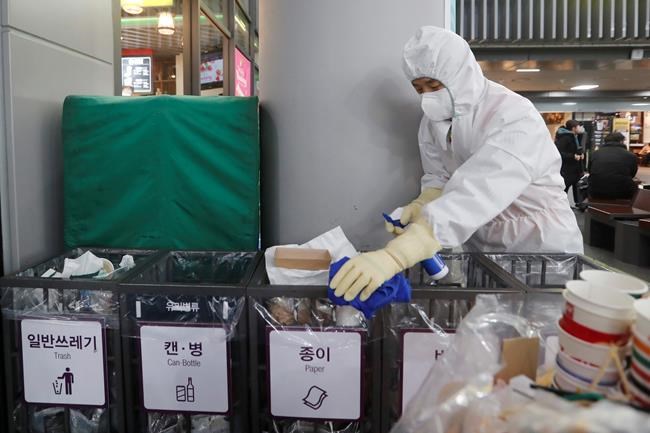
FILE - In this Jan. 24, 2020, file photo an employee works to prevent a new coronavirus at Suseo Station in Seoul, South Korea. On Friday, Jan. 24, 2020, The Associated Press reported on the false claim that the coronavirus outbreak spreading from China is nothing new and that patents were created around it years ago. The patents being shared online are not related to the new respiratory virus that has sickened hundreds of people in China and caused concern around the world. (AP Photo/Ahn Young-joon, File)

“The travel and tourism sectors were most obviously hit, although that ripples through the entire economy,” said Richard Smith, a professor of health economics at the University of Exeter Medical School.

“But many effects are short-lived during an outbreak as once the panic is over people go back to business as usual.”

Chinese authorities clamped down on mass transit during the SARS outbreak, hampering commutes, shopping runs and social outings. The national securities regulatory commission closed stock and futures markets in Shanghai and Shenzhen for two weeks to prevent viral transmission. And Beijing ordered movie theatres, internet cafes and other venues to shut down temporarily while hotels, conference centres, restaurants and galleries saw visitors almost disappear completely.

China’s response to the current crisis appears to be swifter, and the disease less virulent, but the country now boasts a far more extensive high-speed rail network than it did in 2003, and its economy is six times larger, upping the risk of transmission and the repercussions of an epidemic.

“China is the engine of the global economy, churning out goods,” said German health economist Fred Roeder.

Its critical role in international shipping may be thrown into disarray as authorities begin to hold back some ships from entering the port at Wuhan, a key hub on the Yangtze River.

“If they cannot leave it creates huge delays in the supply chain and value chain of businesses all across the world,” Roeder said. “It could actually hit the latest generation of smartphone if ports are shutting down.”

Manufacturing could also feel the crunch as supply chains stall, he said.

Roeder has felt firsthand the disruptive power of a pandemic. In the summer of 2003 the teenage Berliner was eagerly gearing up for a United Nations youth conference that would take him to Taipei, but the event was cancelled a few days beforehand due to SARS.

The epidemic also sparked layoffs and time away from work. At one point Singapore Airlines asked its 6,600 cabin crew to take unpaid leave. Children stayed home from school, prompting more parents to shirk their job duties and further reducing productivity, said AltaCorp Capital analyst Chris Murray.

“I was losing guys left, right and centre as people were quarantined,” recalled Murray, based in Toronto — the epicentre of the SARS pandemic outside of Asia. The disease infected 438 Canadians in total and caused 44 deaths in the Toronto area.

The economic damage culminated with World Health Organization’s one-week travel advisory for the city in April 2003, costing the Canadian economy an estimated $5.25 billion that year.

The outbreak of H1N1, or swine flu, in 2009 also sparked work “dislocations,” Murray said. “It went from, ‘Maybe it’ll be okay,’ to sheer panic.”

Freelancers and gig economy workers such as musicians or ride-hail drivers may feel the pinch more acutely, since they can’t rely on a steady wage when demand shrinks.

“It’s something that unfortunately has happened before in a similar way and it tends to affect areas like retail,” said Carolyn Wilkins, senior deputy governor of the Bank of Canada, said this week.

“People don’t go out, they don’t fly in planes, they don’t do as much tourism to the affected areas,” she said.

The fallout makes workers ranging from servers to wholesale bakers to non-unionized hotel staff more vulnerable. Meanwhile spending or investment plans by larger companies may have to be delayed, said Roeder.

It is not clear how lethal the new coronavirus is or even whether it is as dangerous as the ordinary flu, which kills about 3,500 people every year in Canada alone.

“Still, we should be extremely worried about the economic effects of this,” Roeder said, calling on Chinese authorities to work transparently with Western governments and disease control experts to mitigate the crisis.

“At the end of the day, it hits the entire economy. No one benefits from this.”

This report by The Canadian Press was first published Jan. 25, 2020.

Report Error Submit a Tip

More Stories

Another embarrassing loss: Arniel

Mike McIntyre 7 minute read Preview

Another embarrassing loss: Arniel

Mike McIntyre 7 minute read Yesterday at 6:15 PM EST

RALEIGH — No sticks were smashed. No walls punched. And nary a naughty word was uttered.

Instead, the Winnipeg Jets filed off the ice here at Lenovo Center on Sunday afternoon much like they’d just played the preceding game against the Carolina Hurricanes — with no emotion, no passion, no urgency.

You’d have thought yet another loss, this one in truly humiliating fashion and a ninth consecutive overall, might have triggered something.

Anything.

Read
Yesterday at 6:15 PM EST

Russian Olympic biathlon champion loses Sochi doping case

Graham Dunbar, The Associated Press 5 minute read Preview

Russian Olympic biathlon champion loses Sochi doping case

Graham Dunbar, The Associated Press 5 minute read Thursday, Sep. 24, 2020

GENEVA - Two-time Olympic biathlon champion Olga Zaitseva lost her appeal Thursday against disqualification from the 2014 Sochi Olympics for her part in Russia’s state-backed doping program.

The Court of Arbitration for Sport said its judges upheld the International Olympic Committee’s disciplinary ruling of 2017, which used evidence against Zaitseva from Russian whistleblower Grigory Rodchenkov.

Zaitseva’s disqualification from all her Sochi events strips Russia of its silver medal in the women’s biathlon 4x6-kilometre relay. She won — and will retain — her gold medals from the same relay event at the two previous Winter Games in 2006 and 2010.

Her lawyer in Switzerland, Yvan Henzer, said Zaitseva would appeal the CAS ruling at Switzerland’s supreme court. The federal court typically only intervenes if legal process was abused.

Read
Thursday, Sep. 24, 2020

Letters, Nov. 2

6 minute read 2:00 AM EST

Post-election reflection

The civic election offered both predictable and surprising results. The re-election of Mayor Scott Gillingham and the defeat of Transcona councillor Russ Wyatt were anticipated.

What was surprising was that, in addition to Wyatt, three other incumbents lost their bids for re-election. Devi Sharma (Old Kildonan), Ross Eadie (Mynarski) and Shawn Dobson (St. James) all went down to defeat, and it is clear to me their replacements will bring stronger voices to city hall.

A total of nine new councillors is a seismic shift in Winnipeg civic politics, not seen since the establishment of the 15-member council some 35 years ago. What is most interesting is the political leanings of the new councillors and how they will work with Mayor Gillingham.

Province tables legislation to cover health-care system changes

Larry Kusch 4 minute read Preview

Province tables legislation to cover health-care system changes

Larry Kusch 4 minute read Wednesday, Mar. 6, 2019

The Pallister government has introduced broad legislation to support several of its key planned health-care reforms.

Health Minister Cameron Friesen said Wednesday that Bill 10 (The Regional Health Authorities Amendment Act) will provide the framework to simplify the administration of the health-care system and improve accountability.

All health services in Manitoba will be delivered through the five current regional health authorities, CancerCare Manitoba and a new provincial authority called Shared Health. The administrative changes are set to begin next month and will continue to be rolled out over the next two to three years.

The Health Department will cease to administer health services directly and focus its activities on planning, policy development, funding and oversight. It will set system-wide performance goals and track results.

Read
Wednesday, Mar. 6, 2019

WRHA moves to cut growing echocardiogram wait list

Larry Kusch 6 minute read Preview

WRHA moves to cut growing echocardiogram wait list

Larry Kusch 6 minute read Tuesday, Aug. 21, 2018

Manitobans are waiting a year or more to receive a key test that detects and tracks heart disease.

As of June 15, there were about 6,500 Manitobans on the wait list for an echocardiogram, and the list is growing at a rate of about 265 per month.

Patients facing heart emergencies are receiving tests immediately, while most of those whose conditions are considered urgent or semi-urgent are getting them within established Canadian benchmark times -- about a week, officials say.

However, thousands of patients who are considered candidates for "elective" tests are waiting anywhere from 10 to 15 months, with a median wait of 12 months, according to the Winnipeg Regional Health Authority.

Read
Tuesday, Aug. 21, 2018

New council, new opportunies for Winnipeg

Brent Bellamy 6 minute read Preview

New council, new opportunies for Winnipeg

Brent Bellamy 6 minute read 2:00 AM EST

Last week, Winnipeg voters returned Mayor Scott Gillingham to city hall for a second term, but the more surprising election storyline is that nine of the 15 councillors surrounding him will be new faces.

One encouraging aspect of the results is the community-building experience several of these new councillors bring to the job. Their backgrounds in urban planning, neighbourhood advocacy and community development offer valuable perspectives as Winnipeg confronts difficult questions about how it grows.

These perspectives will be particularly important because some of the most consequential decisions councillors can make happen when they evaluate residential development proposals at committee meetings. Over the next four years, the 16 people we’ve just elected will bear the enormous responsibility of deciding where and how Winnipeggers live. These choices will have profound implications for quality of life, social opportunity and the economic viability of our city. They will shape not only the Winnipeg we know today, but the city we leave to our children and grandchildren.

At committee meetings, councillors will hear endless arguments about parking, traffic, and protecting “neighbourhood character.”

Read
2:00 AM EST