Get coronavirus information from credible sources: public health officials

Advertisement

Advertise with us

TORONTO - Even before Canada's first coronavirus case was announced in Toronto over the weekend, Canada's medical community was on alert — and not just for the disease.

Read this article for free:


or

Already have an account? Log in here »

To continue reading, please subscribe:

Subscribe and receive a limited-edition Free Press branded hat or tote.

Digital Subscription

One year of digital access for only $205*

  • Enjoy unlimited reading on winnipegfreepress.com
  • Read the E-Edition, our digital replica newspaper
  • Access News Break, our award-winning app
  • Play interactive puzzles

*First annual payment billed as $205.00 + GST for one year. This annual subscription will automatically renew at $233.00 + GST every 52 weeks (10% off the regular annual price of $259.35). Offer available to new and qualified returning subscribers only. Cancel any time.

To continue reading, please subscribe:

Add Free Press access to your Brandon Sun subscription for only an additional

$1 for the first 4 weeks*

  • Enjoy unlimited reading on winnipegfreepress.com
  • Read the E-Edition, our digital replica newspaper
  • Access News Break, our award-winning app
  • Play interactive puzzles
Start now

*Your next Brandon Sun subscription payment will increase by $1.00 and you will be charged $17.95 plus GST for four weeks. After four weeks, your payment will increase to $24.95 plus GST every four weeks.

Hey there, time traveller!
This article was published 26/01/2020 (2448 days ago), so information in it may no longer be current.

TORONTO – Even before Canada’s first coronavirus case was announced in Toronto over the weekend, Canada’s medical community was on alert — and not just for the disease.

Public health officials said they were keeping an eye on social media because misinformation has become a threat against illness prevention and they were cognizant of the impact it could have on addressing the respiratory illness that has sickened at least 2,000 people and killed dozens of others.

“In health care, in general right now, we are struggling a little bit to combat misinformation about health care from social media and from all fronts and I don’t suspect this will be any different,” said Dr. Sohail Gandhi, president of the Ontario Medical Association.
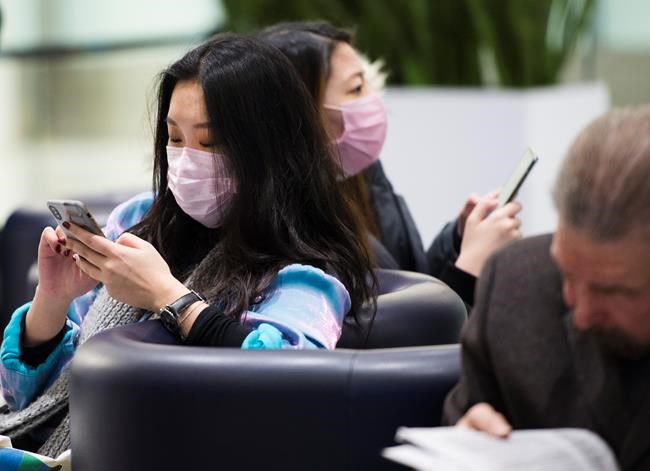
People wear masks as a precaution due to the coronavirus outbreak as they wait for the arrivals at the International terminal at Toronto Pearson International Airport in Toronto on Saturday, January 25, 2020.THE CANADIAN PRESS/Nathan Denette

“We have a media staff that are actively monitoring different emerging trends…If they feel there is too much misinformation particularly on one matter, we will speak out against that.”

The information monitoring by the OMA and other organizations during an outbreak is a relatively recent development. After all, Facebook, Twitter, Instagram and Snapchat were still years away from being founded when in 2002, severe acute respiratory syndrome (SARS) rattled southern China, infected more than 8,000 people and killed nearly 800, including 44 Canadians.

In the age of coronavirus, however, there is a plethora of places for Canadians to get their news — and not all are credible or being vetted by medical experts. A tweet or snap can easily convince someone to disregard proper hygiene or even create fearmongering about the risk of contracting an illness.

“People may actually take the wrong course of action and engage in what they believe are protective measures that are in fact not warranted and in some cases may be harmful,” said Dr. Eileen de Villa, Toronto’s medical officer of health.

Coronavirus misinformation, she said, is especially important to watch out for because our understanding of the illness is only just developing.

Doctors and researchers are still looking into the coronavirus’s origins, how it reached humans, is transferred and what can be done to eradicate it.

“Those are the kinds of areas where there’s some uncertainty and I think when there is some uncertainty, there is often fear and anxiety associated with that,” she said. “That’s where you see some misinformation.”

To combat the spread of misinformation, the federal government is keeping in touch with ethnic media and trying to be as transparent as possible with updates on the illness, said federal Health Minister Patty Hajdu at an Ottawa news conference on Sunday, where she revealed more coronavirus cases are expected in Canada, but cautioned the risk to the public is low.

“Misinformation is difficult to combat online,” she said. “It’s unfortunate that misinformation is creating a perception for Canadians that belies the reality that the risk remains low.”

Meanwhile, Toronto Public Health had set up a coronavirus webpage with information on symptoms, risk level updates, treatment information and federal and provincial resources.

De Villa said that adds to the organization’s constant practice of watching for health misinformation on social media.

“Fundamentally as public health officials, this is our purpose and our goal,” she said. “It is our objective to ensure the people we ensure are given evidence-based, credible information, so they know what is happening and what to do in order to protect their own health.”

De Villa and Gandhi urged Canadians trying to verify what they may see online about coronavirus to pay attention to official health sources, including Toronto Public Health, the World Health Organization, the Public Health Agency of Canada and the Ontario Ministry of Health.

This report by The Canadian Press was first published Jan. 26, 2020.

Report Error Submit a Tip

More Stories

Letters, Oct. 7

6 minute read Yesterday at 2:01 AM CDT

On diet and humanity

Re: “Maybe ASI will need us” (Letters, Oct. 5)

Mr. Martin, humans eating animals is not part of the circle of life. Many cultures with abundant plant resources, or for religious beliefs, have historically subsisted on largely or strictly vegetarian diets. Likewise, in extreme environments such as the Arctic, Inuit rely heavily on animal products due to the near-absence of arable land. Humans adapt locally to their environments and do not have a single ancestral diet.

Clearly vegetarian or vegan diets are not fringe, as evidenced by plant-based products on main-stream grocery store shelves. To suggest the Free Press is morally endorsing a fringe diet is rubbish, (the newspaper) merely gives the public a platform for diverse opinions, thus generating individual, thought-provoking ideas and conversations — a practice that is desperately needed these days.

Weed control increasingly important part of harvest

Laura Rance 4 minute read Preview

Weed control increasingly important part of harvest

Laura Rance 4 minute read Friday, Sep. 8, 2023

We often think of harvest as an annual “rush,” but in reality, it moves at more of a rhythmic pace, especially when the sun is shining, the fields are ripe, and the equipment is running smoothly.

Operators and machinery steadily grind away at the unharvested crops, moving from field to field as needed. Grain carts and trucks roll back and forth, hauling the grain into storage, often sidling up to the moving combine so it can unload on the fly.

Of course, the equipment needs servicing, and the people need food, but every operation has a system that minimizes the downtime and maximizes the effort. So far this season, Manitoba farmers are running ahead of the five-year average for harvest progress.

However, a brief reference in the latest crop report urges producers to break up that synchronicity and pause to closely examine patches of weeds in their fields before they push them through with the combine.

Read
Friday, Sep. 8, 2023

War veteran helped build Rivercrest

Bill Redekop 6 minute read Saturday, Mar. 30, 2019

As one of the original homeowners in Rivercrest, a subdivision north of Winnipeg set aside for war veterans in 1946, and the very last of them to leave at age 101, Art Christensen embodied neighbourhood-building.

He volunteered with the construction of the Rivercrest United Church, Rivercrest Community Club, West St. Paul Curling Club, and West St. Paul Fire Hall.

He went on to serve as West St. Paul councillor for 10 years, and then as reeve for 11.

Christensen was even a bit of a social convener.

This week’s silly geopolitical spat

Gwynne Dyer 4 minute read Yesterday at 2:01 AM CDT

“I would not like to call this an incident. Let’s say it’s a diplomatic misunderstanding,” said Ukrainian Foreign Affairs Minister Andrii Sybiha. But the South Korean president definitely sees it as a serious incident, and he has already gone public with it.

“If (Ukraine’s) refusal to acknowledge the facts and issue a public apology continues, we will take additional measures,” President Lee Jae-myung wrote on X. He probably means cutting the non-military aid South Korea gives to Ukraine. (There is no military aid, since the constitution bans Seoul from providing arms to a country actively involved in a war).

What monstrous misdeed did the Ukrainian government commit to deserve such harsh words from a country that is generally sympathetic to Ukraine’s struggle against its giant neighbour? Have the South Koreans discovered Ukrainian spies in the Blue House?

No, it’s what we professionals call a “spat.”

Manitoba pharmacists push for increased role in administration of vaccines

Chris Kitching 6 minute read Preview

Manitoba pharmacists push for increased role in administration of vaccines

Chris Kitching 6 minute read 6:39 PM CDT

Manitoba’s public health officials are preparing for influenza season to peak earlier than usual amid concerns about declining uptake for flu and COVID-19 vaccinations.

While the season started early in some provinces, including Ontario and B.C., Dr. Brent Roussin, Manitoba’s chief public health officer, said it’s too soon to conclusively say if the same will happen here.

“But certainly seeing what’s around us and seeing an uptick (in cases) here, it’s making a concern it might be an early year,” he told the Free Press on Thursday.

Manitoba’s flu season usually peaks in late December, with the vaccination campaign continuing into the new year.

Read
6:39 PM CDT

More time at work is not always more productive work

Tory McNally 5 minute read Preview

More time at work is not always more productive work

Tory McNally 5 minute read Saturday, May. 2, 2026

There is a quiet assumption built into many workplaces that more time equals more value.

The employee who answers emails late into the evening is seen as committed. The manager who skips lunch and powers through 12-hour days is admired for their work ethic. The team that keeps stretching to absorb one more vacancy, one more project, one more urgent ask is praised for stepping up.

It feels productive. It looks productive. But often, it is not.

Canada’s productivity conversation has increasingly focused on a simple but important measure: output per hour worked. In other words, what are we actually producing for the time we are putting in?

Read
Saturday, May. 2, 2026