‘Amazing they could do that:’ Baby who got organ donation now healthy 6-year-old

Advertisement

Advertise with us

EDMONTON - Hailey Hague only has to look at her healthy, energetic six-year-old to know the importance of organ donation.

Read this article for free:


By clicking the button above, an account will be created and you will begin to receive some of our recommended newsletters. You may opt out of any newsletter by visiting your Email and Communication Preferences page or by clicking "unsubscribe" at the bottom of any email.

or

Already have an account? Log in here »

To continue reading, please subscribe:

Digital Subscription

One year of digital access for only $1.44 a week*

  • Enjoy unlimited reading on winnipegfreepress.com
  • Read the E-Edition, our digital replica newspaper
  • Access News Break, our award-winning app
  • Play interactive puzzles

*Billed as $5.77 plus GST every four weeks. After 52 weeks, price increases to the regular rate of $19.95 plus GST every four weeks. Offer available to new and qualified returning subscribers only. Cancel any time.

To continue reading, please subscribe:

Add Free Press access to your Brandon Sun subscription for only an additional

$1 for the first 4 weeks*

  • Enjoy unlimited reading on winnipegfreepress.com
  • Read the E-Edition, our digital replica newspaper
  • Access News Break, our award-winning app
  • Play interactive puzzles
Start now

*Your next Brandon Sun subscription payment will increase by $1.00 and you will be charged $17.95 plus GST for four weeks. After four weeks, your payment will increase to $24.95 plus GST every four weeks.

Hey there, time traveller!
This article was published 07/04/2019 (2763 days ago), so information in it may no longer be current.

EDMONTON – Hailey Hague only has to look at her healthy, energetic six-year-old to know the importance of organ donation.

Soon after Lily was born, she was diagnosed with biliary artresia — a disease that affects about one in every 10,000 to 20,000 infants.

“Right before Lily hit three months, she went into end-stage liver failure,” says Hague. “Her eyes completely went yellow … and she was sleeping. We had to purposely wake her up to feed her and that’s not normal.”
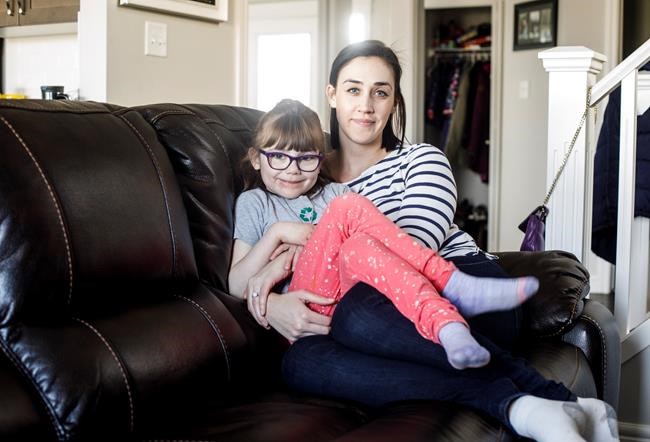
Hailey Hague and her daughter Lily Hague pictured in Edmonton Alta, on Wednesday April 3, 2019. Hailey donated part of her liver to her daughter Lily who was eight-months-old at the time. THE CANADIAN PRESS/Jason Franson

The next day, they found out her liver wasn’t working and she might need a liver transplant.

Organ donation has been in the spotlight the last year after the Humboldt Broncos bus crash in Saskatchewan left 16 people dead and 13 injured. One of the players, Logan Boulet of Lethbridge, Alta., had signed up to be an organ donor in the weeks before the crash and his parents followed through with his wishes.

Six people across Canada benefited from his organs. What has been called the Logan Boulet Effect soon followed.

Canadian Blood Services estimates that nearly 100,000 Canadians registered to become organ donors after the Humboldt crash and the story of Boulet’s donation. Another 50,000 people registered in May.

The head of the David Foster Foundation, which provides financial support to families with children who need organ transplants, says Boulet’s death shows the importance of organ donation.

“Through tragedy has come action,” says Michael Ravenhill. “Because of that one young man’s selfless act, he has actually changed the landscape of organ donation in Canada.”

An event called Green Shirt Day is planned for every April 7, the anniversary of Boulet’s death, to promote organ donation.

The Canadian Institute for Health Information says the country has a shortage of organs, with 4,333 patients waiting for transplants. In 2017, 242 Canadians died while waiting for a transplant.

The Hague family’s experience was in 2013. They moved to Edmonton from Abbotsford, B.C., to be closer to Stollery Children’s Hospital where Lily could get a transplant assessment.

Family members were willing to donate part of their liver, but Lily’s portal vein — the main blood vessel to the liver — wasn’t working properly and a living donor can’t provide one.

“She got moved to the transplant list because she needed a deceased donor,” says her mother.

After an infection, Lily was given three months to live and was bumped up on the transplant list.

“We needed to find her a donor. We needed to do something or she was not going to be here anymore,” said Hague. “I felt like I had the wind knocked out of me.”

Lily was transferred to Toronto’s SickKids Hospital for treatment while she waited for a donor.

“It was a blessing in disguise,” Hague says. “They told us about this new procedure … they could use the living donor’s liver and then they could take deceased vessel from someone who has passed away to create a portal vein.”

A liver donation would still be her best chance at survival, but now they had another option if the next liver went to another patient.

And that’s what happened.

When Lily was seven months old, her mother gave her 22 per cent of her liver.

“Somebody else, a little boy I think it was, passed away. His liver went to somebody else and his vessels created Lily’s portal vein,” says Hague. “It’s amazing that they could do that.”

A lot of people tell her that she’s her daughter’s hero.

“I don’t know,” she says. “I like to think of the little boy who donated his organ, his parents donating his organs — that’s her hero. I’m her mom.”

Hague says she’s encouraged by the recent focus on organ donation.

In addition to Green Shirt Day, Nova Scotia announced legislation last week that would have all residents be potential organ donors unless they opted out. It’s believed Nova Scotia would be the first jurisdiction in North America to adopt the measure.

Hague says she hopes every province follows suit.

“Oh my gosh, please, everywhere,” she says. “If everyone were an organ donor, could you imagine?”

Report Error Submit a Tip

More Stories

Waiting for Cormier verdict the ‘calm before the storm’

Katie May 6 minute read Preview

Waiting for Cormier verdict the ‘calm before the storm’

Katie May 6 minute read Thursday, Feb. 22, 2018

As the jury room door closed behind the seven women and four men who are now deliberating on the evidence against Tina Fontaine’s accused killer, Thelma Favel rose from the chair she’s occupied for most of Raymond Cormier’s second-degree murder trial.

Almost every day over the past three weeks, Favel, the woman who raised 15-year-old Tina, has sat right up front, directly across from the jury box, listening, sobbing and soaking in disturbing details of the teen’s last days that have come to light over the course of Cormier’s second-degree murder trial.

On Wednesday afternoon, after Court of Queen’s Bench Chief Justice Glenn Joyal instructed the jury and sent them off to be sequestered until they decide whether 56-year-old Raymond Cormier is guilty of killing Tina, Favel got up and hugged Crown prosecutor Breta Passler. It was one of many moments, this one shielded from jurors, that have long since proven the emotional impact of the case and the lasting power of Tina’s legacy.

Tina’s death sparked a public outcry that renewed calls for a national inquiry into disproportionately high rates of missing and murdered Indigenous women and girls across Canada, and the criminal trial for the man accused of killing her hasn’t happened in a vacuum.

Read
Thursday, Feb. 22, 2018

Health officials ponder next steps as COVID cases surge in Southern Health region

Katie May 5 minute read Preview

Health officials ponder next steps as COVID cases surge in Southern Health region

Katie May 5 minute read Wednesday, Nov. 3, 2021

Public-health officials say they're trying to avoid ordering another lockdown in southern Manitoba, where COVID-19 infection rates are surging.

Deputy chief provincial public health officer Dr. Jazz Atwal told a news conference Wednesday he doesn't anticipate more lockdowns and suggested he will prioritize keeping schools open when considering future restrictions.

But he couldn't say what the next step will be in an area of the province where hospitalizations among unvaccinated residents are on the rise.

Average daily case counts in the southern part of the province are higher now than they were before lockdown measures went into effect last November, and officials are still figuring out what to do.

Read
Wednesday, Nov. 3, 2021

Today’s horoscope

Georgia Nicols 4 minute read Preview

Today’s horoscope

Georgia Nicols 4 minute read 2:00 AM CDT

MOON ALERT: There are no restrictions to shopping or important decisions today. The moon is in Cancer.

ARIES (March 21-April 19)

Avoid heated discussions regarding kids, social plans, shared expenses or dealing with authority figures. (This covers a wide swath.) People are touchy! Pull in your reins and tread carefully. You don’t have to be right. You don’t even have to be wrong.

TAURUS (April 20-May 20)

Read
2:00 AM CDT

Is Canada headed for time chaos this weekend?

Michelle Bastian 5 minute read 2:00 AM CDT

When Manitoba Premier Wab Kinew declared Sept. 17 that the province would remain on permanent daylight time, he suggested it was a historical moment people would share with their “great-great-grandkids.” But, while Sunday, Nov. 1 has been heralded as the date many Canadians will stop changing their clocks, there are rumblings behind the scenes suggesting this will actually cause more trouble than ever before.

There are, of course, the warnings from chrono-biologists and sleep scientists about the damage permanent daylight time will do. The lighter evenings will mean many more dark mornings. But there is another set of problems in the offing in the critical infrastructure that underpins our digital lives.

While it used to be common to spend the Sunday morning after a time change going around our homes updating the clocks, we now wake up to devices that have already adjusted to the new time. These automatic updates occur regularly for daylight time, as well as when we travel to new time zones.

Our clocks are able to change by themselves owing to the hard work of a group of volunteers who were recently named in a list of the people who hold up the internet. This group, led by Paul Eggert, a computer scientist at UCLA, maintains a little-known tool called the Time Zone Database. Since the 1980s, it has kept track of regional, national and international debates about clock time and provided an up-to-date table of what time it should be on our walls.

Manitoba family adopts Ukrainian children just before Russian invasion

Chris Kitching 7 minute read Preview

Manitoba family adopts Ukrainian children just before Russian invasion

Chris Kitching 7 minute read Wednesday, Mar. 30, 2022

When Trish Braun sees horrific images of Russia’s attack on Ukraine, the Manitoba mother is thankful she had enough time to flee from the country with her three adopted children.

Other Canadian families weren’t as fortunate, as Ukraine halted intercountry adoptions due to the Kremlin’s unprovoked invasion and war.

“I’m so thankful we were able to get out, but lots (of Ukrainians) don’t have the option of getting to leave,” said Braun, who lives in Grunthal, about 50 kilometres southeast of Winnipeg. “It’s hard to adjust to life here while our hearts are over there.”

Just days before Russia began its assault, Braun was staying in the Odesa region with the three Ukrainian children — siblings Daniel, 16, Lewis, 10, and Paige, 6 — that she and her husband, Mike, 43, had adopted from an orphanage.

Read
Wednesday, Mar. 30, 2022

A fond farewell to the Hercules

Editorial 4 minute read Preview

A fond farewell to the Hercules

Editorial 4 minute read 2:00 AM CDT

Fans at the NHL’s outdoor Heritage Classic game last weekend were no doubt thrilled by the sight and sound of two CF-18 Hornet fighter jets conducting a flyover at Princess Auto Stadium shortly before the puck was dropped for the much-anticipated Winnipeg Jets/Montreal Canadiens matchup.

Flyovers such as these always create a spectacular scene, as the speed and power of the jets are on full display for the brief moments they’re in view above the stadium bowl. But fans who maintained their skyward gaze for a few seconds after the Hornets’ blink-and-you’ll-miss-it appearance were treated to a much more poignant aeronautical exhibition, as a CC-130H Hercules aircraft passed over the stadium in the fighter jets’ wake.

Compared to the supersonic CF-18s, the massive, propeller-driven transport plane probably seemed to be doing more of a “crawl-over”; what most folks at the outdoor game probably didn’t realize, however, was that this was almost certainly the last time they’ll see one of these ubiquitous Canadian Forces aircraft in the sky.

The CC-130H is being retired after more than half a century as the RCAF’s combat, rescue and transport workhorse. The “Herc” will be replaced by more modern aircraft, including the smaller and more nimble CC-295 Kingfisher, which will be used for search-and-rescue missions out of 17 Wing Winnipeg, beginning next month.

Read
2:00 AM CDT