Parliamentary budget officer says climate change already costing economy billions

Advertisement

Advertise with us

OTTAWA - The effects of climate change bit a $20-billion hole out of Canada's economy last year, parliamentary budget officer Yves Giroux said Tuesday.

Read this article for free:


By clicking the button above, an account will be created and you will begin to receive some of our recommended newsletters. You may opt out of any newsletter by visiting your Email and Communication Preferences page or by clicking "unsubscribe" at the bottom of any email.

or

Already have an account? Log in here »

To continue reading, please subscribe:

Digital Subscription

One year of digital access for only $1.44 a week*

  • Enjoy unlimited reading on winnipegfreepress.com
  • Read the E-Edition, our digital replica newspaper
  • Access News Break, our award-winning app
  • Play interactive puzzles

*Billed as $5.77 plus GST every four weeks. After 52 weeks, price increases to the regular rate of $19.95 plus GST every four weeks. Offer available to new and qualified returning subscribers only. Cancel any time.

To continue reading, please subscribe:

Add Free Press access to your Brandon Sun subscription for only an additional

$1 for the first 4 weeks*

  • Enjoy unlimited reading on winnipegfreepress.com
  • Read the E-Edition, our digital replica newspaper
  • Access News Break, our award-winning app
  • Play interactive puzzles
Start now

*Your next Brandon Sun subscription payment will increase by $1.00 and you will be charged $17.95 plus GST for four weeks. After four weeks, your payment will increase to $24.95 plus GST every four weeks.

Hey there, time traveller!
This article was published 08/11/2022 (1453 days ago), so information in it may no longer be current.

OTTAWA – The effects of climate change bit a $20-billion hole out of Canada’s economy last year, parliamentary budget officer Yves Giroux said Tuesday.

His office issued a new analysis looking at the economic impacts of climate change over the next 80 years, which comes as the annual United Nations climate conference, also known as COP27, is kicking into high gear in Egypt.

Environment Minister Steven Guilbeault, who is in Sharm El-Sheikh for the two-week gathering, said this meeting is supposed to be the “implementation COP,” where promises made around the world to cut greenhouse-gas emissions become more than just talking points.
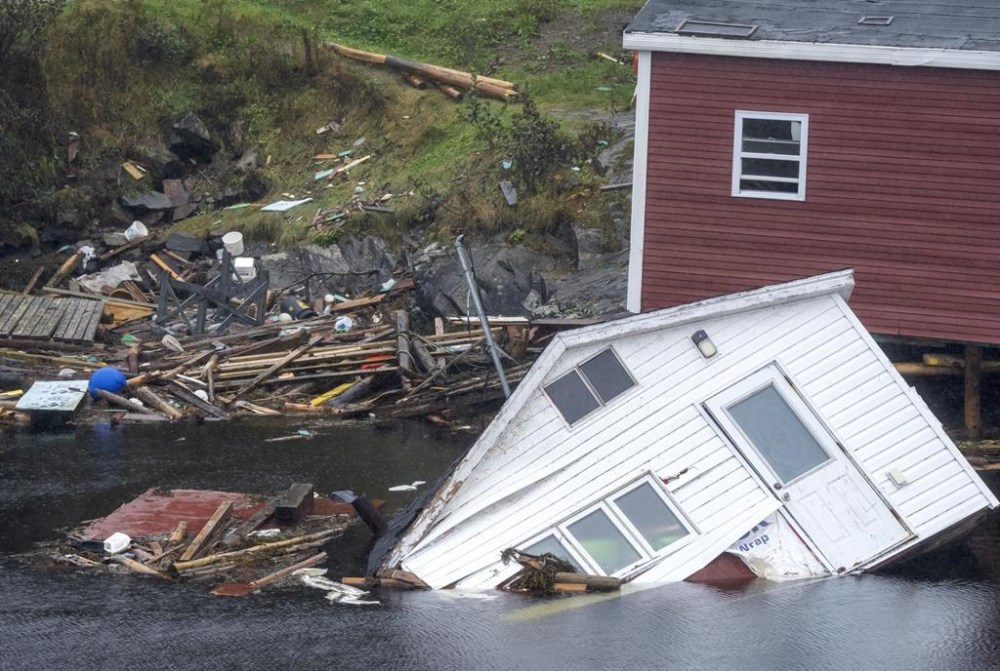
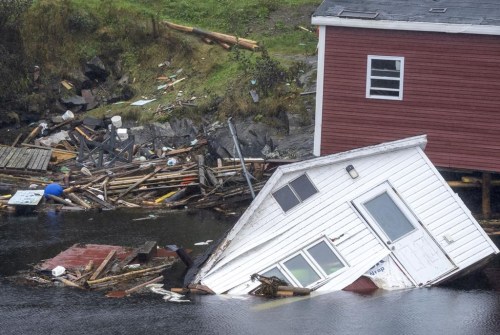
Buildings sit in the water along the shore following hurricane Fiona in Rose Blanche-Harbour Le Cou, N.L. on Tuesday September 27, 2022. The parliamentary budget watchdog says climate change has already begun to hurt the Canadian economy. THE CANADIAN PRESS/Frank Gunn

“We are in the make-or-break decade in our effort to stay below 1.5 degrees Celsius, to keep the planet livable,” Guilbeault said in an interview with reporters by phone on Tuesday.

The 2015 Paris climate accord saw every country agree to reduce emissions enough to limit global warming to as close as possible to 1.5 C above pre-industrial times. Over 1.5 C, the effects of climate change begin to mount exponentially. Above 2 C, many are considered irreversible.

Currently, the average global temperature is 1.2 C above pre-industrial levels. A UN report last month said the climate policies in place now would see that grow to 2.8 C by 2100.

If the policies that have been promised but not yet implemented are added, that will come down to 2.4 C to 2.6 C, the UN report said. In Canada those promises would include a cap on emissions from oil and gas production, which is in development now.

Giroux’s report concludes that even if all those promises are fully implemented, Canada’s GDP is going to grow more slowly than if climate change didn’t exist.

And in fact it already did, Giroux said. In 2021, the PBO estimates that the effects of extreme weather caused Canada’s GDP to fall to 0.8 per cent lower than what it would have been without climate change.

Tim Scholz, a PBO analyst who co-authored the report, said that works out to roughly between $20 billion and $25 billion less on the reported GDP of $2.5 trillion in 2021.

The economic hits from climate change can include reduced farm outputs from drought or extreme precipitation, lowered productivity for outdoor workers and higher energy bills due to hotter summers.

It can also mean lost work hours when hurricanes, tornadoes and other major storms damage power grids or destroy buildings, and impacts on tourism, such as shorter ski seasons.

In a scenario where all promised climate policies are fully enacted, Canada’s GDP is expected to be 0.08 percentage points lower every year than in a world without climate change.

By 2050, that amounts to a GDP reduced by 2.4 per cent compared to no climate change, and by 2100, by 5.8 per cent.

In a scenario where only policies already implemented are in place, the effects of climate change could grow to 2.5 per cent by 2050, and 6.6 per cent by 2100.

Without clear estimates of what Canada’s GDP will be in those years, Giroux said quantifying the amount is difficult. But 5.8 per cent of Canada’s current economy is about $145 billion and 6.6 per cent is $165 billion.

Giroux is clear that this analysis is the first attempt to quantify the economic impact of climate change and that a variety of factors could influence the final outcome.

That includes how much and how well Canada does to adapt to extreme weather. Investments to strengthen power grids against high winds, make homes and businesses more resilient to floods and fires, irrigate or improve drainage of farm land, and reinforce coastal properties against the growing risk of hurricanes and storm surge could all help keep Canada’s economy going even as the weather changes.

Climate change could also bring some positive economic growth, the report notes, such as the possibility of longer growing seasons for farms.

The report doesn’t account for the economic impacts of trade disruptions that may be caused as the changing climate affects the economies of some of Canada’s big trading partners.

The COP27 meeting in Egypt is wrestling with a lot of that this week, amid dire warnings from UN Secretary-General António Guterres.

“We are in the fight of our lives and we are losing,” he said in his opening speech Monday.

Guterres said countries need to make a pact to do everything they can to lower greenhouse gas emissions before 2030, and that rich countries, including Canada, need to step up to help poorer countries transition to renewable energy.

Guilbeault said he hadn’t seen the PBO report but he thinks Canadians understand the costs because almost everyone has been directly impacted by climate change themselves, including increasingly strong post-tropical storms like Fiona.

“I don’t think we need to convince Canadians that climate is already having an impact in Canada, and that it’s costing Canadians billions of dollars,” he said. “Go and talk to people in Atlantic Canada right now and it’s a very, it’s a very quick conversation. They get it.”

This report by The Canadian Press was first published Nov. 8, 2022.

Report Error Submit a Tip

More Stories

Actor-director Cooper takes new approach to familiar tale

Randall King 4 minute read Preview

Actor-director Cooper takes new approach to familiar tale

Randall King 4 minute read Thursday, Oct. 4, 2018

TORONTO — In his self-directed version of A Star Is Born, Bradley Cooper plays a rock star named Jackson Maine.

Note the name: it marks the character as a member of a cinematic lineage that descends all the way to 1937.

That year, the first A Star Is Born was made, with Frederick March in the role of alcoholic actor Norman Maine. The name stayed in 1954, when James Mason took over the role of an actor who first nurtures the career of Judy Garland’s up-and-coming star Vicki Lester before his drunken shenanigans threaten to derail it. By 1976, Kris Kristofferson played the role of musician John Norman Howard, a rock singer with a musical stake in the ascent of Barbra Streisand’s Esther Hoffman.

Cooper, 43, remembered the Maine name, but also brought his own vision as a first-time feature filmmaker to the new version, which opens Thursday, Oct. 4, opposite Lady Gaga after the originally designated director, Clint Eastwood, dropped out. While actors might not want to see different interpretations of a role, Cooper embraced the opportunity to see all the past iterations.

Read
Thursday, Oct. 4, 2018

Parliamentary budget officer says climate change already costing economy billions

Mia Rabson, The Canadian Press 5 minute read Preview

Parliamentary budget officer says climate change already costing economy billions

Mia Rabson, The Canadian Press 5 minute read Tuesday, Nov. 8, 2022

OTTAWA - The effects of climate change bit a $20-billion hole out of Canada's economy last year, parliamentary budget officer Yves Giroux said Tuesday.

His office issued a new analysis looking at the economic impacts of climate change over the next 80 years, which comes as the annual United Nations climate conference, also known as COP27, is kicking into high gear in Egypt.

Environment Minister Steven Guilbeault, who is in Sharm El-Sheikh for the two-week gathering, said this meeting is supposed to be the "implementation COP," where promises made around the world to cut greenhouse-gas emissions become more than just talking points.

"We are in the make-or-break decade in our effort to stay below 1.5 degrees Celsius, to keep the planet livable," Guilbeault said in an interview with reporters by phone on Tuesday.

Read
Tuesday, Nov. 8, 2022

Teemu Selanne living the good life in southern California

Mike McIntyre 19 minute read Preview

Teemu Selanne living the good life in southern California

Mike McIntyre 19 minute read Friday, Oct. 15, 2021

LAGUNA BEACH — He likes his coffee black. His steak “medium rare plus.” And he’s an extremely generous pour, especially when it comes to a Moscow mule.

His left knee is giving him all sorts of trouble these days, he’s admittedly almost always running behind schedule and his biggest pride and joy are his four children, who keep him and his wife Sirpa hopping with their numerous athletic pursuits.

He is Teemu Selanne, the beloved Winnipeg Jets legend who, you’ll be happy to know, is still living the good life just a stone’s throw from the Pacific Ocean in this little piece of southern California paradise.

Despite being nearly eight years removed from the end of a Hall of Fame hockey career, the Finnish Flash remains a big deal around here. That was clear as we sat down earlier this week for an exclusive chat inside “Selanne’s Steak Tavern” — a high-end eatery he owns that sits along the stunning Pacific Coast Highway.

Read
Friday, Oct. 15, 2021

A little toponder, a lot to celebrate

Erna Buffie 5 minute read 2:01 AM CDT

Well, another civic election season has come and gone, and I have to say it was a doozy. The most surprising event was the steady climb in support for young mayoral candidate Noah Redden, who started out with just four per cent public support in September but had reached a solid 14 per cent support in October.

On election day, Redden nearly came in second, less than one percentage point behind Kevin Klein, an experienced politician.

Indeed, the 27-year-old’s accomplishment was nothing short of astonishing. Particularly given that his shoestring campaign was given very little coverage — largely, according to one pundit, because he didn’t send out any press releases.

This when Redden’s unwritten press releases were there for everyone to see on Instagram, as he popped up in locations across the city, posting videos about what he hoped to achieve as mayor.

The new normal in Canadian politics

David McLaughlin 5 minute read Preview

The new normal in Canadian politics

David McLaughlin 5 minute read 2:01 AM CDT

“Nothing happening, all at once.”

Welcome to the new normal of Canadian politics, where normality is the new normal. Routine and stable are in; disruptive and excessive are out. Exhibits A and B are the Alberta referendum and the British Columbia election. Voters opted for stability over volatility.

The opposite of being normal is being different from the norm. In politics that means different from where we’ve been and what we’ve come to expect. Two competing trends have dominated our politics for the past decade and a half — progressivism and populism. Think Justin Trudeau and liberal, progressive identity politics in Canada, and Donald Trump and conservative, populist MAGA politics in America. We are now experiencing a swing away from both those trends.

Representing this “new normal” are Prime Minister Mark Carney, for one, and newly elected British Columbia premier, Lorne Doerksen, for another. Both are considered normal because they talk and act like adults in a childish political world. Their political flair is to not have any political flair. They stand out for not standing out.

Read
2:01 AM CDT

Doctor’s departure stressful for teen

Kevin Rollason 6 minute read Preview

Doctor’s departure stressful for teen

Kevin Rollason 6 minute read Sunday, Oct. 24, 2021

Morgan Walker is a typical teen — but only because a piece of his brain the size of a deck of cards was removed four years ago.

Walker, who had seizures multiple times a day before his surgery, fears other people might not be so lucky.

That’s because his surgeon, Dr. Demitre Serletis, is leaving the province and Health Sciences Centre. Serletis will start practising at the Cleveland Clinic in the new year.

“I was kind of shocked, but I understood why,” Walker said from his home in Brandon. “The government really hasn’t been respecting doctors.”

Read
Sunday, Oct. 24, 2021