Former Obama adviser Podesta on Biden’s Keystone XL decision: ‘He’s not going back’

Advertisement

Advertise with us

WASHINGTON - A senior adviser to two former U.S. presidents delivered a stark message Friday to Canadians hoping for the resurrection of the Keystone XL pipeline: get over it.

Read this article for free:


or

Already have an account? Log in here »

To continue reading, please subscribe:

Subscribe and receive a limited-edition Free Press branded hat or tote.

Digital Subscription

One year of digital access for only $205*

  • Enjoy unlimited reading on winnipegfreepress.com
  • Read the E-Edition, our digital replica newspaper
  • Access News Break, our award-winning app
  • Play interactive puzzles

*First annual payment billed as $205.00 + GST for one year. This annual subscription will automatically renew at $233.00 + GST every 52 weeks (10% off the regular annual price of $259.35). Offer available to new and qualified returning subscribers only. Cancel any time.

To continue reading, please subscribe:

Add Free Press access to your Brandon Sun subscription for only an additional

$1 for the first 4 weeks*

  • Enjoy unlimited reading on winnipegfreepress.com
  • Read the E-Edition, our digital replica newspaper
  • Access News Break, our award-winning app
  • Play interactive puzzles
Start now

*Your next Brandon Sun subscription payment will increase by $1.00 and you will be charged $17.95 plus GST for four weeks. After four weeks, your payment will increase to $24.95 plus GST every four weeks.

Hey there, time traveller!
This article was published 12/02/2021 (2048 days ago), so information in it may no longer be current.

WASHINGTON – A senior adviser to two former U.S. presidents delivered a stark message Friday to Canadians hoping for the resurrection of the Keystone XL pipeline: get over it.

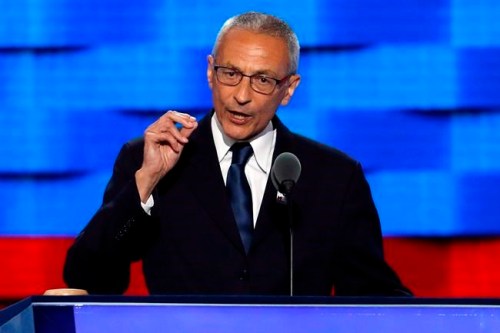
The project is gone and not coming back, said John Podesta, who was White House chief of staff in the final years of Bill Clinton’s second term and a senior counsellor to Barack Obama.

“I think Keystone’s dead,” Podesta told an online panel discussion hosted by Canada 2020, a prominent think-tank with deep ties to the federal Liberal party.
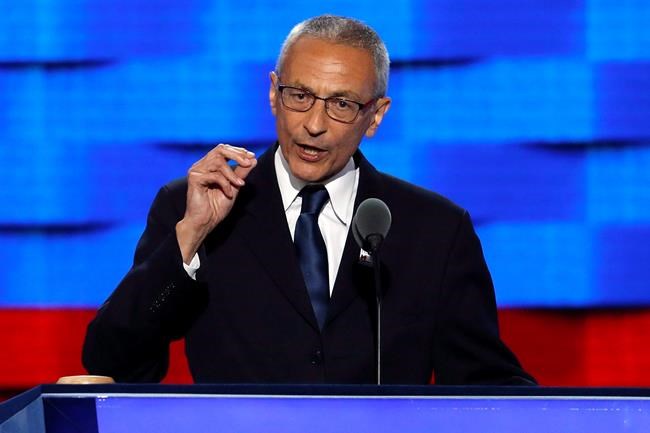
In this July 25, 2016, file photo, John Podesta speaks during the first day of the Democratic National Convention in Philadelphia. The prominent former adviser to Barack Obama says it's time for Canada to get over the demise of the Keystone XL pipeline expansion. THE CANADIAN PRESS/AP-J. Scott Applewhite

President Joe Biden signed an executive order on his first day in office that rescinded predecessor Donald Trump’s decision to let the pipeline project cross the Canada-U.S. border.

“He’s withdrawn the permit, he’s not going back. He made that commitment,” Podesta said of the president.

“We’ve just got to get over it and move on and find these places on clean energy where we can co-operate… I think there’s no turning back at this point.”

Podesta was joined by Gerald Butts, a former principal secretary to Prime Minister Justin Trudeau who’s now vice-chairman at the political-risk consultancy Eurasia Group.

Butts was less declarative about Keystone XL and acknowledged the impact the decision will have on a Canadian economy that’s heavily dependent on the health of the Alberta oilpatch.

But he agreed the time has come to move on.

“There’s no changing the current administration’s mind,” Butts said.

“We should spend as much time as possible on the things where we agree and minimize our disagreements, as most productive relationships do.”

The expansion, first proposed in 2008, would have ferried more than 800,000 additional barrels a day of diluted bitumen from Alberta to refineries and ports along the U.S. Gulf Coast.

Its demise, Butts said, has more to do with an “astronomical increase” in domestic oil and gas production in the U.S. in the intervening years than anything Canada could ever say or do.

“Presidents Trump, Obama and Biden had something that no president really since Eisenhower, maybe even Truman, has had at their disposal when it comes to oil and gas, and that is choices,” he said.

“They’ve exercised those choices to the detriment of the Keystone pipeline and to the broader Canadian economy.”

Biden’s critics, meanwhile, show no signs of planning to give up the fight.

Alberta Premier Jason Kenney, whose provincial government is invested in Keystone XL to the tune of about $1 billion, has all but declared war, promising legal action and calling on the federal government to consider “proportionate economic consequences.”

Republicans on Capitol Hill, particularly those representing Midwest states with thousands of jobs dependent on the project, have also continued to question the president’s priorities.

The Keystone XL decision quickly focused attention on the potential fates of two other prominent cross-border pipelines, both owned by Calgary-based Enbridge Inc.

One is Line 3, which crosses the Canada-U.S. border in Minnesota and links the Alberta oilsands with the westernmost tip of Lake Superior. It’s set for a $9.3-billion replacement.

The other, Line 5, picks up where Line 3 ends and runs through the Great Lakes to Sarnia, Ont. Michigan Gov. Gretchen Whitmer wants Line 5 shut down, an order Enbridge is fighting in court. It would rather replace a portion of the pipe.

The White House has not signalled a direction on those projects except to say they are “part of what our climate team is looking at and assessing,” in the words of press secretary Jen Psaki.

That may reflect the competing interests that are likely at work within the Biden administration itself, said James Lindsay, senior vice-president at the Council on Foreign Relations.

“This is a case in which you have elements of the Biden coalition or constituency, in essence, at odds,” Lindsay told a briefing last week with the Washington Foreign Press Center.

Climate hawks want pipelines shut down to limit U.S. dependency on fossil fuels, while labour leaders and economic experts argue in favour of good, sustainable jobs, he said.

Proponents also argue that since both Enbridge projects involve replacing existing lines, the case for allowing them to proceed should be easier to make, he added.

“The challenge for a Biden administration is the reality that even when you want to work with close partners, there are going to be issues over which you disagree,” Lindsay said.

“You want to work with others; that means to some extent you have to acknowledge their interests. But at times your own interests may take you in a different direction.”

This report by The Canadian Press was first published Feb. 12, 2021.

Report Error Submit a Tip

More Stories

Sharpeville massacre survivors file class action lawsuit in South Africa

Michelle Gumede, The Associated Press 4 minute read Thursday, Sep. 3, 2026

JOHANNESBURG (AP) — More than six decades after South African apartheid police opened fire on an unarmed crowd protesting pass laws in Sharpeville, a township south of Johannesburg, survivors and relatives of the victims announced on Thursday they would launch a class-action lawsuit against the government.

At a media briefing held in Sharpeville, lawyers said the case seeks compensation and asks a court to strike down the 1961 Indemnity Act, which they say prevented victims from pursuing claims arising from the massacre and remains in force today.

Police shot at an unarmed crowd protesting apartheid pass laws on March 21, 1960, and drew international condemnation. Apartheid-era police records put the toll at 69 dead and 180 injured, while research cited by the plaintiffs says at least 91 people were killed and more than 238 wounded.

The massacre became a defining moment in the struggle against apartheid, with March 21 now observed in South Africa as Human Rights Day, a public holiday.

Letters, Sept. 21

7 minute read 2:00 AM CDT

Treat the disease

I understand there are valid concerns regarding specific short term rentals (STR) in Winnipeg. However, the article raised other alarms for me.

Winston Yee, the city’s manager of licensing and bylaw enforcement, stated the purpose of the new requirement (reporting 911 calls for STR) is “so we can become aware of issues.” So he isn’t aware of “the issues” yet? Are there not systems in place to obtain this information? Doesn’t the city know which addresses have high calls for emergency service? I sure hope the city’s systems aren’t so antiquated that it can’t cross-reference emergency calls with the STR registry.

I think the focus needs to be on the behavior, rather than the ownership structure. Part of the proposed solution to “parties, noise, violence, vandalism and other criminal activity” is to require owners of STR to advise the city when an emergency responder attends the property.

Hard-hitting Hansen working his way back into Bombers lineup

Taylor Allen 5 minute read Preview

Hard-hitting Hansen working his way back into Bombers lineup

Taylor Allen 5 minute read 7:06 PM CDT

Thiadric Hansen is a European who lives in India and plays professional football in Canada.

Forget Pitbull, if anyone deserves the moniker “Mr. Worldwide” it’s the German-born defensive lineman for the Winnipeg Blue Bombers.

“I love it,” Hansen told reporters after Monday’s practice at Fort Garry Lions Field. He resides in Bangalore, the capital and largest city of the southern Indian state of Karnataka, because his girlfriend works there.

“I love travelling. The year before, I lived in Thailand for the off-season so I’m just making the most out of the opportunities that I can.”

Read
7:06 PM CDT

Investigating the Ukraine Airlines crash

Jordan Press, The Canadian Press 6 minute read Preview

Investigating the Ukraine Airlines crash

Jordan Press, The Canadian Press 6 minute read Wednesday, Jan. 8, 2020

OTTAWA - The crash of an airplane, anywhere in the world, launches an investigative process with standards for what evidence needs to be collected and who can be involved. Here's how it might work after the crash of a Ukrainian airliner flying from Tehran to Kyiv, with many Canadians aboard.

Who is involved?

Under rules set out by the International Civil Aviation Organization (ICAO), the countries where the crash happened, where the plane is registered, where the plane's operator is located, and where its manufacturer is based are all brought in. In this case, the Aircraft Accident Investigation Board of the Civil Aviation Organization of the Islamic Republic of Iran is in charge. Ukraine assists because the operator is based there, and so should the United States because that's where Boeing, the manufacturer of the 737-800 aircraft, is located.

The lead country can call in other outside experts to look more closely at the engines, the pilots and maintenance, among other areas, said Barbara Dunn, president of the Canadian Society of Air Safety Investigators.

Read
Wednesday, Jan. 8, 2020

Who will vote for trees?

Erna Buffie 5 minute read Preview

Who will vote for trees?

Erna Buffie 5 minute read 2:01 AM CDT

In July 2026, Terrasse-Vaudreuil, a small Quebec town, made international headlines.

And no, it wasn’t the result of murder and mayhem or a catastrophic flood. The headlines were about a remarkable resolution passed by its town council, making Terrasse-Vaudreuil the first city in the world to recognize the rights of trees.

The town’s resolution, based on a Universal Declaration of the Rights of Trees crafted in France, recognizes that trees are living beings which have the right to exist, thrive and receive protections under the law.

I was blown away when I heard about it. I was even more impressed when I read the words of the town’s mayor, Michel Bordeau, who affirmed that trees were not merely the backdrop for his community. They were “indispensable allies for our health, our climate resilience and our quality of life.”

Read
2:01 AM CDT

Where is the rest of the plan?

Ron Thiessen 5 minute read Saturday, Sep. 19, 2026

Manitoba has a climate plan. Where is the pathway for protecting nature?

The Manitoba government has released its long awaited Path to Net Zero Plan, outlining ways to tackle emissions and build a more climate resilient future.

But something essential is missing.

In 2023, the Manitoba government committed to developing an action plan to protect 30 per cent of Manitoba’s lands and waters by 2030. The Path to Net Zero Plan recognizes the importance of nature in addressing climate change, calling for measures that restore, conserve, and enhance natural ecosystems. That recognition is welcome.