WEATHER ALERT

Members of Kenney’s UCP caucus nix NDP bid to seek details of failed Keystone XL deal

Advertisement

Advertise with us

EDMONTON - Members of Alberta Premier Jason Kenney’s caucus have refused an Opposition NDP bid to make public details of Alberta’s $7.5-billion investment in the failed Keystone XL pipeline project.

Read this article for free:


By clicking the button above, an account will be created and you will begin to receive some of our recommended newsletters. You may opt out of any newsletter by visiting your Email and Communication Preferences page or by clicking "unsubscribe" at the bottom of any email.

or

Already have an account? Log in here »

To continue reading, please subscribe:

Digital Subscription

One year of digital access for only $1.44 a week*

  • Enjoy unlimited reading on winnipegfreepress.com
  • Read the E-Edition, our digital replica newspaper
  • Access News Break, our award-winning app
  • Play interactive puzzles

*Billed as $5.77 plus GST every four weeks. After 52 weeks, price increases to the regular rate of $19.95 plus GST every four weeks. Offer available to new and qualified returning subscribers only. Cancel any time.

To continue reading, please subscribe:

Add Free Press access to your Brandon Sun subscription for only an additional

$1 for the first 4 weeks*

  • Enjoy unlimited reading on winnipegfreepress.com
  • Read the E-Edition, our digital replica newspaper
  • Access News Break, our award-winning app
  • Play interactive puzzles
Start now

*Your next Brandon Sun subscription payment will increase by $1.00 and you will be charged $17.95 plus GST for four weeks. After four weeks, your payment will increase to $24.95 plus GST every four weeks.

Hey there, time traveller!
This article was published 26/01/2021 (2106 days ago), so information in it may no longer be current.

EDMONTON – Members of Alberta Premier Jason Kenney’s caucus have refused an Opposition NDP bid to make public details of Alberta’s $7.5-billion investment in the failed Keystone XL pipeline project.

The eight members of the governing United Conservative caucus unanimously rejected an NDP motion in public accounts committee Tuesday.

The motion was to seek from Kenney the details, along with any financial risk advice, he was given when he made the Keystone investment last March.
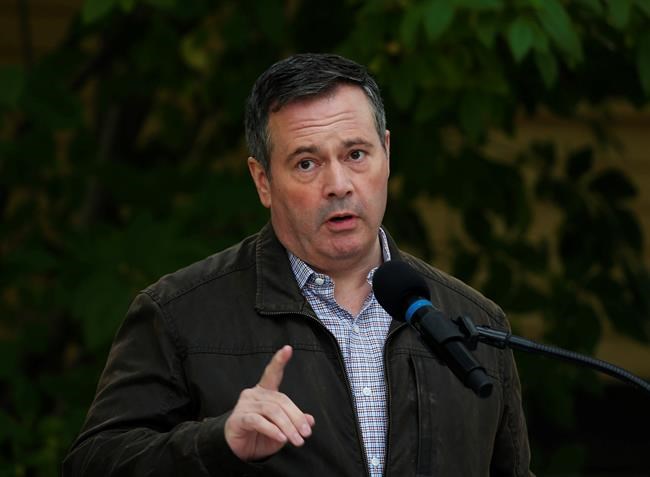
Alberta Premier Jason Kenney answers questions after announcing $43 million in repairs and improvements to provincial parks at a news conference in Calgary on Tuesday, Sept. 15, 2020. Members of Kenney’s caucus have refused an Opposition NDP bid to make public details of Alberta’s $7.5-billion investment in the failed Keystone XL pipeline project.THE CANADIAN PRESS/Todd Korol

NDP energy critic Kathleen Ganley, who moved the motion, noted the UCP members voted it down without giving reasons.

“I had hoped that some of them would have shown a deeper sense of duty to Albertans to be open, honest and transparent, but they failed on every front,” Ganley told reporters.

“This is a party that claims to be transparent and responsible stewards of the public purse.”

Alberta has directly invested $1.5 billion with another $6 billion in loan guarantees, but the NDP says Albertans need to know the rationale and advice Kenney used to make what it calls a risky decision. They also want to know what the final bill will be now that the project is shelved.

“There could be more costs, including (site) reclamation and legal fees associated with the deal,” Ganley told the committee, noting the motion comes after the government has declined other requests from the NDP caucus for the information.

Keystone XL, a TC Energy Corp. project, was to take more Alberta oil through the Midwest and on to refineries and ports along the U.S. Gulf Coast to fetch a better price on overseas markets.

When Kenney invested in the project, Keystone XL line was facing multiple court challenges, and the emerging Democrat party candidate, now President Joe Biden, was on record against it.

Biden promised in his election campaign to cancel Keystone and did so last week on his first day in office, saying more product from Alberta’s oilsands does not mesh with his larger goal of combating climate change.

Kenney has called Biden’s decision an insult to Canada, given its close and mutually beneficial trading relationship. He has called on Prime Minister Justin Trudeau to, as a last resort, impose economic sanctions in response. He is also pressing for direct compensation.

Ganley’s motion was upheld by her two other NDP colleagues, but rejected unanimously by the eight UCP members sitting on the committee.

UCP member Miranda Rosin instead put forward a motion to have Energy Minister Sonya Savage’s department release to the committee details on Alberta’s financial exposure on Keystone XL.

Rosin said that would balance the needs of the public to know the details while respecting the confidentiality of sensitive business information, similar to the secrecy surrounding $3.7 billion in contracts signed by the former NDP government to deliver more oil by rail.

“Albertans do deserve to know where the money is spent (and) how much of it has been spent,” Rosin told the committee.

“It’s important as members of this committee and, just frankly, as ethical legislators to ensure that we have transparency in our governments.”

Rosin’s motion passed 8 to 3, again along party lines.

The NDP dismissed the motion as a public relations stunt, given it does not address the key information they seek and is information the government would have to make public anyway when the 2021-22 budget is unveiled next month.

“What the government caucus is trying to do here is some performance art,” said NDP committee member Marlin Schmidt.

This report by The Canadian Press was first published Jan. 26, 2021.

Report Error Submit a Tip

More Stories

Imperialist crusades: 21st-century style

John R. Wiens 5 minute read Preview

Imperialist crusades: 21st-century style

John R. Wiens 5 minute read Wednesday, Jul. 8, 2026

In the 11th century and lasting into the 13th, the papacy launched a series of at least eight military campaigns we now refer to as the Crusades, or Holy Wars. They were an imperialistic call to arms for Christians to retake Jerusalem, which was at the time under Muslim rule.

Spiritual rewards for participation were implied, and other incentives offered, to dull the extra taxation demanded to fund the campaigns. Over time, the “crusades” morphed to become massacres of not only Muslims but also Jews and Christian dissidents — in other words, any enemies of the papacy. If today’s news sounds like déjà vu all over again, it probably should.

The stories keep repeating themselves in many forms. We now know that two 20th century world wars, global in scope, were caused by imperialistic ambitions, changes in the balance of international powers and corresponding arms races. The first was attributed to the assassination of the heir to the Austro-Hungarian throne by a Bosnian Serb, a kind of “regime change” initiative. The second resulted from rising tensions between Allied and Axis powers, triggered by the rise of European fascism and Japanese militarism. The human toll of both was unimaginable.

In the First World War, 15 to 22 million people, including soldiers and civilians, were killed and another 23 million were wounded. These numbers do not account for those otherwise affected — victims of chemical warfare whose compromised health shortened their lives; of the subsequent Spanish flu epidemic amplified by the displacement of peoples; others who died from other diseases caused by war conditions; and those who were malnourished or starved. Nor do they account for the ongoing trauma and resentments passed on intergenerationally to this day.

Read
Wednesday, Jul. 8, 2026

SNC planned U.S. move if no deal: documents

Jordan Press and Christopher Reynolds, The Canadian Press 5 minute read Preview

SNC planned U.S. move if no deal: documents

Jordan Press and Christopher Reynolds, The Canadian Press 5 minute read Thursday, Mar. 28, 2019

OTTAWA - SNC-Lavalin warned federal prosecutors last fall about a possible plan to split the company in two, move its offices to the United States and eliminate its Canadian workforce if it didn't get a deal to avoid criminal prosecution, newly obtained documents show.

The documents, part of a PowerPoint presentation obtained by The Canadian Press, describe something called "Plan B" — what Montreal-based SNC might have to do if it can't convince the government to grant a so-called remediation agreement to avoid criminal proceedings in a fraud and corruption case related to projects in Libya.

Under that plan, SNC would move its Montreal headquarters and corporate offices in Ontario and Quebec to the U.S. within a year, cutting its workforce to just 3,500 from 8,717, before eventually winding up its Canadian operations.

“The government of Canada needs to weigh the public interest impact of the prosecution of SNC-Lavalin," the presentation reads.

Read
Thursday, Mar. 28, 2019

Court ruling concludes Canadian Wheat Board saga

Laura Rance-Unger 4 minute read Preview

Court ruling concludes Canadian Wheat Board saga

Laura Rance-Unger 4 minute read Yesterday at 2:01 AM CDT

It remains to be seen whether the recent court ruling in a lawsuit filed after Canadian Wheat Board’s dissolution in 2012 puts the whole debate to rest, as some no doubt hope.

But either way, the dust has settled on the post-CWB world. The sun still rises and a new generation of farmers on the land only knows by name an institution that for generations influenced every aspect of Prairie grain farming.

The first Rural Revival column I wrote for this newspaper more than 30 years ago was about a thousand farmers from Western Canada demonstrating in support of the Wheat Board. It was in the aftermath of the Western Grain Marketing Panel report, one of several efforts that eventually included a plebiscite to help the federal government decide what to do about a vocal minority of farmers who wanted marketing “freedom.”

The polls at the time suggested about two-thirds of farmers were comfortable enough with the single-desk system for food wheat and barley to keep it around. It served as a counterbalance to canola, which they sold on the open market. They essentially had a dual market.

Read
Yesterday at 2:01 AM CDT

Killer pleads guilty in three-year-old daughter’s fatal stabbing

Dean Pritchard 4 minute read Preview

Killer pleads guilty in three-year-old daughter’s fatal stabbing

Dean Pritchard 4 minute read Thursday, May. 26, 2022

A Winnipeg man has pleaded guilty to second-degree murder in the shocking stabbing death of his three-year-old daughter.

Frank Nausigimana, 29, entered his plea before Queen’s Bench Justice Joan McKelvey during a brief hearing Thursday morning.

Asked if he understood he was waiving his right to a trial, Nausigimana, through an American Sign Language interpreter, told McKelvey: “ Yes, I accept the punishment and I am following the law of God.”

“I’ve decided that I am going to pray,” Nausigimana said. “I admit I am guilty.”

Read
Thursday, May. 26, 2022

Say What?! Sports guys travel to new destination

Steve Lyons and Paul Wiecek 16 minute read Preview

Say What?! Sports guys travel to new destination

Steve Lyons and Paul Wiecek 16 minute read Thursday, Jan. 30, 2020

Say What?! is an email conversation between sports editor Steve Lyons and sports columnist Paul Wiecek. Look for us regularly but intermittently on the Free Press website.


Steve Lyons: Heya. How you doing? How’s 2020 treating you so far?

Few things to get us started:

Read
Thursday, Jan. 30, 2020

Letters, Oct. 31

6 minute read Yesterday at 2:01 AM CDT

Civic election a missed opportunity

The outcome of the latest municipal election in Winnipeg is nothing short of baffling. The decline of what was once a proud, beautiful prairie hub is impossible to ignore.

Winnipeg is rapidly sliding into a state of structural and social dilapidation, yet voters have inexplicably chosen to hand incumbent Mayor Scott Gillingham a second term. The decision smells of complacency, and sadly, it represents a massive missed opportunity for real urban renewal.

Walking through downtown Winnipeg today is an exercise in heartbreak. A city centre that should be a bustling economic and cultural core has instead transformed into an absolute eyesore. Encampments and tents are permitted to dot the heart of the city. Streets that used to thrive are now dominated by the tragic, visible reality of severe addiction, with individuals wandering and staggering through public spaces without adequate intervention or care.