Alberta legislature resumes: Focus on jobs and bill to punish protesters

Advertisement

Advertise with us

EDMONTON - A new session of the Alberta legislature began Tuesday with the government promising to invest directly in oil and gas, if necessary, and to pass a law that would punish people who block roads and rail lines.

Read this article for free:


By clicking the button above, an account will be created and you will begin to receive some of our recommended newsletters. You may opt out of any newsletter by visiting your Email and Communication Preferences page or by clicking "unsubscribe" at the bottom of any email.

or

Already have an account? Log in here »

To continue reading, please subscribe:

Digital Subscription

One year of digital access for only $1.44 a week*

  • Enjoy unlimited reading on winnipegfreepress.com
  • Read the E-Edition, our digital replica newspaper
  • Access News Break, our award-winning app
  • Play interactive puzzles

*Billed as $5.77 plus GST every four weeks. After 52 weeks, price increases to the regular rate of $19.95 plus GST every four weeks. Offer available to new and qualified returning subscribers only. Cancel any time.

To continue reading, please subscribe:

Add Free Press access to your Brandon Sun subscription for only an additional

$1 for the first 4 weeks*

  • Enjoy unlimited reading on winnipegfreepress.com
  • Read the E-Edition, our digital replica newspaper
  • Access News Break, our award-winning app
  • Play interactive puzzles
Start now

*Your next Brandon Sun subscription payment will increase by $1.00 and you will be charged $17.95 plus GST for four weeks. After four weeks, your payment will increase to $24.95 plus GST every four weeks.

Hey there, time traveller!
This article was published 25/02/2020 (2437 days ago), so information in it may no longer be current.

EDMONTON – A new session of the Alberta legislature began Tuesday with the government promising to invest directly in oil and gas, if necessary, and to pass a law that would punish people who block roads and rail lines.

The throne speech read by Lt.-Gov. Lois Mitchell said Premier Jason Kenney’s government is prepared to support companies and invest directly in the resource industry if that’s what it takes to boost Alberta’s wellspring industry.

“My government will do everything it can to reduce unacceptably high levels of unemployment and get people back to work,” said the speech outlining government’s goals and commitments for the session.

Alberta Premier Jason Kenney comments on the Teck mine decision in Edmonton on Monday, February 24, 2020. Alberta politicians are returning to the legislature with a promise of new legislation targeting protesters who set up blockades. THE CANADIAN PRESS/Jason Franson

Kenney’s United Conservative government was elected last spring on a mandate to create jobs and get more oil and gas infrastructure built.

It has been a struggle. The Opposition NDP estimates 50,000 full-time jobs have been lost in recent months. This week, Teck Resources Ltd. announced it would not proceed with a $20-billion oilsands mine in northern Alberta.

Teck pegged its decision in part on economic uncertainty arising from protesters setting set up blockades on rail lines in support of hereditary chiefs of the Wet’suwet’en First Nation, who oppose a natural gas pipeline project on their land in British Columbia.

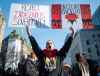
There was one such blockade of a rail line last week near Edmonton’s city limits, but it was up for less than a day before a few counter-protesters arrived and carted off a barrel and signs to free up the tracks.

The government introduced a bill after the throne speech that proposes stiffer penalties for anyone trying to shut down critical economic infrastructure, including railways.

The penalties for individuals would be up to $10,000 for a first offence and up to $25,000 for each subsequent day a blockade or protest remained in place.

The bill also proposes making it easier for police to intervene in blockades rather than wait for a court injunction.

“For the last three weeks we have seen virtual anarchy in many parts of Canada, massively damaging our economy, killing thousands of jobs, jeopardizing the livelihoods of countless Canadians,” Kenney told a news conference earlier Tuesday.

“Blocking railways, roadways, commuter trains and critical infrastructure is simply and plainly illegal.”

The session is also to see amendments that would allow referendums not related to constitutional issues, as well as proposed legislation to replace the federal parole board with a provincial one.

Another bill will be about fixed dates for provincial elections and budgets. And the government also wants to bring in a recall act that would allow constituents to remove from office their legislature members, municipal councillors, mayors, and school board trustees between elections.

Alberta Premier Jason Kenney has a laugh after the Speech from the Throne in Edmonton, Tuesday, Feb. 25, 2020. THE CANADIAN PRESS/Jason Franson

The focus of the session comes Thursday, when Finance Minister Travis Toews is to introduce the 2020-2021 budget.

The province is promising renewed belt-tightening to erase a recent string of budget deficits and get back to balance before the end of Kenney’s first term.

While the government says it is continuing to fund health and education as before, the Opposition NDP says program changes coupled with growth and inflation are effectively creating multimillion-dollar cuts to frontline services.

The NDP gave some of its throne speech tickets to Albertans, who it says have been hurt by changes to health and education funding and failed UCP job policies.

NDP Leader Rachel Notley said the changes are having a major impact on people’s lives and she wanted to give Kenney a chance to look those people in the eye.

“This session should be about undoing the damage that has been done,” said Notley.

This report by The Canadian Press was first published Feb. 25, 2020

Report Error Submit a Tip

More Stories

Seniors should never be homeless

Jon Gerrard 4 minute read Yesterday at 2:00 AM CDT

There is much attention paid to helping those who become homeless, but all too little attention given to preventing homelessness in the first place.

About one quarter of all the people experiencing homelessness are seniors, according to the most recent End Homelessness Winnipeg report. This represents a fundamental failure of our province to prevent homelessness.

Ending homelessness where it has become chronic should not be considered the end point in addressing homelessness. It is like trying to solve the problem of water on your kitchen floor by mopping it up, without considering the importance of turning off the tap so that water does not continue flowing over the edge of the sink.

Preventing homelessness in seniors is achievable. We have many resources and many organizations which support seniors, but they are fragmented, poorly co-ordinated, inadequately, funded in some cases, and have not sufficiently focused their efforts on preventing homelessness in seniors. Too many seniors are falling through the cracks.

Hassan gets 3 distance medals in amazing Olympic odyssey

Gerald Imray, The Associated Press 4 minute read Preview

Hassan gets 3 distance medals in amazing Olympic odyssey

Gerald Imray, The Associated Press 4 minute read Sunday, Aug. 8, 2021

TOKYO (AP) — By the time she reached the 65th and final lap of her eight-day Olympic odyssey, Sifan Hassan's neck had seized up and she couldn't turn her head. She could barely breathe and she couldn't feel her arms anymore.

As she neared the end, she couldn't see properly and thought “why did they move the finish line?”

Her legs knew right where it was.

Deep into her sixth race across three distances that covered more than 24 kilometers on Tokyo's sweltering Olympic track, Hassan burst past world-record holder Letesenbet Gidey to win the 10,000-meter gold on Saturday.

Read
Sunday, Aug. 8, 2021

Submit a news tip

1 minute read Monday, Mar. 16, 2026

Submit a news tip

Remembering Canada’s first national internment

Peter Manastyrsky 4 minute read Preview

Remembering Canada’s first national internment

Peter Manastyrsky 4 minute read 2:00 AM CDT

Canada’s first national internment operation, from 1914 to 1920, is a part of Canadian history that is at times forgotten. Oct. 28 marks the anniversary of the Canadian government passing an order-in-council (essentially an executive decree) in 1914, under the War Measures Act. The order legally authorized the arrest and internment of Canadian civilians as enemy aliens during the First World War, and thousands of Canadians were sent to internment camps across the country.

The war of 1914-18 created difficulty for new Canadians hoping to become naturalized citizens. Many new immigrants to Canada came from regions of Europe that was under the rule of the Austro-Hungarian Empire at the start of the First World War.

The Canadian government, under Prime Minister Sir Robert Borden introduced internment camps throughout Canada, fearing that many eastern European immigrants would have some form of affiliation with the Austro-Hungarian Empire.

Even though there was never any evidence of disloyalty, people were imprisoned needlessly and forced to do heavy labour in 24 internment camps throughout Canada’s frontier hinterland. There were two identified internment camps in Manitoba, one in Brandon and the other in Winnipeg.

Read
2:00 AM CDT

Letters, Oct. 27

7 minute read Yesterday at 2:01 AM CDT

Time for ranked ballots?

Re: Get out and exercise your franchise (Editorial, Oct. 24)

Declining turnout is indeed a threat to our democracy and, while I am grateful that the editorial mentioned proportional representation, the issue on the municipal level can be solved far more simply — using ranked-choice voting.

In the last Winnipeg municipal election, the mayor “won” the election with only 27 per cent of the vote. Multiply that by the turnout of 37.5 per cent and the mayor’s positive mandate — the portion of the electorate that voted for him as mayor — drops to a paltry 10 per cent. That number should shock us into an awareness that the single-mark ballot has failed us miserably.

Election results: School trustees 2026

Staff 1 minute read Preview

Election results: School trustees 2026

Staff 1 minute read Friday, Oct. 23, 2026

Below you’ll find live 2026 election results for school trustees in Winnipeg divisions.

We can display results only for wards in which Winnipeg voters cast a ballot; we do not have access to live results reporting for school boards outside of Winnipeg.


Read
Friday, Oct. 23, 2026