A timeline on rail disruptions by anti-pipeline protesters across Canada

Advertisement

Advertise with us

RCMP began enforcing an injunction earlier this month that prevents interference with construction of a $6.6-billion natural gas pipeline in northern British Columbia.

Read this article for free:


or

Already have an account? Log in here »

To continue reading, please subscribe:

Subscribe and receive a limited-edition Free Press branded hat or tote.

Digital Subscription

One year of digital access for only $205*

  • Enjoy unlimited reading on winnipegfreepress.com
  • Read the E-Edition, our digital replica newspaper
  • Access News Break, our award-winning app
  • Play interactive puzzles

*First annual payment billed as $205.00 + GST for one year. This annual subscription will automatically renew at $233.00 + GST every 52 weeks (10% off the regular annual price of $259.35). Offer available to new and qualified returning subscribers only. Cancel any time.

To continue reading, please subscribe:

Add Free Press access to your Brandon Sun subscription for only an additional

$1 for the first 4 weeks*

  • Enjoy unlimited reading on winnipegfreepress.com
  • Read the E-Edition, our digital replica newspaper
  • Access News Break, our award-winning app
  • Play interactive puzzles
Start now

*Your next Brandon Sun subscription payment will increase by $1.00 and you will be charged $17.95 plus GST for four weeks. After four weeks, your payment will increase to $24.95 plus GST every four weeks.

Hey there, time traveller!
This article was published 20/02/2020 (2416 days ago), so information in it may no longer be current.

RCMP began enforcing an injunction earlier this month that prevents interference with construction of a $6.6-billion natural gas pipeline in northern British Columbia.

Here is a timeline of the dispute, along with rail disruptions by people showing solidarity with the hereditary Wet’suwet’en chiefs opposing the Coastal GasLink project:

Dec. 31, 2019 — The B.C. Supreme Court grants Coastal GasLink an injunction calling for the removal of any obstructions including cabins and gates on any roads, bridges or work sites the company has been authorized to use.
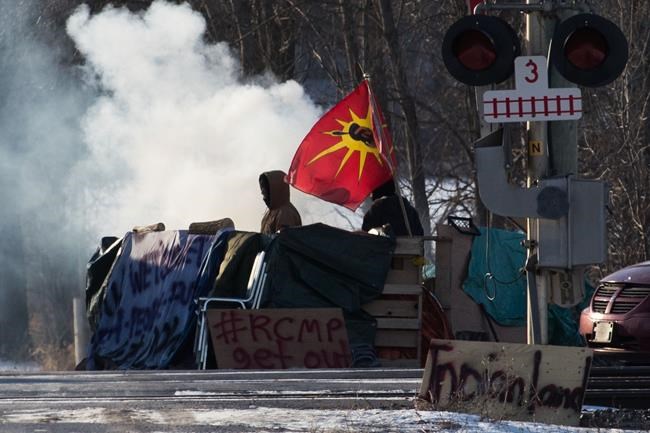
A protesters stand beside smoke at the closed train tracks in Tyendinaga Mohawk Territory near Belleville, Ont., on Thursday Feb. 20, 2020, as they protest in solidarity with the Wet'suwet'en hereditary chiefs opposed to the LNG pipeline in northern British Columbia. THE CANADIAN PRESS/Lars Hagberg

Jan. 1, 2020 — The Wet’suwet’en First Nation serves Coastal GasLink with an eviction notice, telling the company workers are “currently trespassing” on their unceded territory.

Jan. 27 — The British Columbia government appoints former New Democrat MP Nathan Cullen as a provincial liaison with Wet’suwet’en hereditary chiefs in the LNG pipeline dispute.

Jan. 30 — The hereditary chiefs of the Wet’suwet’en agree to seven days of meetings with the province.

Feb. 5 — The talks that were intended to de-escalate the dispute fail after just two days.

Feb. 6 — The RCMP move in to Wet’suwet’en territory to enforce the court injunction that would have allowed construction work to resume. A handful of pipeline opponents are arrested. Hours later, outside of Belleville, Ont., east of Toronto, protesters start holding up railway traffic in solidarity with the Wet’suwet’en hereditary chiefs.

Feb. 7 — Via Rail halts service along one of its busiest routes because of the Belleville-area blockade. All travel between Toronto, Ottawa and Montreal is cancelled. Canadian National Railway obtains a court injunction to end a demonstration by members of the Tyendinaga Mohawk Territory near Belleville. Protesters also begin disruptions at ports in Vancouver and Delta, B.C.

Feb. 8 — Protesters in Toronto disrupt Canadian Pacific Railway traffic moving through the downtown area.

Feb. 9 — Kahnawake Mohawk community members south of Montreal erect a blockade on a CP rail line.

Feb. 10 — Demonstrators in the Montreal area disrupt commuter train service on the Exo Candiac line. A shuttle bus service is in effect for affected rail stations.

Feb. 11 — CN stops transport between Prince George, B.C., and Prince Rupert, B.C., because of a blockade near Hazelton, B.C. The company says it has halted more than 150 freight trains since blockades started on Feb. 6.

Feb. 12 — The Manitoba government says it may seek a court injunction to end a blockade on a rail line west of Winnipeg, but CN obtains its own court order. Two hereditary Wet’suwet’en chiefs start a constitutional challenge of fossil fuel projects, as Prime Minister Justin Trudeau calls for demonstrators across the country to observe the rule of law.

Feb. 13 — CN shuts down its operations in Eastern Canada. The railway says blockades have ended in Manitoba and may come down soon in British Columbia, but the orders of a court in Ontario have yet to be enforced and continue to be ignored.

Feb. 14 — A rail blockade that halted train traffic to and from the Port of Prince Rupert is lifted as First Nations leaders agree to meet with federal and provincial politicians.

Feb. 15 — Federal Indigenous Services Minister Marc Miller travels to meet with protesters in Tyendinaga Mohawk Territory near the site of the Belleville blockade. He says “modest progress” was made during nine hours of talks, but declines to share details on what was discussed.

Feb. 16 — Trudeau cancels his planned trip to Barbados, less than 24 hours before his scheduled departure, so he can handle the protests in Canada. Meanwhile, protesters briefly shut down a busy Ontario border crossing.

Feb. 17 — Trudeau convenes the Incident Response Group, an emergency committee that meets in the event of a national crisis.

Feb. 18 — An emergency debate is held in the House of Commons, where the Opposition Conservatives advocate for forceful action and the governing Liberals push for ongoing dialog with backing from other political parties. Meanwhile, CN issues temporary layoff notices for 450 employees, citing the ongoing protests as the reason for the move.

Feb. 19 — Protesters erect a blockade along a stretch of CN rail line in Edmonton, but are soon faced with counter-protesters who begin forcibly dismantling the barricade. The blockade is taken down later in the day. Via Rail announces nearly 1,000 temporary layoffs in light of ongoing service suspensions across much of Canada. The rail provider also cancels plans to resume a route between Ottawa and Quebec City as a new blockade is erected near Montreal.

Feb. 20 — Federal Public Safety Minister Bill Blair says the RCMP has offered to move its officers from Wet’suwet’en territory to a nearby town. He says this concession meets a key condition from the hereditary chiefs and calls for all rail blockades to be dismantled. Wet’suwet’en hereditary chiefs travel to Quebec and Ontario to thank supporters who have maintained the blockades.

This report by The Canadian Press was first published Feb. 17, 2020.

Report Error Submit a Tip

More Stories

Virus variant from South Africa detected in US for 1st time

Michelle Liu And Mike Stobbe, The Associated Press 3 minute read Thursday, Jan. 28, 2021

COLUMBIA, S.C. - A new coronavirus variant identified in South Africa has been found in the United States for the first time, with two cases diagnosed in South Carolina, state health officials said Thursday.

The arrival of this variant now surging in other countries "is an important reminder to all South Carolinians that the fight against this deadly virus is far from over,” Dr. Brannon Traxler, DHEC Interim Public Health Director, said in a statement. “While more COVID-19 vaccines are on the way, supplies are still limited. Every one of us must recommit to the fight by recognizing that we are all on the front lines now. We are all in this together.”

Viruses are constantly mutating, with coronavirus variants circulating around the globe, but scientists are primarily concerned with the emergence of three of them. Other variants first reported in the United Kingdom and Brazil were previously confirmed in the U.S. Researchers believe these three variants may spread more easily, and predicted it was only a matter of time before they appeared here.

Also, scientists last week reported preliminary but troubling signs that some of the recent mutations may modestly curb the effectiveness of two current vaccines, although they stressed that the shots still protect against the disease. And there are signs that some of the new mutations may undermine tests for the virus and reduce the effectiveness of certain treatments.

Winnipeg, source d’inspiration pour la philanthropie canadienne

Camille Harper 7 minute read Preview

Winnipeg, source d’inspiration pour la philanthropie canadienne

Camille Harper 7 minute read Saturday, Sep. 19, 2026

Dirigé par le Franco-Manitobain d’origine Jean-Marc Mangin, l’organisme Fondations philanthropiques du Canada (FPC) sera à Winnipeg du 23 au 25 septembre prochains pour sa conférence nationale, organisée tous les deux ans. Une première pour FPC, et un retour au bercail attendu pour son président-directeur général.

Pour la première fois depuis 26 ans que l’organisme existe, FPC a choisi le Manitoba pour sa grande conférence nationale de 2026. “On a été dans plusieurs gros centres urbains du Canada, notamment Ottawa, Montréal, Toronto, Vancouver ou encore Calgary, mais ce sera notre première fois à Winnipeg,” se réjouit le PDG de FPC, Jean-Marc Mangin, lui-même originaire de Saint-Boniface.

Ce n’est toutefois pas la nostalgie de l’enfance qui a fait pencher la balance en faveur du Manitoba, mais plutôt un vent de changement observé par bon nombre dans la capitale manitobaine.

“Nous ne sommes pas les seuls dans le secteur caritatif à choisir Winnipeg,” constate Jean-Marc Mangin. “Plusieurs organismes y tiennent leurs conférences nationales cette année ou la suivante. Et ça, ça dit quelque chose sur ce qui se passe au Manitoba : c’est très actif, il y a beaucoup d’innovation sociale qui prend place.”

Read
Saturday, Sep. 19, 2026

You’re a solid, loyal sister, so worry not

Maureen Scurfield 5 minute read 2:00 AM CDT

DEAR MISS LONELYHEARTS: I ran into my sister’s husband at the bar recently. He was drinking with a bunch of people from his work. I noticed he was sitting close to a young woman, with his arm around her.

I just nodded without a smile as I slowly passed them. I kept on going, but he knew I saw them together. A few minutes later he came over — obviously drunk — and said, “You’re a good girl! You won’t say anything to your sister, will you?” Ha! I looked at him and said, “Of course I’m going to say something!”

My loyalty will always be to my sister. I phoned my sis in my car and blabbed. She tried to laugh it off, but she’s gone silent since — not answering my calls or messages. So apparently now I’m the troublemaker? That’d be just her style! What should I do?

— Worried About Us, North Kildonan

Churchill draws scientists from around the world researching impacts of climate change

Sarah Lawrynuik 13 minute read Preview

Churchill draws scientists from around the world researching impacts of climate change

Sarah Lawrynuik 13 minute read Friday, Oct. 23, 2020

CHURCHILL — There is something special about this town.

People who have been here know, though it is challenging to describe. Those who haven’t are told tales of a nearly mystical small community, the unique geography and the magnificent wildlife.

Exactly what makes it such a special place is hard to define, but whatever that intrinsic character is, it acts as a magnetic force for humans and animals alike.

Every summer — as if on cue — the sleek white backs of more than 50,000 beluga whales begin peeking out of the waters of southwestern Hudson Bay as they return to the estuaries of northern Manitoba. Their fidelity to this summer habitat is centuries old, passed on from one generation to the next. This loyalty to the region ensures for as long as this site is safe, these alien-like, curious whales will continue to return.

Read
Friday, Oct. 23, 2020

Twenty-seven new COVID cases in New Brunswick

The Canadian Press 2 minute read Preview

Twenty-seven new COVID cases in New Brunswick

The Canadian Press 2 minute read Thursday, Jan. 28, 2021

FREDERICTON - New Brunswick is reporting 27 new cases of COVID-19 today, including 14 in the hard-hit Edmundston region, which has been under lockdown since Sunday.

Health officials say 11 new cases were identified in the Moncton area and two in the Saint John region.

Moncton remains at the red pandemic-alert level while the rest province — outside Edmundston — is at the lower, orange level.

Indoor and outdoor gatherings are prohibited in Edmundston as is non-essential travel in and out of the region.

Read
Thursday, Jan. 28, 2021

Wellbrock romps to win in men's swimming marathon

Paul Newberry, The Associated Press 5 minute read Wednesday, Aug. 4, 2021

They Jays have been getting big-time performance from the man with the big-time contract, now that he’s healthy.