Anti-pipeline protesters blocking access to Vancouver ports served with injunction

Advertisement

Advertise with us

Anti-pipeline protesters were served Sunday with a court injunction ordering them to stop blocking access to four ports in the Vancouver area, marking the latest development in what has become a national movement to halt construction on the natural gas project.

Read this article for free:


By clicking the button above, an account will be created and you will begin to receive some of our recommended newsletters. You may opt out of any newsletter by visiting your Email and Communication Preferences page or by clicking "unsubscribe" at the bottom of any email.

or

Already have an account? Log in here »

To continue reading, please subscribe:

Digital Subscription

One year of digital access for only $1.44 a week*

  • Enjoy unlimited reading on winnipegfreepress.com
  • Read the E-Edition, our digital replica newspaper
  • Access News Break, our award-winning app
  • Play interactive puzzles

*Billed as $5.77 plus GST every four weeks. After 52 weeks, price increases to the regular rate of $19.95 plus GST every four weeks. Offer available to new and qualified returning subscribers only. Cancel any time.

To continue reading, please subscribe:

Add Free Press access to your Brandon Sun subscription for only an additional

$1 for the first 4 weeks*

  • Enjoy unlimited reading on winnipegfreepress.com
  • Read the E-Edition, our digital replica newspaper
  • Access News Break, our award-winning app
  • Play interactive puzzles
Start now

*Your next Brandon Sun subscription payment will increase by $1.00 and you will be charged $17.95 plus GST for four weeks. After four weeks, your payment will increase to $24.95 plus GST every four weeks.

Hey there, time traveller!
This article was published 09/02/2020 (2454 days ago), so information in it may no longer be current.

Anti-pipeline protesters were served Sunday with a court injunction ordering them to stop blocking access to four ports in the Vancouver area, marking the latest development in what has become a national movement to halt construction on the natural gas project.

The injunction, sought by the Vancouver Fraser Port Authority and signed by Justice Michael Tammen, orders protesters to leave the authority’s lands and stop blockading access points to ports in Vancouver and Delta, B.C.

“The police are ordered to arrest and remove any person who has knowledge of this order and who the police have reasonable and probable grounds to believe is contravening or has contravened any provision of this order,” the court document reads.

Protesters block the road access to one of Vancouver's port entrances in Vancouver Sunday, February 9, 2020. The protesters who are standing in solidarity with the Wet'suwet'en members opposed to the LNG pipeline in northern British Columbia are on day 4 of blocking the main ports in Vancouver. THE CANADIAN PRESS/Jonathan Hayward

A spokeswoman for the authority said there was no option but to force the protesters out so port operations can resume, but the protesters say they intend to stay.

They’re acting in solidarity with Wet’suwet’en hereditary chiefs, who are trying to halt construction of a massive pipeline project that crosses their traditional territory in northwestern British Columbia.

The hereditary chiefs oppose the pipeline crossing their territory and efforts by the B.C. government to negotiate an agreement to end the protests have failed.

Their fight has sparked a protest movement that spans from the steps of the B.C. legislature in Victoria to the ports in Vancouver to rail lines in Ontario and Quebec.

Meantime, several people arrested at various remote locations in northwest British Columbia near construction zones for the 670-kilometre Coastal GasLink natural gas pipeline were due in court Monday.

They are charged with breach of trust, a Wet’suwet’en spokeswoman said.

“All of the 14 people have refused to sign their undertakings because they are following Wet’suwet’en law,” Jen Wickham said in a telephone interview from Houston, B.C. “They’ve all been charged with breach of the injunction.”

The RCMP said Saturday that officers enforcing a court injunction arrested 11 people who allegedly barricaded themselves in a warming centre in a forested area near a pipeline work site. The other arrests occurred Friday at another Indigenous camp near the pipeline route.

Premier John Horgan said the pipeline, which is part of the massive $40 billion LNG Canada liquefied natural gas export terminal project, is of vital economic and social importance to the province’s north and already has the approval of 20 elected First Nations councils along the route from Dawson Creek to Kitimat.

He said the courts have decided the pipeline can proceed and the rule of law must prevail.

Supporters blocked access to Victoria’s downtown Johnson Street bridge Saturday and dozens of Indigenous youth have set up a camp on the front steps of the B.C. legislature.

Rail traffic near Toronto has also been disrupted by Wet’suwet’en supporters.

Before the court injunction was served, Vancouver Wet’suwet’en protest organizer Natalie Knight said dozens of people were picketing in solidarity with the Wet’suwet’en chiefs and to send a message to the government and business community.

“We recognize the importance of disrupting capital, disrupting money and goods that come out of the city of Vancouver, that are coming from up north or going up north or that are being sent around the world,” said Knight. “This sends a very clear message to business and the government that we are not going to allow business to continue as usual.”

At the B.C. legislature, Wet’suwet’en supporter Kolin Sutherland-Wilson said people intend to camp on the steps while the RCMP remains in Wet’suwet’en territory.

“We’re here as long as the (RCMP) raid is happening,” he said.

The supporters at the legislature have lit a ceremonial fire in a steel pit on the front steps and are sleeping at the entrance reserved for dignitaries, including the lieutenant governor. B.C.’s legislature is set to resume sitting Tuesday.

Sutherland-Wilson said the fire is for sacred purposes and is being monitored for safety.

“If all this granite catches on fire, I’ll be awfully surprised,” he said.

This report by The Canadian Press was first published Feb. 9, 2020.

Report Error Submit a Tip

More Stories

Carrying a torch for tiki

Eva Wasney 5 minute read Preview

Carrying a torch for tiki

Eva Wasney 5 minute read Monday, Nov. 15, 2021

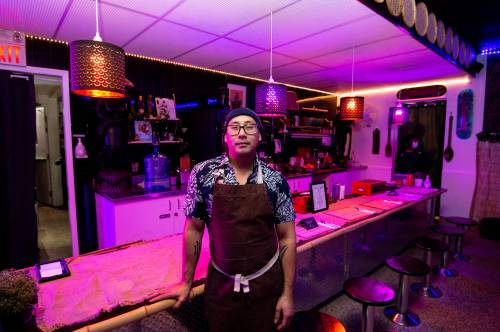
A paper tiki mask is the only indication that the door it’s affixed to leads somewhere other than a dive bar. Ring the doorbell and walk through the kitchen, however, and you’ll be transported to an island-themed lounge that’s equal parts kitschy and comfortable.

“This is just from people’s houses, like my mom’s,” says Allan Pineda, pointing to the wood carvings, water-buffalo horns and rattan furniture decorating the room. “A lot of the stuff you see in here, you’d see in a Filipino’s house back in the day — like second-wave immigrants in the ‘60s and ‘70s, they’d bring this stuff home (from the Philippines).”

Pineda is a local chef and part of the team behind the Bahay Kubo Tiki Bar, a pop-up Filipino drinking and dining experience hosted weekly at an undisclosed Winnipeg establishment.

The details are hush-hush because the temporary eatery is meant to operate like a speakeasy. The dinners are an offshoot of Baon Manila Nights, which Pineda started as a way to highlight Winnipeg’s Filipino culinary scene.

Read
Monday, Nov. 15, 2021

No Christmas trees, no Christmas trees — the lots are empty as can be

Doug Speirs  3 minute read Preview

No Christmas trees, no Christmas trees — the lots are empty as can be

Doug Speirs  3 minute read Monday, Dec. 7, 2020

It might take a Christmas miracle to get your hands on even a scraggly Charlie Brown-style tree this holiday season.

Winnipeg garden centre owners interviewed Monday morning said they are totally sold out and they’ve never seen stock vanish this quickly in all their years in the business.

They likened it to the holiday version of panicked shoppers binge-buying toilet paper when the COVID-19 pandemic first arrived in the province back in March.

“I’m sold out,” declared Ray DuBois, owner of Ron Paul Garden Centre on St. Mary’s Road. “I could see it coming back in August. When we placed our order, I bumped it up by 10 per cent.”

Read
Monday, Dec. 7, 2020

Railways report more accidents with dangerous goods

Dylan Robertson 6 minute read Preview

Railways report more accidents with dangerous goods

Dylan Robertson 6 minute read Monday, Jan. 20, 2020

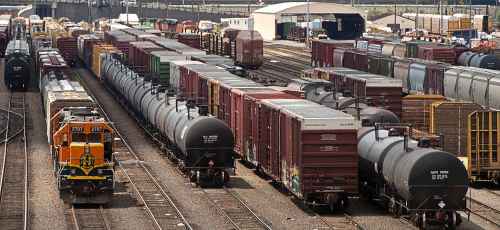
OTTAWA — The number of rail accidents involving dangerous goods more than doubled in Canada in 2018.

There were 25 accidents involving dangerous goods in 2018, involving one death, according to Transport Canada data published Monday.

There were 11 accidents recorded a year prior, and five in 2016.

These accidents involve dangerous goods — flammable or corrosive substances — that either exploded or leaked.

Read
Monday, Jan. 20, 2020

Adult education should be the foundation of the North

Jim Silver 5 minute read 2:00 AM CDT

Major economic developments are, we are being told, coming to northern Manitoba, focusing on the port of Churchill and the railway system that leads to it, and the production and export via that port of various commodities. Many challenges, particularly environmental, lie along that path, and they deserve particularly serious consideration if any development is to proceed.

One aspect of northern development about which almost nothing has been said is: “Who will do the work in the north?”

For decades past and still today, great reliance has been placed on bringing skilled tradespeople and other skilled workers to northern Manitoba from the south. The result has been that not only has the bulk of corporate profits been drained south, but so too have wages. As a result, rates of poverty are higher and formal educational levels are lower in the north than elsewhere in Manitoba. This is obviously detrimental to the north and particularly to those who live in the north.

If northerners themselves are to benefit from economic development in the north by forming the skilled labour force that will be needed, then we will need more of those northerners to be educationally prepared to undertake training for skilled employment.

Wolseley perfumer given reprieve in dispute with city

Gabrielle Piché 3 minute read Preview

Wolseley perfumer given reprieve in dispute with city

Gabrielle Piché 3 minute read Yesterday at 7:02 PM CDT

A perfumer who sells fragrances from a store on the first floor of his home in Wolseley won’t have to close in mid-November after all.

Michael O’Malley says La Parfumerie can stay open while the municipal government processes a conditional use order, which he planned to submit Wednesday.

“If we have to go through city council again… I’ll need a lot of people from my community to show up,” O’Malley said. “I hate to have to keep doing this… I’m just incredibly grateful to the people of Winnipeg.”

He had feared he’d have to shutter the business, which he has operated in his 145 Evanson St. home for 27 years.

Read
Yesterday at 7:02 PM CDT

World Indigenous Business Forum comes home to Winnipeg for first time, ponders questions for future prosperity

Aaron Epp 5 minute read Preview

World Indigenous Business Forum comes home to Winnipeg for first time, ponders questions for future prosperity

Aaron Epp 5 minute read Tuesday, Oct. 27, 2026

When Nicola Shirley-Phillips imagines what the Indigenous economy in her country might look like 100 years from now, she doesn’t mention social media or artificial intelligence. Instead, she envisions a holistic way of life where people work alongside each other in a way that cares for the planet.

“I see community (and) I see us being more respectful of all the energies around us — our water energy, our climate (and) the soil,” she said. “In all of that, there are opportunities for us to create businesses and opportunities to provide our services.”

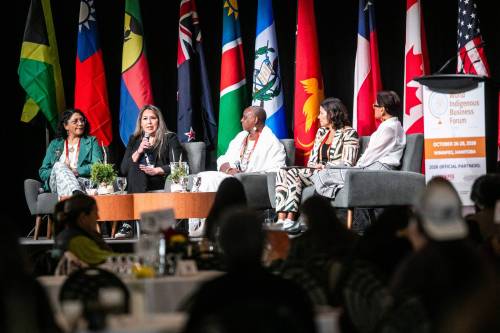
Shirley-Phillips, a serial entrepreneur, organic farmer and community economic development specialist from Jamaica, shared her vision Tuesday morning during a panel discussion focused on Indigenous women and prosperity.

The discussion was one of the first items on the schedule during the first full day of the World Indigenous Business Forum at the RBC Convention Centre in Winnipeg.

Read
Tuesday, Oct. 27, 2026