Climate strikers naive but have right to protest, say energy sector leaders
Advertisement
Read this article for free:
or
Already have an account? Log in here »
To continue reading, please subscribe:
Digital Subscription
One year of digital access for only $1.44 a week*
- Enjoy unlimited reading on winnipegfreepress.com
- Read the E-Edition, our digital replica newspaper
- Access News Break, our award-winning app
- Play interactive puzzles
*Billed as $5.77 plus GST every four weeks. After 52 weeks, price increases to the regular rate of $19.95 plus GST every four weeks. Offer available to new and qualified returning subscribers only. Cancel any time.
To continue reading, please subscribe:
Add Free Press access to your Brandon Sun subscription for only an additional
$1 for the first 4 weeks*
- Enjoy unlimited reading on winnipegfreepress.com
- Read the E-Edition, our digital replica newspaper
- Access News Break, our award-winning app
- Play interactive puzzles
*Your next Brandon Sun subscription payment will increase by $1.00 and you will be charged $17.95 plus GST for four weeks. After four weeks, your payment will increase to $24.95 plus GST every four weeks.
Read unlimited articles for free today:
or
Already have an account? Log in here »
Hey there, time traveller!
This article was published 27/09/2019 (2575 days ago), so information in it may no longer be current.
BANFF, Alta. – Oil and gas industry insiders say demands by organizers of Friday’s Global Climate Strike to transition swiftly away from fossil fuels to 100 per cent renewable energy are naive and unrealistic.
But the leaders reached on the sidelines of the Global Business Forum in Banff on Friday say they support the right of participants to draw attention to the issue and applaud their emotional commitment.
“The strikes in some ways raise the emotional urgency of the whole process,” said Hal Kvisle, chairman of ARC Resources Ltd. and former CEO of pipeline builder TransCanada Corp., now called TC Energy Corp.
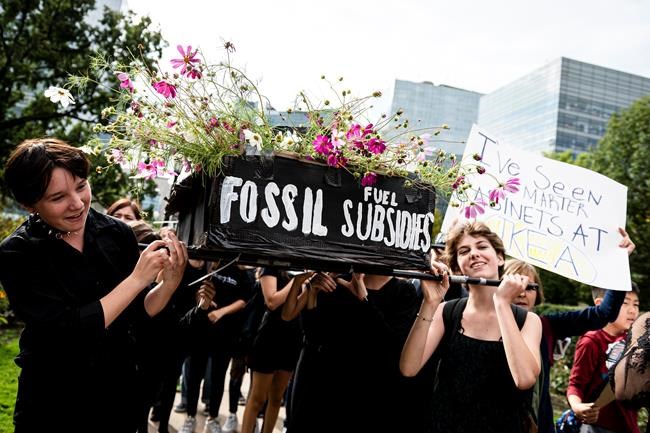
“The strikes themselves are not offering any answers. The strikes are not addressing the question of how we reduce carbon demand.”
He said he doesn’t mind students missing school to take part in the protests but he would not support his employees missing scheduled work for that reason.
Activists who want to stop new pipelines aren’t considering the negative impact on Indigenous communities who are counting on oil and gas development to improve their lives, said Harrie Vredenburg, an executive board member for Project Reconciliation, an Indigenous consortium considering making a bid to buy the Trans Mountain pipeline from the federal government.
“Another issue (other than climate change) Canada needs to address is its relationship with its Indigenous people that has gone awry over the last 150 years that needs to be corrected,” said Vredenburg, who is also a professor at the University of Calgary’s Haskayne School of Business, in an interview at the business forum.
“And a way to do that is majority ownership of the Trans Mountain pipeline with the highest possible environmental standards.”
Young people taking part in the climate change strike are being manipulated and misled by radical environmentalists, said Earl Hickok, chairman and founder of Advantage Energy Services Ltd.
“Generally, emotionally, they want to make a change and I think that’s a positive thing,” he said.
“Now, do I believe they are right and we should strike and stop the world and stop our economy and stop our way of life? No, I don’t. But I think their intentions are good.”
Gary Mar, CEO of the Petroleum Services Association of Canada and a former Alberta Progressive Conservative environment minister, said some of his three grown children have taken part in environmental protests before and he supports their right to do so.
He said if one of his children wanted to skip school to attend the strike Friday he would “be OK with that.”

However, he said it’s unrealistic for the climate change strikers to demand the immediate end of oil and gas production.
“We’re not opposed to the environment,” Mar said of the energy industry.
“In fact, I would argue the environmental characteristics of the energy we develop in Canada are part of the brand of Canadian energy, that we are responsible about it, that we do support governments in their efforts to make this a cleaner environment and, someday, we will transition to different forms of energy. But that’s not going to happen in the next five or 10 or 15 years.”
This report by The Canadian Press was first published Sept. 27, 2019.
Companies mentioned in this article: (TSX:TRP, TSX:ARX)
Related Articles
City boosts Global Climate Strike with 10,000 marchers![“Everyone’s here demonstrating and here I am carrying the canoe, and I thought there was a bit of symmetry and symbolism. The portage is often the hardest part [of a canoe trip],” said Garrett Tremblay. (Ruth Bonneville / Winnipeg Free Press)](https://staging.winnipegfreepress.com/wp-content/uploads/sites/2/2022/04/190927+Climate+Strike+Canoe+Leg+3a+.jpg?w=100)
Advertisement Advertise With Us
Advertisement Advertise With Us