Canadian youth gather en masse across Canada to demand drastic climate action
Advertisement
Read this article for free:
or
Already have an account? Log in here »
To continue reading, please subscribe:
Digital Subscription
One year of digital access for only $1.44 a week*
- Enjoy unlimited reading on winnipegfreepress.com
- Read the E-Edition, our digital replica newspaper
- Access News Break, our award-winning app
- Play interactive puzzles
*Billed as $5.77 plus GST every four weeks. After 52 weeks, price increases to the regular rate of $19.95 plus GST every four weeks. Offer available to new and qualified returning subscribers only. Cancel any time.
To continue reading, please subscribe:
Add Free Press access to your Brandon Sun subscription for only an additional
$1 for the first 4 weeks*
- Enjoy unlimited reading on winnipegfreepress.com
- Read the E-Edition, our digital replica newspaper
- Access News Break, our award-winning app
- Play interactive puzzles
*Your next Brandon Sun subscription payment will increase by $1.00 and you will be charged $17.95 plus GST for four weeks. After four weeks, your payment will increase to $24.95 plus GST every four weeks.
Read unlimited articles for free today:
or
Already have an account? Log in here »
Hey there, time traveller!
This article was published 27/09/2019 (2590 days ago), so information in it may no longer be current.
OTTAWA – Greta Thunberg, the 16-year-old Swedish activist whose global crusade compelled Canadians to flood the streets Friday as part of a global protest, says claims to climate leadership in both Sweden and Canada mean “absolutely nothing.”
“In both cases, it’s just empty words,” she said to a roaring crowd in Montreal Friday afternoon. “The politics needed are still nowhere in sight.”
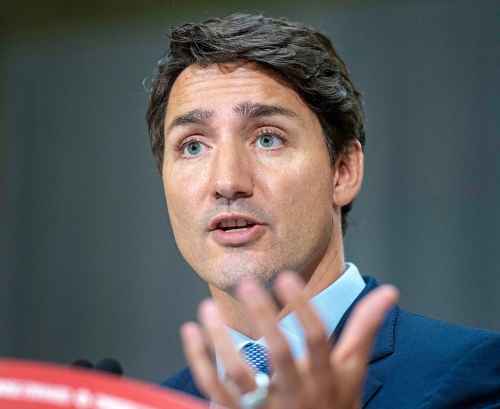
Thunberg did not mention the Canadian election underway, one in which climate change is expected to play a pivotal role at the ballot box, but her criticism of Canada does undermine the climate credibility of Liberal Leader Justin Trudeau. Thunberg met Trudeau privately for about 15 minutes Friday morning, before he also joined the Montreal climate protest. She said later she told him the same thing she tells all world leaders: they are not doing nearly enough and need to listen to the science.

“If they had started to act in time, then this crisis wouldn’t be the crisis it is today,” Thunberg said.
She added that scientists from multiple countries in 2018 said the world had a limit on how much more carbon dioxide and other greenhouse gases can be emitted before irreversible and catastrophic climate change takes hold. She said at the current rate of global emissions, that limit will be hit in less than nine years.
“We are not in school today, you are not at work, because this is an emergency,” Thunberg said. “We will not be bystanders.”
Thunberg began weekly sit-ins outside the Swedish legislature last year, which over the course of a few months grew into a global phenomenon.
From St. John’s to Victoria, and as far north as Inuvik in the Northwest Territories, they came in strollers and on skateboards, on bikes and in army boots, wearing knee braces and leaning on crutches and canes. From babies to baby boomers, grandkids to grandparents, they filled parks and the lawns of legislatures and Parliament, toting papier-mache Earths and trees, some with full potted plants on their backs.
Their message was clear: bolder action is urgently needed to save the planet from the crisis of climate change.
“I want things to change,” said Thani Ratelle, a 16-year-old student in Montreal.
Taicha-Cloe Theodore, also 16, said she was marching for future generations. “If there is global warming, it is certain that our children will live in a rotten world. And that’s not fun.”
In Halifax, several thousand people marched through the streets and ended their protest at the headquarters of Nova Scotia Power. In Toronto, thousands filled the front lawn of the provincial legislature and the streets around it.
In Ottawa, the crowd size exceeded most Canada Day celebrations, filling the streets for more than a dozen city blocks. Some put their placards on hockey sticks and insisted their chants be delivered in both official languages.
Many of those who came out called Thunberg their inspiration.
“I think she has revolutionized how we look at activism,” said Pascal Morimanno, a 17-year-old marching in Fredericton. “She is one person but there are millions of youth out here now because of her. She is the face of new activism.”
Thousands of protesters in Vancouver reached the final destination in their three kilometre march from city hall, plugging West Georgia Street in the city’s downtown.
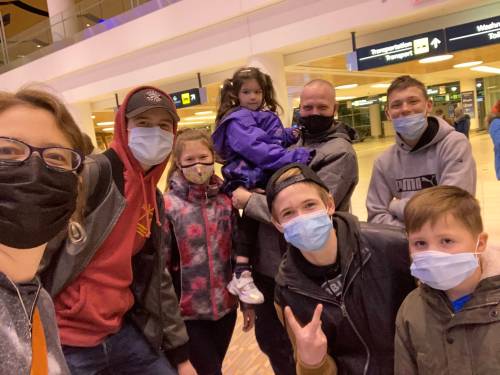
Among them were the five children of the Duprat family of nearby Lions Bay, who brought their parents to the rally.
“It hurts me because I’ve only lived on this Earth for so little time and I don’t want to end it that quick,” said Nalia, 11.
Betty Kidanewold, 14, travelled with friends from the Vancouver suburb of Surrey to join the march, saying they’re tired of seeing world leaders deny climate change on TV or fail to act with urgency.
“If we’re going to take a stand, it’s got to be now,” she said.
Not everyone in Canada backed the events. In the Alberta capital, several thousand people protested on the lawn of the provincial legislature, but were measured in criticizing things like the Trans Mountain oil pipeline.
Paula Camacho, a 25-year-old student at The King’s University in Edmonton, said she didn’t have a particular stance on expanding the pipeline, but added that other energy sources are also needed.
“I know there are so many people who depend (on oil) job-wise,” Camacho said. “But I think it’s good to have these conversations and talk about something that is more sustainable for everybody.”
Inside the legislature, some people put posters in their windows saying they loved Canadian oil and gas.
Thunberg has been ridiculed by some of the world’s most powerful people, including U.S. President Donald Trump. But if adults are mocking children, they must be feeling the heat, Thunberg said during a Friday morning news conference in Montreal.
“I guess they must feel like their worldview or their interests or whatever it is, is threatened by us. We should take as a compliment that we are having so much impact that people want to silence us. We’ve become too loud for people to handle so they try to silence us.”
The grassroots groups behind the Canadian marches have some specific demands, including refusing any new oil and gas projects and cutting emissions to be just one-quarter of what they were in 2005 by 2030.
Trudeau’s decision to allow an expansion of the Trans Mountain pipeline, and then buy it outright to get that project past opposition, is dogging him. Throughout his time in the Montreal march Friday, critics shouted at him that his pipeline plan makes him a hypocrite.
Trudeau marched with some Quebec candidates, his wife, Sophie Gregoire Trudeau, and two of his three children, Xavier, 11, and Ella-Grace, 10. He smiled and waved through most of the event, shouting “Thank you for being here” at those who decried him, while his supporters around him chanted in French, “Moving forward for the planet.”

One protester tried to throw an egg at Trudeau but was promptly wrestled to the ground by his security detail. Xavier appeared visibly upset after that incident and Trudeau stopped to comfort him for a few moments.
Green Leader Elizabeth May and Bloc Quebecois Leader Yves-Francois Blanchet also marched in the Montreal protest, while NDP Leader Jagmeet Singh chose to join an event in Victoria.
Conservative Leader Andrew Scheer flew over many of the protests Friday as he made his way on his campaign plane from Montreal to Vancouver. He mocked Trudeau for joining a protest against his own government’s climate record.
This report by The Canadian Press was first published Sept. 27, 2019.
— with files from Holly McKenzie-Sutter in St. John’s, Michael Tutton in Halifax, Kevin Bissett in Fredericton, Morgan Lowrie and Stephanie Marin in Montreal, Shawn Jeffords in Toronto, Steve Lambert in Winnipeg, Daniela Germano in Edmonton and Amy Smart in Vancouver.
Related Articles
City boosts Global Climate Strike with 10,000 marchers


Advertisement Advertise With Us
Advertisement Advertise With Us