Trudeau to march at Montreal climate rally after days of green promises
Advertisement
Read this article for free:
or
Already have an account? Log in here »
To continue reading, please subscribe:
Digital Subscription
One year of digital access for only $1.44 a week*
- Enjoy unlimited reading on winnipegfreepress.com
- Read the E-Edition, our digital replica newspaper
- Access News Break, our award-winning app
- Play interactive puzzles
*Billed as $5.77 plus GST every four weeks. After 52 weeks, price increases to the regular rate of $19.95 plus GST every four weeks. Offer available to new and qualified returning subscribers only. Cancel any time.
To continue reading, please subscribe:
Add Free Press access to your Brandon Sun subscription for only an additional
$1 for the first 4 weeks*
- Enjoy unlimited reading on winnipegfreepress.com
- Read the E-Edition, our digital replica newspaper
- Access News Break, our award-winning app
- Play interactive puzzles
*Your next Brandon Sun subscription payment will increase by $1.00 and you will be charged $17.95 plus GST for four weeks. After four weeks, your payment will increase to $24.95 plus GST every four weeks.
Read unlimited articles for free today:
or
Already have an account? Log in here »
Hey there, time traveller!
This article was published 26/09/2019 (2591 days ago), so information in it may no longer be current.
SUDBURY, Ont. – Liberal Leader Justin Trudeau will take part in Friday’s massive climate march in Montreal, he announced Thursday as he continued to criss-cross the country making a series of environmental announcements.
Speaking in Sudbury, Ont., Trudeau confirmed his attendance at the Montreal march, which is expected to draw hundreds of thousands of people as well as Greta Thunberg, the 16-year-old Swedish climate activist who has become the symbolic leader of the movement demanding action on climate change.
Thunberg will be given the key to the city from Montreal Mayor Valerie Plante during her visit, but the Liberals have not said whether Trudeau will meet with her.
On Thursday, Trudeau praised the “extraordinary amount of mobilization” by young people across Canada and around the world who have been pressuring for action on climate change, and pitched himself as the best person to lead the charge.
“I look forward to marching with thousands of Canadians tomorrow in Montreal, like people are marching across the country and around the world to fight for the environment,” said Trudeau.
More than 140 climate protests are planned nationwide Friday.
Trudeau also blasted his Conservative rival, Andrew Scheer, challenging him directly to ask whether Scheer would commit to banning single-use plastics, as the Liberals plan to do.
Trudeau was in Sudbury, Ont., to announce one-fourth of Canada’s land and oceans will be given protected status by 2025 under a re-elected Liberal government.
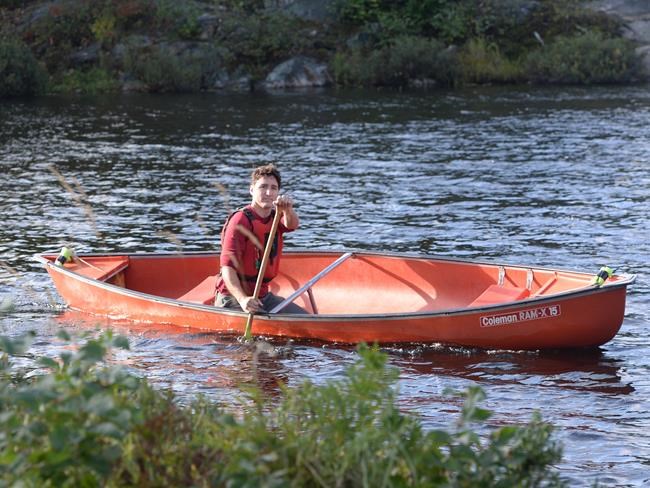
He made the announcement after paddling a red canoe in the Lake Laurentian Conservation Area accompanied by local children.
Trudeau also said 30 per cent of Canadian land and ocean areas will be protected by 2030, and he will push the rest of the world to follow suit.
“We know protecting our nature, protecting our land for future generations, protecting our waters in partnership with Indigenous Peoples, is about fighting climate change and protecting our future,” said Trudeau.
Trudeau was flanked by local candidates, including Paul Lefebvre, who is running to represent Sudbury for a second term.
He also drew a few fans, including Martha Padilla and her daughter, Maricela Faucheux, who carried a sign that said: “Justin Trudeau, my mom [loves] you!” The mother and daughter, who said they immigrated to Canada from Mexico, left happy after meeting the Liberal leader.
The Liberals committed in their first mandate to protect 17 per cent of land and 10 per cent of marine areas by 2020. As of the end of 2018, Environment Canada was reporting 11.2 per cent of land and 7.9 per cent of marine areas had been protected.
Trudeau said Canada has already exceeded the marine goal with almost 14 per cent of Canadian coastal waters protected, and was on track to meet its land preservation goal.
The protected ocean areas went over the 10 per cent goal in August with the addition of the Tuvaijuittuq Marine Protected Area off the coast of Ellesmere Island in Nunavut, which covers more than 5.5 per cent of all Canadian coastal and marine areas.
Trudeau is also promising to expand the Learn to Camp program, and give travel bursaries to lower income families to spend up to four nights in one of Canada’s national or provincial parks.
The Liberals say these announcements will cost $75 million in fiscal year 2020-21 and $150 million by fiscal year 2023-24.
Dan Kraus, the national conservation biologist with the Nature Conservancy of Canada, said the 25 or 30 per cent goal was ambitious, but necessary. Some scientists, he said, have pegged the ideal number of conserved land at half.
Canada is “one of the few countries on Earth where we have the opportunity to protect nature on a large scale,” said Kraus, who said there’s particular urgency to protect the Prairies, which have already lost 70 per cent of their grasslands.
The pledges were the latest in a string of environmental announcements from the Liberals that include promises to make Canada carbon neutral by 2050, cut taxes for green tech companies, and bring in national flood insurance and zero-interest loans to retrofit homes.
It’s a set of ambitious promises, but Trudeau has been criticized for the lack of detail in his plans and how much they’ll cost.
On Thursday afternoon, Trudeau hit up a pair of Ontario ridings that went Conservative blue in 2015.
First he headed to cottage country, where he met with Trisha Cowie, the candidate for Parry Sound-Muskoka. The two shook hands and posed for photos with local residents, two of whom told Trudeau they remembered his father, former prime minister Pierre Elliott Trudeau.
Trudeau is hoping Cowie, a local lawyer and member of the Hiawatha First Nation, can win the riding formerly held by Tony Clement, who was ejected from the Conservative caucus following a sexting scandal and is not running again.
A more raucous scene greeted Trudeau outside a brewery in Barrie, in a riding the Conservatives won in 2015 by 86 votes.
The mostly friendly crowd was mixed with a handful of protesters, some of whom wore yellow vests and heckled Trudeau through a megaphone, referencing the blackface scandal that has dogged the Liberal leader ever since photos of him in skin-darkening makeup surfaced last week.
Ojibwa woman Waabshki Mkwa Mnidoo Kwe, who came with her two young children, was there to urge action on climate.
She said Trudeau hadn’t lived up to his promises to Indigenous people or the environment during his four years in office.

She called on him to act urgently to put more money into the inquiry into missing and murdered Indigenous women and girls, defund fossil fuels, move completely to green energy, and ensure all Indigenous reserves have clean drinking water.
“We need to take climate action right now, to cut our emissions, or else all people will be suffering,” she said.
Trudeau ended his day at a rally in Peterborough, where cabinet minister Maryam Monsef is campaigning for re-election.
— With files from Mia Rabson
This report by The Canadian Press was first published Sept. 26, 2019.