Advocacy group campaigns for Canada, U.S. unity on right whale conservation

Advertisement

Advertise with us

An ocean advocacy group is calling for unified action from Canadian and U.S. governments to protect the dwindling North Atlantic right whale population from extinction.

Read this article for free:


or

Already have an account? Log in here »

To continue reading, please subscribe:

Subscribe and receive a limited-edition Free Press branded hat or tote.

Digital Subscription

One year of digital access for only $205*

  • Enjoy unlimited reading on winnipegfreepress.com
  • Read the E-Edition, our digital replica newspaper
  • Access News Break, our award-winning app
  • Play interactive puzzles

*First annual payment billed as $205.00 + GST for one year. This annual subscription will automatically renew at $233.00 + GST every 52 weeks (10% off the regular annual price of $259.35). Offer available to new and qualified returning subscribers only. Cancel any time.

To continue reading, please subscribe:

Add Free Press access to your Brandon Sun subscription for only an additional

$1 for the first 4 weeks*

  • Enjoy unlimited reading on winnipegfreepress.com
  • Read the E-Edition, our digital replica newspaper
  • Access News Break, our award-winning app
  • Play interactive puzzles
Start now

*Your next Brandon Sun subscription payment will increase by $1.00 and you will be charged $17.95 plus GST for four weeks. After four weeks, your payment will increase to $24.95 plus GST every four weeks.

Hey there, time traveller!
This article was published 12/09/2019 (2550 days ago), so information in it may no longer be current.

An ocean advocacy group is calling for unified action from Canadian and U.S. governments to protect the dwindling North Atlantic right whale population from extinction.

Oceana is launching its campaign in Toronto and Washington, D.C. on Thursday.

The group is asking both countries to expand existing protection measures for the marine mammals, with a particular focus on preventing ship strikes and fishing gear entanglement.
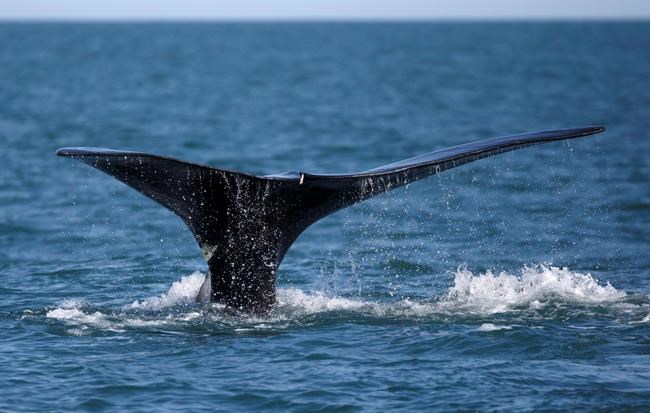
In this Wednesday March 28, 2018 photo, a North Atlantic right whale feeds on the surface of Cape Cod bay off the coast of Plymouth, Mass. An ocean advocacy group is campaigning for unified action from Canadian and U.S. governments to save North Atlantic right whales from extinction. THE CANADIAN PRESS/AP-Michael Dwyer

Twenty-eight right whales have died in North American waters since 2017, including eight in Canadian waters this summer, of a population numbering only about 400 animals.

Kim Elmslie, campaign director for Oceana Canada, said the bi-national campaign is asking officials for urgent, collaborative responses to the worsening crisis, as the world’s oceans experience the effects of climate change.

“The species is still at risk of extinction, so we need to find solutions for this species across borders,” Elmslie said in a phone interview from Ottawa on Wednesday.

Recommendations include reductions in vertical lines used in fixed-gear fisheries and fishery closures that would come into effect once right whales are detected in an area.

Oceana is also lobbying for stronger tracking of fishing vessels, limits on seismic blasting in right whale territory, an expanded task force of right whale experts and more long-term funding for research, including necropsies, which probe an animal’s cause of death.

A supplementary report by Oceana Canada describes the history of the animal — named “right whales” because their slow swimming speeds and proximity to shore made them the “right” whales to hunt. After being hunted to near-extinction in the mid-1900s, the species made a slight rebound, but its status has taken a sharp decline in recent years.

Oceana Canada’s report also details the agonizing deaths right whales suffer when entangled in fishing gear, taking six months on average to die, usually from drowning or starvation.

The campaign comes after a summer in which a spate of right whale deaths highlighted the cross-border policy considerations that complicate ocean conservation efforts.

Last week, Massachusetts’ attorney general wrote to political leaders in eastern North America urging unity and action on right whale protections. In late August, the Maine Lobstermen’s Association said it would pull out of an agreement that sought to reduce risk to right whales, arguing the rules were too restrictive and that Canadian fisheries and vessels posed the greatest risk.

Elmslie said complicated issues of intergovernmental collaboration are typical in marine conservation work, where large animals like right whales move through ocean regions governed by different laws.

Another challenge is the unpredictable impact of climate change in oceans, Elmslie said, making it difficult to draft effective policies as animals adjust their behaviour.

Right whales like to feed on small fish called copepods, and scientists believe the whales are following their prey into the Gulf of St. Lawrence in larger numbers, as temperatures rise in the more southern waters they used to frequent. This migration has put right whales at greater risk of ship strikes.

“They’re encountering threats they’ve never encountered before, because their food is shifting, and we could continue to see further shifts in the years coming,” Elmslie said. “That’s what makes it challenging, is the unknown, and trying to be predictive in what you’re doing.”

Some of Oceana’s recommendations aim to illuminate those unknowns, like funding more detailed necropsies on right whales killed in the Atlantic. Elmslie said this funding would fill in gaps about the greatest risks to the animals and would provide support for the scientists who carry out the physically and emotionally difficult work.

Canada strengthened its marine mammal protections last year, including vessel speed limits and minimum approach distances. Elmslie said Oceana’s campaign is about expanding and improving existing protections.

She said she is optimistic that whoever forms government after October’s federal election will remain committed to saving the species.

“There’s no silver bullet to this,” she said. “It is going to take multiple departments, multiple organizations, multiple scientists, multiple industry groups to continue to work on this and solve this.”

Report Error Submit a Tip

More Stories

Before her health took a rapid, fatal turn, Genevieve Price was an independent grandmother guided by her faith in God and love for family.

The Winnipeg senior, 82, died last weekend after going to the hospital for what began as swelling in her one of her hands.

Her daughter, Michelle Price, believes she suffered organ failure as a result of spending more than 30 hours in an emergency department hallway at Grace General Hospital as sepsis took hold.

After a Grace ER doctor discovered she had suffered a heart attack, Michelle’s mother was transferred to St. Boniface Hospital, where she died.

Veterinarian petitions Ottawa to consider four-legged patients in legal cannabis regime

Solomon Israel 5 minute read Preview

Veterinarian petitions Ottawa to consider four-legged patients in legal cannabis regime

Solomon Israel 5 minute read Thursday, Jun. 6, 2019

An Ontario veterinarian has launched a formal petition asking the government to include animals and the physicians who care for them in Canada's cannabis regulations.

"What we're hearing repeatedly from Health Canada... is that the entire framework surrounding cannabis legalization was focused on human consumption," said Sarah Silcox, who practices palliative and hospice care for companion animals in Ajax, Ont., and serves as president of the Canadian Association of Veterinary Cannabinoid Medicine.

"And so they hadn't even considered animals being involved in this, or veterinarians being involved in the medical side of things. And what that's left us with is this catch-22, because now it's perfectly legal for a Canadian adult to go out and purchase cannabis, and to give it to their animal, and yet veterinarians have no legal pathway to authorize its use... Therefore we're really limited in terms of the education and support that we can give our clients to ensure that they're doing that safely."

The online petition on the House of Commons e-petitions website was launched May 27, and already has more than 500 signatures — enough to require the government to table an official response in Parliament.

Read
Thursday, Jun. 6, 2019

Dynacare labs quickly reach capacity ahead of strike

Nicole Buffie 5 minute read Preview

Dynacare labs quickly reach capacity ahead of strike

Nicole Buffie 5 minute read 3:06 PM CDT

Patients were being turned away from several Dynacare locations Saturday morning as people packed the labs in hopes of getting their blood collection done before workers strike.

By 10:30 a.m. the lobby at the Dynacare at 1581 Regent Ave. was standing-room only and walk-up patients were being turned away as the wait time for those lucky enough to get in creeped past two hours.

One woman got in right before workers cut off walk-ins at 10 a.m. after travelling to two other locations.

“I was driving by at 7:15 this morning and there was already a line-up to the road, so I was like ‘nope, not going there’ so I went to the one on Sterling Lyon (Parkway) and it was closed, and then I went to the one at St. Vital Mall and there had a line zig-zagging all the way through the corridors so I gave up and came back,” said Joanna, who declined to give her last name.

Read
3:06 PM CDT

Discourse we’d rather avoid

Tory McNally 8 minute read Preview

Discourse we’d rather avoid

Tory McNally 8 minute read 2:02 AM CDT

We have all been there. A colleague says something that bothers us. A manager is not addressing an issue everyone can see. An employee’s behaviour is becoming increasingly difficult. A misunderstanding has taken on a life of its own. Or perhaps we simply need to have a conversation that we know is going to be uncomfortable.

Our first instinct is often to avoid it.

Honestly, that instinct is understandable. Difficult conversations can make us nervous. We worry about upsetting someone, damaging a relationship, saying the wrong thing or making a situation worse.

Sometimes we tell ourselves the problem will resolve itself. We decide to wait for a better time. We send the email instead of having the conversation. We hope if we give it a little more time, somehow it will become easier.

Read
2:02 AM CDT

Canada goes young and old for Olympic men's hockey

Joshua Clipperton, The Canadian Press 6 minute read Preview

Canada goes young and old for Olympic men's hockey

Joshua Clipperton, The Canadian Press 6 minute read Tuesday, Jan. 25, 2022

Canada is turning to a mix of youthful exuberance and battle-scarred experience in its quest for Olympic men's hockey gold minus the country's NHL stars.

The 25-man roster announced Tuesday is bookended by 37-year-old Eric Staal and fellow centre Mason McTavish, who turns 19 this weekend, for the upcoming Beijing Games.

"We always talk about playing the Canadian way," head coach Claude Julien said on a video conference call with reporters. "We're a proud country of the way we play the game.

"We're going to be an aggressive team."

Read
Tuesday, Jan. 25, 2022

No end in sight to Ottawa’s pandemic spending

Temur Durrani 8 minute read Preview

No end in sight to Ottawa’s pandemic spending

Temur Durrani 8 minute read Monday, Nov. 30, 2020

A crucial caveat expected in Monday's fiscal statement from Ottawa failed to manifest: there is no end in sight to federal spending amidst the COVID-19 pandemic.

As Canada stares down a nearly $400-billion, record-high deficit for 2020, the Liberal government plans to spend up to $100 billion over the next three years, along with a further $25.1 billion in immediate measures to support workers and businesses affected by the novel coronavirus.

That's not all.

In a long-awaited speech from the House of Commons, Finance Minister Chrystia Freeland did not provide a spending cap to draw any red lines around the limit to which the feds will continue funnelling toward an economic recovery she acknowledged is still well-off the horizon.

Read
Monday, Nov. 30, 2020