Dizzying weather extremes a new fact of life for Canadians, experts say

Advertisement

Advertise with us

As Ottawa limps across the finish line of its snowiest January on record, cherry blossoms are blooming at the legislature in coastal Victoria, B.C.

Read this article for free:


By clicking the button above, an account will be created and you will begin to receive some of our recommended newsletters. You may opt out of any newsletter by visiting your Email and Communication Preferences page or by clicking "unsubscribe" at the bottom of any email.

or

Already have an account? Log in here »

To continue reading, please subscribe:

Digital Subscription

One year of digital access for only $1.44 a week*

  • Enjoy unlimited reading on winnipegfreepress.com
  • Read the E-Edition, our digital replica newspaper
  • Access News Break, our award-winning app
  • Play interactive puzzles

*Billed as $5.77 plus GST every four weeks. After 52 weeks, price increases to the regular rate of $19.95 plus GST every four weeks. Offer available to new and qualified returning subscribers only. Cancel any time.

To continue reading, please subscribe:

Add Free Press access to your Brandon Sun subscription for only an additional

$1 for the first 4 weeks*

  • Enjoy unlimited reading on winnipegfreepress.com
  • Read the E-Edition, our digital replica newspaper
  • Access News Break, our award-winning app
  • Play interactive puzzles
Start now

*Your next Brandon Sun subscription payment will increase by $1.00 and you will be charged $17.95 plus GST for four weeks. After four weeks, your payment will increase to $24.95 plus GST every four weeks.

Hey there, time traveller!
This article was published 31/01/2019 (2828 days ago), so information in it may no longer be current.

As Ottawa limps across the finish line of its snowiest January on record, cherry blossoms are blooming at the legislature in coastal Victoria, B.C.

Millions of Canadians were hiding out this week under extreme cold warnings stretching across the map, even as some East Coast cities enjoyed moderate temperatures.

According to experts, these co-existing extremes have been predicted for some time — and they’re likely here to stay.

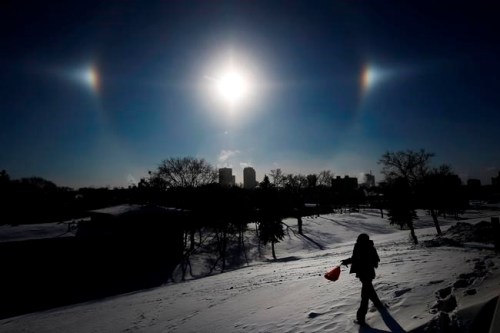
Sun Dogs, formed by the sun reflecting off ice crystals in bitterly cold temperatures, sit over the Winnipeg skyline Wednesday, Jan. 30, 2019. Winnipeg and the region has been experiencing below -35 degree celsius temperatures and windchills of -45 to -50 degree celsius. THE CANADIAN PRESS/John Woods

“This is the kind of thing people have been predicting for years,” said Konrad Gajewski, a professor of geography and environment at the University of Ottawa.

“This kind of pattern of more alternation, more extremes, both in terms of warm and cold conditions is what we’re expecting for the future.”

Central Canada’s cold snap comes from the oscillating upper wind patterns of the jet stream, pushing the cold air down from the north with the polar vortex.

At the same time, the large “waves” in the wind patterns push some warm air north, explaining comparatively warm temperatures on the coasts.

The exact role climate change plays in the pattern’s changes is an ongoing discussion in the scientific community, but a common belief says it’s the result of a warming Arctic.

“It’s thought that as the Arctic warms up because the ice is melting back, we’re going to have more of a situation where you have what we call ‘waviness’ in the polar vortex,” Gajewski said.

This “waviness” in the upper wind’s pattern could be carrying cold further and further south into south and central Canada, and pushing warm air further north along the coast.

Atmospheric physics professor Kent Moore at the University of Toronto says the striking weather patterns show how the world’s climate system is intimately coupled, and how changes in the coldest and warmest regions can be felt in central Canadian cities.

As an example, Moore pointed to the theory that the waves in upper wind patterns are moving slower, with larger amplitudes as a possible result of warming in the Arctic.

“The largest changes in the climate are occurring in the Arctic and some would say, ‘Who cares? I live in mid-latitudes, why should I care about that stuff?'” Moore said.

“The Earth is kind of a small place and so things that happen in the Arctic don’t stay in the Arctic.”

This interconnectedness of the world’s climate system also explains the impacts from El Nino systems on Canada, Moore said.

David Atkinson, a climate professor at the University of Victoria, said the jet stream’s behaviour could also make the increasingly frequent, intense storms on the East Coast gain even more strength.

“If the air is kind of moving apart, it allows surface air to rise more easily,” Atkinson said. “That helps a storm to work, storms depend on rising air.”

Gajewski said the arrival of long-predicted weather patterns means it’s time for all levels of government to seriously plan for changes that are already hitting Canada in the form of sweltering heat waves in the summer and record cold in the winter.

This could mean more snow-clearing and flood response on the municipal level and global warming mitigation efforts across the board.

In Ottawa, Gajewski pointed to some ongoing local efforts like more bicycle lanes and efforts to plow some of them in the winter.

“A lot of it would just be common sense. It’s going to get hotter in the summers and we’re going to get perhaps more snow, more rain, more extreme conditions, more floods,” Gajewski said.

“Cities have to be planned to deal with that kind of thing.”

For cities like Ottawa, which just completed its twelfth straight day of round-the-clock plowing, people shouldn’t plan to retire their shovels any time soon.

“We’re going to have to shovel more often.”

Report Error Submit a Tip

More Stories

Voter turnout in mayoral race about 38 per cent

Free Press staff 2 minute read Preview

Voter turnout in mayoral race about 38 per cent

Free Press staff 2 minute read 11:07 AM CDT

Voter turnout in Wednesday’s mayoral contest in Winnipeg was 38 per cent, based on a Free Press analysis of unofficial results.

The city has not yet provided a figure for overall turnout for the municipal and school board election.

Incumbent Scott Gillingham won a second term with 39.82 per cent of the vote. He was followed by Kevin Klein (20.71 per cent), Noah Redden (19.84 per cent) and Mike Vogiatzakis (9.66 per cent) in a field of 12 candidates.

Unofficial voter turnout within the city’s 15 wards ranged from 26 per cent (Point Douglas) to 46 per cent (River Heights-Fort Garry).

Read
11:07 AM CDT

Baffled by experience with ex who left

Maureen Scurfield 4 minute read 2:00 AM CDT

DEAR MISS LONELYHEARTS: My beautiful ex-wife used to travel with her girlfriends, and they were a wild and free group! I counted myself lucky to have tamed and married her. I should have woken up shortly after our wedding when she got restless, and then announced she did not want to have children!

It was a half-lie. She always wanted children. I know now she meant she didn’t want children with me. I was just a guy to mess around with.

So, she finally divorced me and married a new guy, and already has two kids. That hurts me so much! I loved her deeply and had always wanted kids with her, but I guess she didn’t have the same dream.

I ran into her recently at her best friend’s September wedding. She was looking sideways at me as I had a new younger girlfriend on my arm. I swear my ex was jealous! How could she be jealous when she could have had me for life, but dumped me?

City rec facilities crumbling

Ryan Thorpe 6 minute read Preview

City rec facilities crumbling

Ryan Thorpe 6 minute read Monday, Oct. 22, 2018

Throughout Winnipeg, decades-old community assets — pools, arenas and recreation and leisure centres — are deteriorating so quickly that service disruptions are inevitable.

Meanwhile, the city’s community services department, which is responsible for managing those assets, operates with an annual deficit of roughly $80 million, meaning there are scant resources to do little more than bail water on a sinking ship.

Soon, Winnipeggers will have a choice: fewer community services or higher costs.

“It poses a huge challenge because we have very limited dollars that we have to invest in our existing facilities. We also have growing demands for new amenities in new areas. We have to be very strategic,” said Ken McKim, manager of asset management for the department.

Read
Monday, Oct. 22, 2018

Dizzying weather extremes the new normal: experts

Holly McKenzie-Sutter, The Canadian Press 4 minute read Preview

Dizzying weather extremes the new normal: experts

Holly McKenzie-Sutter, The Canadian Press 4 minute read Thursday, Jan. 31, 2019

As Ottawa limps across the finish line of its snowiest January on record, cherry blossoms are blooming at the legislature in coastal Victoria, B.C.

Millions of Canadians were hiding out this week under extreme cold warnings stretching across the map, even as some East Coast cities enjoyed moderate temperatures.

According to experts, these co-existing extremes have been predicted for some time — and they're likely here to stay.

"This is the kind of thing people have been predicting for years," said Konrad Gajewski, a professor of geography and environment at the University of Ottawa.

Read
Thursday, Jan. 31, 2019

Railways report more accidents with dangerous goods

Dylan Robertson 6 minute read Preview

Railways report more accidents with dangerous goods

Dylan Robertson 6 minute read Monday, Jan. 20, 2020

OTTAWA — The number of rail accidents involving dangerous goods more than doubled in Canada in 2018.

There were 25 accidents involving dangerous goods in 2018, involving one death, according to Transport Canada data published Monday.

There were 11 accidents recorded a year prior, and five in 2016.

These accidents involve dangerous goods — flammable or corrosive substances — that either exploded or leaked.

Read
Monday, Jan. 20, 2020

Adult education should be the foundation of the North

Jim Silver 5 minute read 2:00 AM CDT

Major economic developments are, we are being told, coming to northern Manitoba, focusing on the port of Churchill and the railway system that leads to it, and the production and export via that port of various commodities. Many challenges, particularly environmental, lie along that path, and they deserve particularly serious consideration if any development is to proceed.

One aspect of northern development about which almost nothing has been said is: “Who will do the work in the north?”

For decades past and still today, great reliance has been placed on bringing skilled tradespeople and other skilled workers to northern Manitoba from the south. The result has been that not only has the bulk of corporate profits been drained south, but so too have wages. As a result, rates of poverty are higher and formal educational levels are lower in the north than elsewhere in Manitoba. This is obviously detrimental to the north and particularly to those who live in the north.

If northerners themselves are to benefit from economic development in the north by forming the skilled labour force that will be needed, then we will need more of those northerners to be educationally prepared to undertake training for skilled employment.