Congregants celebrate the reconstruction of one of America’s oldest Black churches

Advertisement

Advertise with us

WILLIAMSBURG, Va. (AP) — The reconstruction of one of the nation's oldest Black churches, where congregants gathered in secret before building a meeting house in Virginia, was celebrated Friday.

Read this article for free:


By clicking the button above, an account will be created and you will begin to receive some of our recommended newsletters. You may opt out of any newsletter by visiting your Email and Communication Preferences page or by clicking "unsubscribe" at the bottom of any email.

or

Already have an account? Log in here »

To continue reading, please subscribe:

Digital Subscription

One year of digital access for only $1.44 a week*

  • Enjoy unlimited reading on winnipegfreepress.com
  • Read the E-Edition, our digital replica newspaper
  • Access News Break, our award-winning app
  • Play interactive puzzles

*Billed as $5.77 plus GST every four weeks. After 52 weeks, price increases to the regular rate of $19.95 plus GST every four weeks. Offer available to new and qualified returning subscribers only. Cancel any time.

To continue reading, please subscribe:

Add Free Press access to your Brandon Sun subscription for only an additional

$1 for the first 4 weeks*

  • Enjoy unlimited reading on winnipegfreepress.com
  • Read the E-Edition, our digital replica newspaper
  • Access News Break, our award-winning app
  • Play interactive puzzles
Start now

*Your next Brandon Sun subscription payment will increase by $1.00 and you will be charged $17.95 plus GST for four weeks. After four weeks, your payment will increase to $24.95 plus GST every four weeks.

WILLIAMSBURG, Va. (AP) — The reconstruction of one of the nation’s oldest Black churches, where congregants gathered in secret before building a meeting house in Virginia, was celebrated Friday.

Hundreds of residents gathered for a community-wide re-dedication of the original First Baptist Church of Williamsburg, which was established in 1776 by enslaved and free African Americans in defiance of laws that prevented them from congregating.

In 1805, its original parishioners built the church house, known as the African Baptist Meeting House, with recycled bricks and materials they scrounged. A tornado in 1834 destroyed the church, which was rebuilt in 1856 before it was turned into a parking lot a century later by the Colonial Williamsburg Foundation, a living history museum, because it didn’t match the 18th century aesthetic of the town at the time.
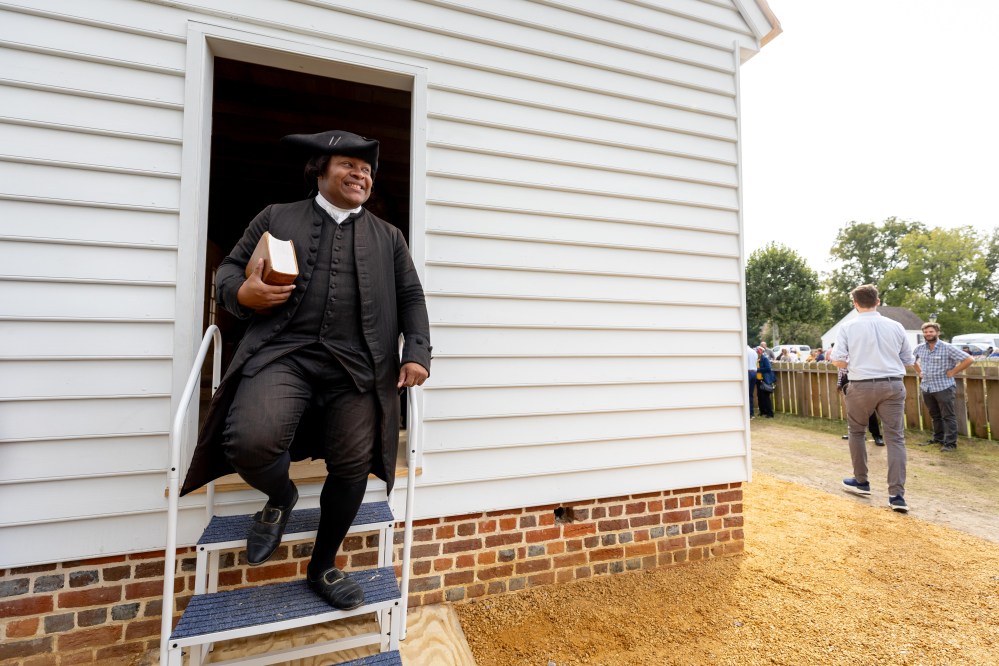
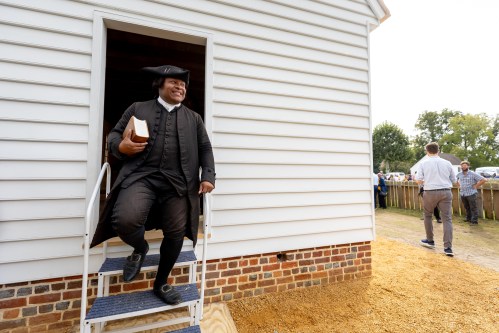
Joe Feaster, a part-time historical interpreter who portrays pastor Gowan Pamphlet, steps out of the reconstructed African Baptist Meeting House, now known as First Baptist Church of Williamsburg, during a rededication ceremony in Williamsburg, Va., Friday, Oct. 9, 2026. (AP Photo/Mike Kropf)

Since then, the 16-foot by 32-foot church has been reconstructed, after archaeologists in 2021 uncovered the church’s original foundation, as well as 62 graves linked to the congregation.

“What this day means and shows is that Black history is American history, and we’re an example for the rest of the nation,” Reginald F. Davis, pastor of First Baptist, told The Associated Press on Friday.

“A church that has a history that was during the signing of the Declaration of Independence, you cannot erase us out of American history because we have been at the outset and formulation of the nation,” said Davis, who leads the current 215-member congregation in a 20th century church on Scotland Street, less than a mile from the original site.

For decades, Colonial Williamsburg didn’t tell the story of the church’s history as a pioneer of Black American faith traditions. More than half of the 2,000 people who lived in Williamsburg in the 18th century were Black, with few of them free. But in recent years, the museum has resuscitated the church’s traditions, starting with Friday’s celebration of the building’s 250th anniversary.

“I wanted them to know that we were always here, where when the doors of the Colonial Williamsburg Foundation first opened, the restoration, and even before then, we were sometimes present, but not able to speak,” said Janice Canaday, community engagement manager at the Colonial Williamsburg Foundation.

“This is a reclamation, a reclaiming of the narrative,” she said.

From past to present

On Friday, the event began with a procession symbolizing the ways the historic congregation has continued a multigenerational fight for education, faith, and freedom.

The mood was set with a performance by the Nassau Street Remembrance Choir, before an invocation from Davis and speeches from Virginia state Senator Mamie Locke and James Ingram, a museum interpreter who has for 26 years portrayed Gowan Pamphlet, First Baptists’ pastor when the original church structure was built.

In a 2025 AP interview, Ingram said Pamphlet was “a precursor to someone like Frederick Douglass, who would be the precursor to someone like Martin Luther King Jr.”

Pamphlet, an enslaved tavern worker, preached about equality in the face of laws that prohibited large gatherings of African Americans out of fear of slave uprisings. Ingram handed the mantle off to the new Pamphlet interpreter, Brandon Lee, who debuted at the dedication.

‘We were just so elated’

In addition to discovering the original church’s foundation, archaeologists uncovered the graves of 62 community members. DNA tests and bone analyses for three sets of remains linked them back to the African Baptist Meeting House congregation.

But it was oral tradition that served as the first hint in the discovery, where stories of ancestors buried in the area led to a search.

“We knew the building was here, and we knew that there were maybe burials behind it,” said Jennifer Wilkoski, director of architectural preservation and research at Colonial Williamsburg.

When the church’s original structure was discovered in 2021, Davis called it “a rediscovery of the humanity of a people.”

“We were just so elated that those people who had been buried and forgotten, have now been unearthed and given the recognition as human beings, as they should have been,” he said. “It’s a wonderful time to shed light on our history in light of the erasure of so many things within our history.”

Construction is nearly finished

The meeting house reconstruction, built at its original site, honors its original character. Archaeologists and Colonial Williamsburg’s construction team modeled the new church out of pine and white oak woods, and recreated details like the original half-round brick steps.

Wilkoski said the materials for the original church demonstrated the resourcefulness of the congregants, who likely included carpenters with the skills necessary to build the church.

Modern renovations include an HVAC system for Virginia’s hot summers, a refreshed altar table for sermons, shutters, and handblown glass windows. Last year, Colonial Williamsburg considered glassless windows but has since had to reconsider to build the cooling HVAC system.

“It’s not church stained glass, but we call it restoration glass, handmade like they would’ve had in the 18th and early 19th century,” Wilkoski said.

Finishing touches on the church will wrap in the next few months and will include an ADA- accessible ramp.

Davis, the First Baptist pastor, said the meeting house structure is overdue recognition for “those of us who are still working to make America a more perfect union.”

____

Nancy Jiang reported from New York.

Report Error Submit a Tip

The Free Press acknowledges the financial support it receives from members of the city’s faith community, which makes our coverage of religion possible.
More Stories

Province’s first female dentist took skill, insight wherever needed

David Sanderson    25 minute read Preview

Province’s first female dentist took skill, insight wherever needed

David Sanderson    25 minute read Saturday, Apr. 3, 2021

Some stories take longer to get around to than others.

In the fall of 2011 I hooked up with Fiona Odlum at an Academy Road Starbucks for a lighthearted feature about people who report on traffic for a living. Odlum, currently a contributor at CBC Saskatchewan, was working for 680 CJOB at the time, clueing rush-hour commuters in on stalls, lane closures and fender-benders they’d be wise to avoid.

Odlum turned the tables at one point by asking a few questions of her own including, “So, what’s your main beat?”

I don’t really have one, I told her, but if pressed, I would probably go with human-interest pieces.

Read
Saturday, Apr. 3, 2021

Has the political wind changed?

Gwynne Dyer 5 minute read 2:01 AM CDT

It has been quite a week. First we had “Lula” – Luiz Inácio da Silva (as nobody but his mother ever called him) – defying everybody’s expectations. After winding up two million votes behind his challenger, Flávio Bolsonaro, in the first round of the Brazilian presidential election, he made a “miraculous” comeback in the second.

It was like a man going into a revolving door behind you and coming out in front. At the end of the first round, Lula was two million votes behind; at the end of the second round on Oct. 25 he was four million votes ahead. So how did he win a fourth term without cheating?

That’s what Bolsonaro claims he did, having fled to the United States; Trump, Flávio’s mentor, hints at the same. But Lula’s victory was not miraculous. He only learned to read when he was 10, and at 80 he still refused to have a mobile phone. His team finally made him get one and use it.

He wouldn’t do social media videos, so they created a WhatsApp channel called Lula’s Army, and made him appear on it at least daily. The channel went from zero to 10.8 million viewers in two weeks, and Lula won.

Walkout creates chaos at St. James Smitty’s

Morgan Modjeski 3 minute read Preview

Walkout creates chaos at St. James Smitty’s

Morgan Modjeski 3 minute read 2:01 AM CDT

Gordon Sharpe wanted to eat a meal at the St. James Smitty’s Wednesday, but he got a helping of bad news instead.

He saw several workers walk out of the restaurant, at 1017 St. James St.

“(The waiter) came back about 10 minutes later and stood over the table, looking a little distraught and said, ‘I’m quitting right now and so is everybody else,’” Sharpe said. “He said, ‘This is my last time serving you,’ and he was quite choked up.”

“I’ve never seen anything like it,” he said, adding that the managers scrambled to serve patrons.

Read
2:01 AM CDT

Congregants celebrate the reconstruction of one of America’s oldest Black churches

Nancy Jiang, The Associated Press 5 minute read Preview

Congregants celebrate the reconstruction of one of America’s oldest Black churches

Nancy Jiang, The Associated Press 5 minute read Friday, Oct. 9, 2026

WILLIAMSBURG, Va. (AP) — The reconstruction of one of the nation's oldest Black churches, where congregants gathered in secret before building a meeting house in Virginia, was celebrated Friday.

Hundreds of residents gathered for a community-wide re-dedication of the original First Baptist Church of Williamsburg, which was established in 1776 by enslaved and free African Americans in defiance of laws that prevented them from congregating.

In 1805, its original parishioners built the church house, known as the African Baptist Meeting House, with recycled bricks and materials they scrounged. A tornado in 1834 destroyed the church, which was rebuilt in 1856 before it was turned into a parking lot a century later by the Colonial Williamsburg Foundation, a living history museum, because it didn't match the 18th century aesthetic of the town at the time.

Since then, the 16-foot by 32-foot church has been reconstructed, after archaeologists in 2021 uncovered the church's original foundation, as well as 62 graves linked to the congregation.

Read
Friday, Oct. 9, 2026

The trick to attracting wee, treat-seeking ghosts and goblins on Halloween is to go all-in

Jen Zoratti 5 minute read Preview

The trick to attracting wee, treat-seeking ghosts and goblins on Halloween is to go all-in

Jen Zoratti 5 minute read Wednesday, Oct. 31, 2018

When I was a kid in the 1990s, I lived for Halloween.

My mom, a gifted seamstress, made all of my costumes. Deciding what I’d dress up as involved imagination and a trip to the fabric or craft store.

I loved flipping through the McCall’s patterns, and running my hands along the bolts of fabric that my mom would transform into Little Bo Peep, or Dorothy from the Wizard of Oz, or, one year, a Christmas tree — complete with the star on top. Old things were repurposed into new things.

Trick-or-treating was my... I don’t know, some sort of sports reference. The goal? Amass as much candy as possible. We’d troll the neighbourhood for hours, dragging snow-sodden pillow cases full of it. We’d target specific streets, lured mostly by the promise of full-sized chocolate bars.

Read
Wednesday, Oct. 31, 2018

Haunted houses aren’t the only places to find jump scares

Jen Zoratti 3 minute read Preview

Haunted houses aren’t the only places to find jump scares

Jen Zoratti 3 minute read 2:01 AM CDT

C’est l’Halloween, to quote the 1981 elementary school French class banger by Matt Maxwell, but you know what’s already plenty scary? Life.

We all have our personal haunted houses, so to speak, hence the popularity of the “a haunted house but it’s just…” meme that pops up every October. Sample: “a haunted house but it’s just a bunch of men telling you you’d be prettier if you smiled.”

In the spirit of the season, I thought I’d offer up a few jump scares of my own.

A haunted house but it’s just Gate E25

Read
2:01 AM CDT