Pew research
Long-term data lacking about the religiosity of Gen Z

Advertisement
Read this article for free:
or
Already have an account? Log in here »
To continue reading, please subscribe:

Digital Subscription
One year of digital access for only $205*
- Enjoy unlimited reading on winnipegfreepress.com
- Read the E-Edition, our digital replica newspaper
- Access News Break, our award-winning app
- Play interactive puzzles
*First annual payment billed as $205.00 + GST for one year. This annual subscription will automatically renew at $233.00 + GST every 52 weeks (10% off the regular annual price of $259.35). Offer available to new and qualified returning subscribers only. Cancel any time.
To continue reading, please subscribe:
Add Free Press access to your Brandon Sun subscription for only an additional
$1 for the first 4 weeks*
- Enjoy unlimited reading on winnipegfreepress.com
- Read the E-Edition, our digital replica newspaper
- Access News Break, our award-winning app
- Play interactive puzzles
*Your next Brandon Sun subscription payment will increase by $1.00 and you will be charged $17.95 plus GST for four weeks. After four weeks, your payment will increase to $24.95 plus GST every four weeks.
Read unlimited articles for free today:
or
Already have an account? Log in here »
There’s been lots of media attention recently about the idea of youth religious revival — that young people, especially those from Gen Z, are flocking to church.
It all started in April last year, when the Bible Society in the United Kingdom shared the results of a poll it commissioned from YouGov, a prominent online marketing organization. That poll showed a 16 per cent increase in church attendance in the U.K. by young people ages 18-24.
This was, the Bible Society contended, “dramatic” proof of a “quiet revival” among youth in that country.
MIKE DEAL / FREE PRESS FILES
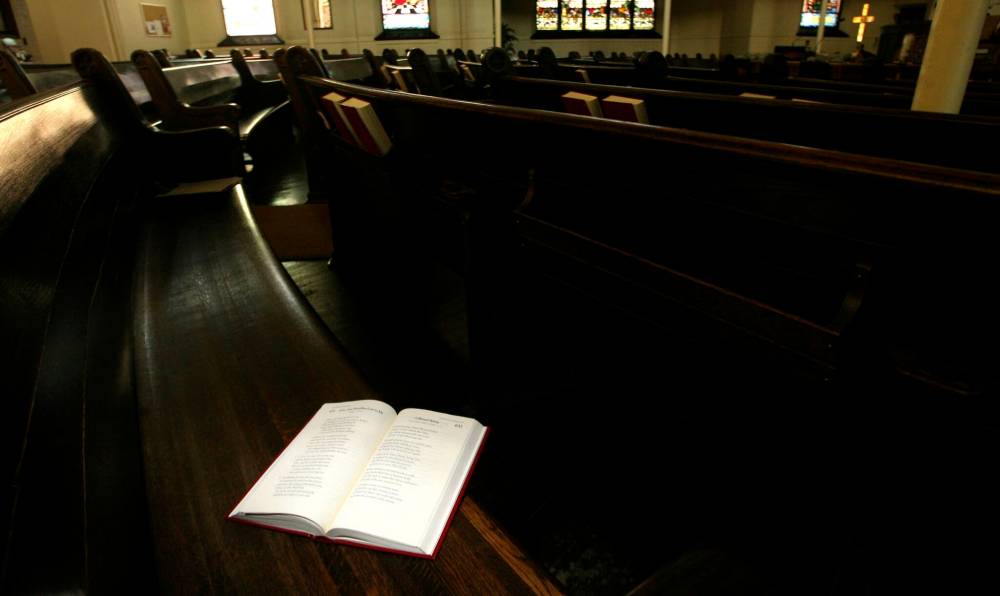
A song book sits in a pew at the Augustine United Church.
Skeptics quickly pushed back. The reason it was “quiet,” they said, was because there was no other poll, including those done by the U.K. Anglican and Catholic churches themselves, that had found anything like the Bible Society’s results. Not only that, they pointed out that anyone who visited most any church on a Sunday morning could see for themselves how few young people were in attendance.
The Bible Society was “fierce in their defence” of the polling, said journalist Sam Hailes in Premier Christianity, “stating time and again that YouGov were a reputable polling company who would not put out faulty numbers.”
It turns out the skeptics were right.
Last month, YouGov retracted the results of the poll, saying it was wrong. It had, it said, failed to implement key quality control technologies to eliminate fraudulent participants in the survey. YouGov apologised to the Bible Society, saying they took “full responsibility” for the mistake.
Before the U.K. study was found to be wrong, it had sparked discussion in Canada and the U.S. about whether similar revivals were happening in those countries. The Canadian Bible Society was inspired to sponsor its own research into the topic. The result was a report titled “Faith Restored? The Evolving Relationship Between Religion and Young Canadians.”
Like the results of the now-discredited U.K. study, the Canadian research also did not find evidence of widespread religious revival among Canadian youth. While it said there were anecdotal reports about increased youth attendance at some places of worship, there was no evidence to suggest “that Canadian young adults are increasingly demonstrating commitment to Christianity or other faiths.”
At best, it could conclude there is “some level of openness among young people to the Christian faith and church attendance.”
To find out more about this situation, I asked some Canadian scholars of religion for their thoughts on youth and religion in this country.
Sam Reimer teaches sociology at Crandall University in New Brunswick. While he has heard enough anecdotal stories to conclude “there are pockets across Canada where young people are engaging in Christianity in greater numbers than in the recent past,” he is “not yet convinced that we are seeing revival or that Gen Z is more religiously committed than older generations.”
To be convinced otherwise, Reimer “would like to see more consistent evidence over a longer period of time,” he said.
Joel Thiessen teaches sociology at Ambrose University in Calgary. While he considered the Canadian report to be measured in its conclusions, he said, “I would have been a bit stronger and more categorical in stating that the evidence in this report does not support revival narratives.”
While Thiessen doesn’t doubt some churches are seeing more youth at services, there is no way to know if any of those are new attendees or are simply people moving from one church to another — with no net increase in the number of believers, in other words.
Rachel Brown directs the religion, culture and society program at the University of Victoria. While she also wants to see more evidence, something may be happening, she said. At least, that’s what her students are telling her.
“Our students are highly non-religious, and yet when I spoke to them about this idea and the studies that are coming out, they enthusiastically state they feel like there is, in fact, a revival happening among their Gen Z peers,” she said. “This lands with them in terms of what they are witnessing within their social circles.”
Rick Hiemstra of the Evangelical Fellowship of Canada agrees. Church leaders he speaks with are also saying something is happening among youth, he said — even if there isn’t data to back it up.

Until there is a reputable long-term study, it will be impossible to “confirm or refute the purported Gen-Z revival,” he said.
In other words, nobody knows for sure if youth are turning to faith or not. And if they are, it’s not clear what kind of religion or spirituality they might be turning to. What we can say is it possible that some people, including youth, are turning to religion and spirituality during this uncertain time.
What should religious leaders take away from this? Maybe the Canadian study said it best when it stated that places of worship should be ready to “welcome young people who may be seeking answers to questions concerning the challenges of life or the reality of the transcendent.”
That would be a good thing to do whether they show up in droves or just in ones and twos.
faith@freepress.mb.ca
The Free Press is committed to covering faith in Manitoba through our Religion in the News project. This reporting continues because readers like you step forward to fund it.
Donate now to support our reporting on religion.
Your donation is eligible for a charitable tax receipt.
BECOME A FAITH JOURNALISM SUPPORTER
John Longhurst has been writing for Winnipeg's faith pages since 2003. He also writes for Religion News Service in the U.S., and blogs about the media, marketing and communications at Making the News.
Our newsroom depends on a growing audience of readers to power our journalism. If you are not a paid reader, please consider becoming a subscriber.
Our newsroom depends on its audience of readers to power our journalism. Thank you for your support.
The Free Press is committed to covering faith in Manitoba through our Religion in the News project. This reporting continues because readers like you step forward to fund it.
Donate now to support our reporting on religion.
Your donation is eligible for a charitable tax receipt.
BECOME A FAITH JOURNALISM SUPPORTER
John Longhurst has been writing for Winnipeg's faith pages since 2003. He also writes for Religion News Service in the U.S., and blogs about the media, marketing and communications at Making the News.
Our newsroom depends on a growing audience of readers to power our journalism. If you are not a paid reader, please consider becoming a subscriber.
Our newsroom depends on its audience of readers to power our journalism. Thank you for your support.
Advertisement Advertise With Us
Advertisement Advertise With Us
The Free Press acknowledges the financial support it receives from members of the city’s faith community, which makes our coverage of religion possible.