Indigenous CMU students welcome teepee on campus

Advertisement
Read this article for free:
or
Already have an account? Log in here »
To continue reading, please subscribe:

Digital Subscription
One year of digital access for only $205*
- Enjoy unlimited reading on winnipegfreepress.com
- Read the E-Edition, our digital replica newspaper
- Access News Break, our award-winning app
- Play interactive puzzles
*First annual payment billed as $205.00 + GST for one year. This annual subscription will automatically renew at $233.00 + GST every 52 weeks (10% off the regular annual price of $259.35). Offer available to new and qualified returning subscribers only. Cancel any time.
To continue reading, please subscribe:
Add Free Press access to your Brandon Sun subscription for only an additional
$1 for the first 4 weeks*
- Enjoy unlimited reading on winnipegfreepress.com
- Read the E-Edition, our digital replica newspaper
- Access News Break, our award-winning app
- Play interactive puzzles
*Your next Brandon Sun subscription payment will increase by $1.00 and you will be charged $17.95 plus GST for four weeks. After four weeks, your payment will increase to $24.95 plus GST every four weeks.
Read unlimited articles for free today:
or
Already have an account? Log in here »
Hey there, time traveller!
This article was published 20/09/2022 (1432 days ago), so information in it may no longer be current.
There’s something new on the campus of Canadian Mennonite University — a teepee.
The traditional Indigenous dwelling, which was put up in mid-September on the school’s north campus behind Marpeck Commons, was initiated by the university’s Indigenous Student Group as a way to honour the land and acknowledge the presence of Indigenous students at the school.
“It’s great to have,” said Katie Anderson, 21, a member of the Indigenous Student Group. “It’s a place to meet, a place to have ceremonies. It shows CMU is open to creating relationships with Indigenous people.”
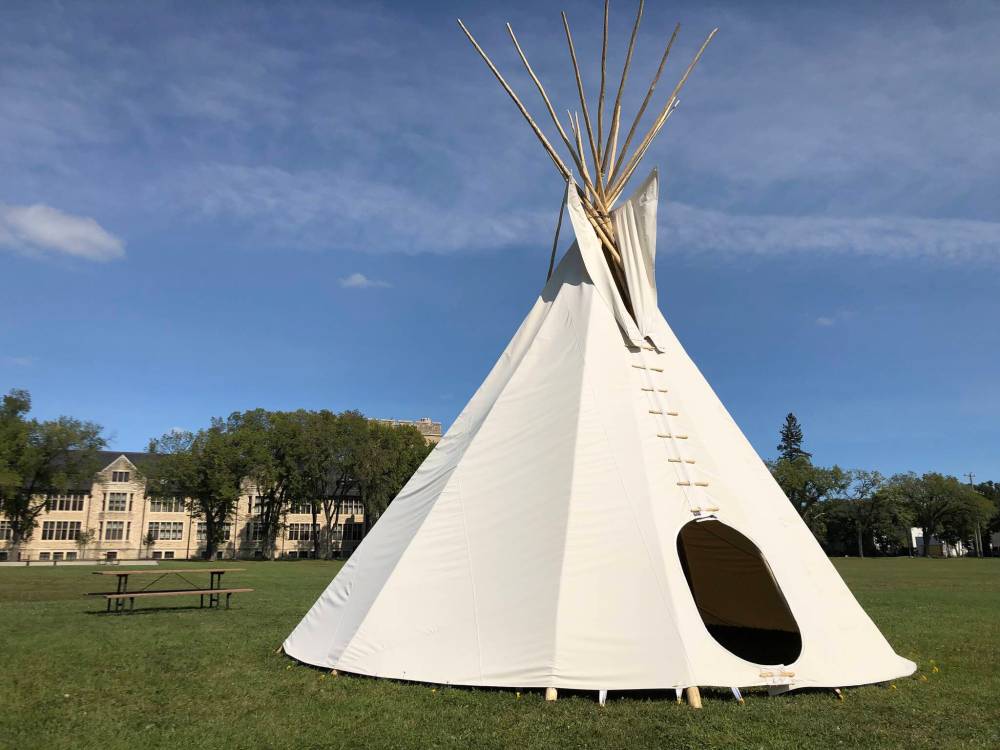
A teepee was erected at Canadian Mennonite University as a way to honour the land and acknowledge the presence of Indigenous students at the school.
And she said it’s not just decorative.
“It’s a place to host elders or have sacred fires.”
Anderson, who is Ojibwe and Cree, is one of about 40 Indigenous students at the school of 550 students.
It is part of the larger goal to promote CMU as a “safe space” for Indigenous students, said the music student, adding she personally feels welcome there.
Kelly Selkirk is a post-secondary co-ordinator at Fisher River Cree Nation. She served as an adviser to the CMU Indigenous Student Group as they went about working with the university to procure and set up the teepee.
The teepee represents how “CMU has taken on the responsibility for reconciliation in a meaningful and thought-out manner,” she said.
“Sometimes organizations do a lot of talk, but not much action. CMU is trying to do the work, understand what its responsibilities are,” she said.
The teepee was purchased last year, but COVID-19 restrictions prevented its use, said Charlie Peronto, director of student life.
He pointed out the structure was paid for by the student council and CMU.
A ceremony with an elder was held when the teepee went up.
“We learned each pole has a meaning,” Peronto said, noting about 100 people gathered to watch during the two hours it took to erect.
For Peronto, the teepee is “more than a symbol. It’s a sign of CMU’s promise to future collaboration with Indigenous people. We want it to be a conversation starter, to open doors to discussion, to be a place to gather.”
It’s also part of CMU’s commitment to “making Indigenous students feel at home here as we honour their heritage, language and culture and show it is respected and valued.”
Last year the university unveiled special Treaty One uniforms for its sports teams.

“We see ourselves as a school with Mennonite in the name that is far beyond Mennonites,” Peronto said, noting only about 30 per cent of students at the school come from Mennonite backgrounds.
Knowledge keeper Mervin McKay told CMU “the teepee now belongs to you. It’s your responsibility to remember the teachings and to follow through on what they mean in your own lives.”
“With honour we accept that call as a step in our path to truth and reconciliation,” said CMU president Cheryl Pauls.
The teepee will remain up until mid-October and will then be put away for the winter.
faith@freepress.mb.ca
The Free Press is committed to covering faith in Manitoba through our Religion in the News project. This reporting continues because readers like you step forward to fund it.
Donate now to support our reporting on religion.
Your donation is eligible for a charitable tax receipt.
BECOME A FAITH JOURNALISM SUPPORTER
John Longhurst has been writing for Winnipeg's faith pages since 2003. He also writes for Religion News Service in the U.S., and blogs about the media, marketing and communications at Making the News.
Our newsroom depends on a growing audience of readers to power our journalism. If you are not a paid reader, please consider becoming a subscriber.
Our newsroom depends on its audience of readers to power our journalism. Thank you for your support.
The Free Press is committed to covering faith in Manitoba through our Religion in the News project. This reporting continues because readers like you step forward to fund it.
Donate now to support our reporting on religion.
Your donation is eligible for a charitable tax receipt.
BECOME A FAITH JOURNALISM SUPPORTER
John Longhurst has been writing for Winnipeg's faith pages since 2003. He also writes for Religion News Service in the U.S., and blogs about the media, marketing and communications at Making the News.
Our newsroom depends on a growing audience of readers to power our journalism. If you are not a paid reader, please consider becoming a subscriber.
Our newsroom depends on its audience of readers to power our journalism. Thank you for your support.
Related Articles
Indigenous education conversation ‘has really shifted in schools’
Advertisement Advertise With Us
Advertisement Advertise With Us
The Free Press acknowledges the financial support it receives from members of the city’s faith community, which makes our coverage of religion possible.