Marking history of Mennonites in Canada

Tour celebrates migration from Russia in1920s

Advertisement

Advertise with us

Just before he died in 2014, Ingrid Riesen Moehlmann’s father made a request to her: Find a way to celebrate the arrival in Canada of Mennonites who fled Russia in the 1920s.

Read this article for free:


or

Already have an account? Log in here »

To continue reading, please subscribe:

Subscribe and receive a limited-edition Free Press branded hat or tote.

Digital Subscription

One year of digital access for only $205*

  • Enjoy unlimited reading on winnipegfreepress.com
  • Read the E-Edition, our digital replica newspaper
  • Access News Break, our award-winning app
  • Play interactive puzzles

*First annual payment billed as $205.00 + GST for one year. This annual subscription will automatically renew at $233.00 + GST every 52 weeks (10% off the regular annual price of $259.35). Offer available to new and qualified returning subscribers only. Cancel any time.

To continue reading, please subscribe:

Add Free Press access to your Brandon Sun subscription for only an additional

$1 for the first 4 weeks*

  • Enjoy unlimited reading on winnipegfreepress.com
  • Read the E-Edition, our digital replica newspaper
  • Access News Break, our award-winning app
  • Play interactive puzzles
Start now

*Your next Brandon Sun subscription payment will increase by $1.00 and you will be charged $17.95 plus GST for four weeks. After four weeks, your payment will increase to $24.95 plus GST every four weeks.

Hey there, time traveller!
This article was published 02/07/2022 (1542 days ago), so information in it may no longer be current.

Just before he died in 2014, Ingrid Riesen Moehlmann’s father made a request to her: Find a way to celebrate the arrival in Canada of Mennonites who fled Russia in the 1920s.

“Those were his last words to me,” said Riesen Moehlmann, a language consultant for the River East Transcona School Division. “He asked me to organize an event to commemorate the Mennonite migration to Canada from Russia. That story was an all-consuming passion for him. He was afraid it was being lost and forgotten.”

She is fulfilling his dying wish through the “Memories of Migration: Russlaender (Russian Mennonite) Tour 100” to mark the 100th anniversary of Mennonites coming to Canada from Russia.
MIKAELA MACKENZIE / WINNIPEG FREE PRESS
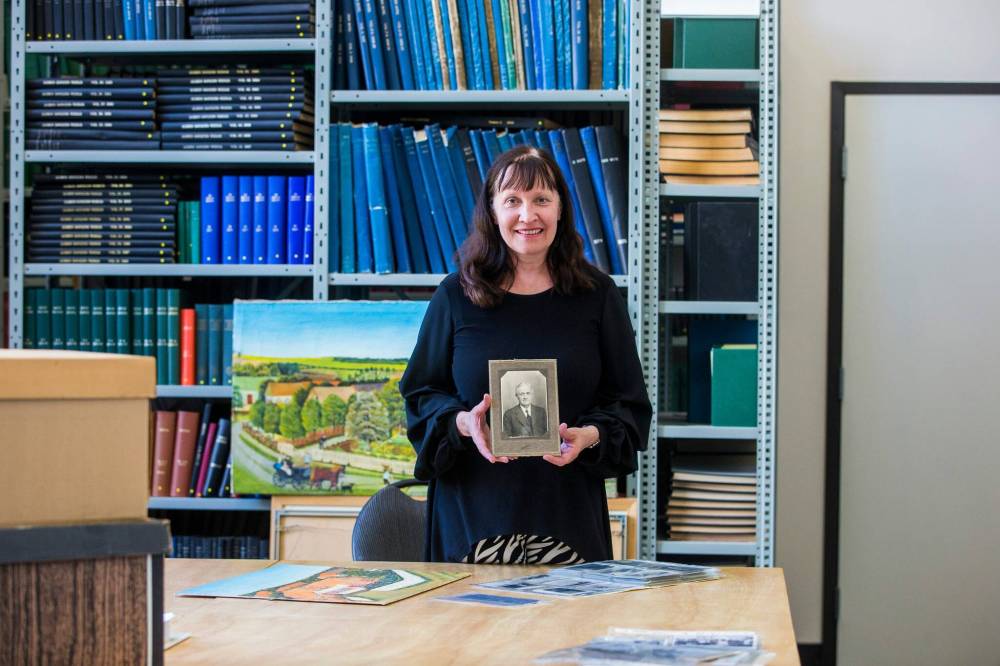
Ingrid Riesen Moehlmann, who is organizing a tour marking the 100th anniversary of the 1920s arrival of Mennonites from Russia in Canada, holds a portrait of her great-grandfather David Toews at the Mennonite Heritage Archives in Winnipeg.
MIKAELA MACKENZIE / WINNIPEG FREE PRESS Ingrid Riesen Moehlmann, who is organizing a tour marking the 100th anniversary of the 1920s arrival of Mennonites from Russia in Canada, holds a portrait of her great-grandfather David Toews at the Mennonite Heritage Archives in Winnipeg.

The cross-Canada train tour, which will re-enact the historic migration of 21,000 Mennonites from Russia to Canada between 1923 and 1930, will take place from July 6 to 25, 2023.

The tour, which is being organized under the auspices of the Mennonite Historical Society of Canada, together with Tourmagination of Waterloo, Ont., will celebrate the faith of the Mennonites, memorialize the challenges they faced as settlers in Canada, and acknowledge their impact on Indigenous people, especially on the Prairies.

For Riesen Moehlmann’s father, David Riesen, the subject was personal.

He was the grandson of David Toews, who played a key role in persuading then-prime minister William Lyon Mackenzie King to let the Mennonites into Canada. He also helped negotiate with the Canadian Pacific Railway to advance $2 million in credit to the immigrants to transport them to their new homes in this country.

For the rest of his life, Toews collected the travel debt, or reiseschuld, which each family promised to pay. It was finally repaid in full in 1946, six months before he died.

“To say that this story had an impact on our family is an understatement,” Riesen Moehlmann said.

Due to the important role played by the CPR, the tour is using Via Rail, departing from Quebec City and arriving in Abbotsford, B.C.

The tour is broken into three parts; from Quebec City to Kitchener, Ont.; from Toronto to Saskatoon; and from Saskatoon to Abbotsford, B.C. Participants can take only one portion, or the entire tour. Sixty people have signed up so far; Riesen Moehlmann is hoping for 100.
MIKAELA MACKENZIE / WINNIPEG FREE PRESS
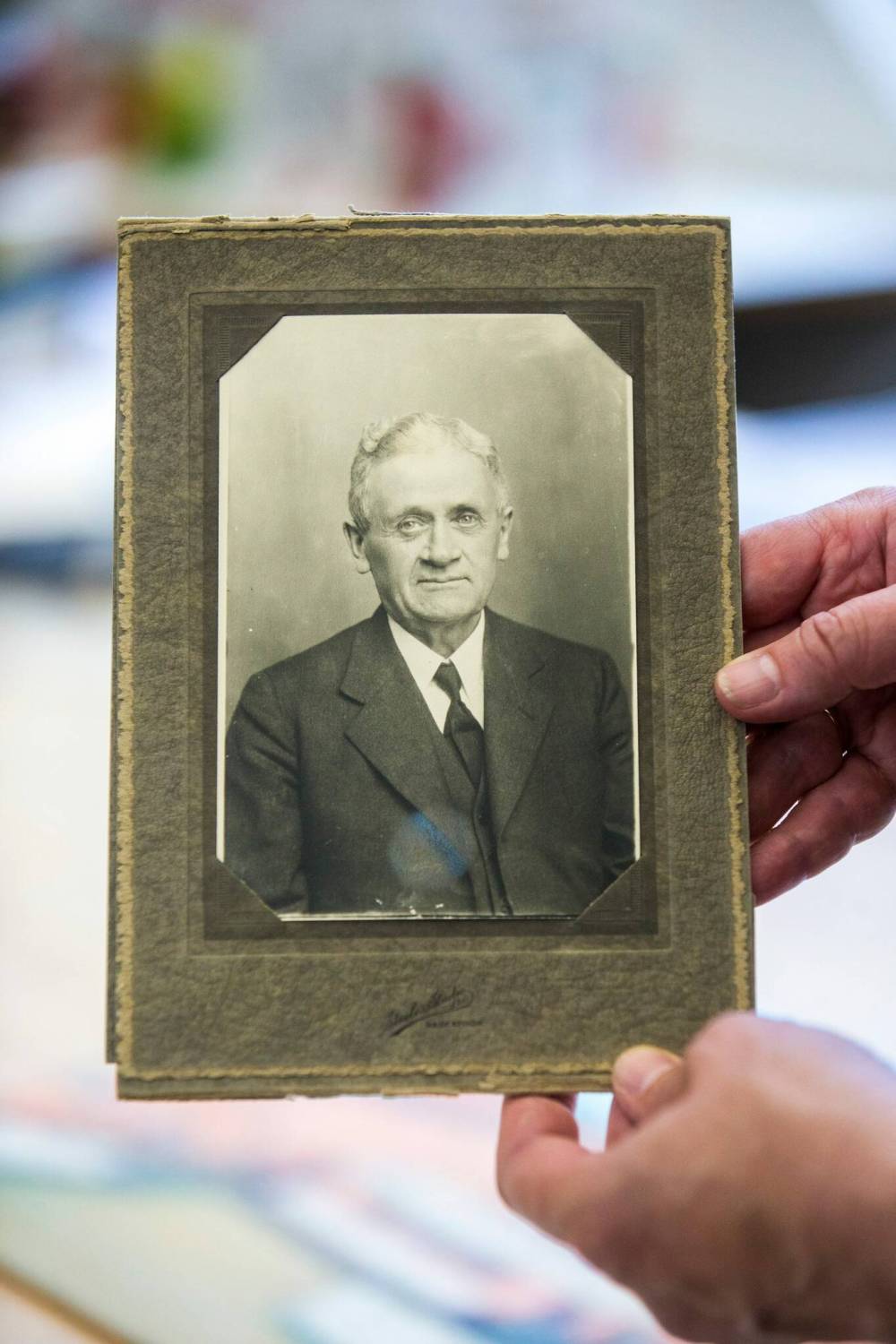
Ingrid Riesen Moehlmann, who is organizing a tour marking the 100th anniversary of the arrival of Mennonites fleeing Russia to Canada, holds up a photo of her great-grandfather at the Mennonite Heritage Archives (which is a stop on the tour) in Winnipeg on Thursday, June 30, 2022. Her great-grandfather helped bring many Russian Mennonites to Canada in the 1920s. For John Longhurst story. Winnipeg Free Press 2022.
MIKAELA MACKENZIE / WINNIPEG FREE PRESS Ingrid Riesen Moehlmann, who is organizing a tour marking the 100th anniversary of the arrival of Mennonites fleeing Russia to Canada, holds up a photo of her great-grandfather at the Mennonite Heritage Archives (which is a stop on the tour) in Winnipeg on Thursday, June 30, 2022. Her great-grandfather helped bring many Russian Mennonites to Canada in the 1920s. For John Longhurst story. Winnipeg Free Press 2022.

While in Manitoba, tour participants will be able to visit the local Mennonite archives, the Mennonite Heritage Museum in Steinbach, see a commissioned play by the Winnipeg Mennonite Theatre Company, attend an academic conference on Mennonite migration and join locals at a saengerfest, a free choral concert, at the Centennial Concert Hall on July 15. All proceeds collected at the event will go to the Mennonite Central Committee for its refugee work.

“My dad wanted people who traced their history to those Russian Mennonites to remember that history,” she said, adding her mother’s entire family came to Canada at that time, escaping “civil war, anarchists and starvation and the horrors of Stalinist Russia which were still to come.”

Through the tour, Riesen Moehlmann, a member of Winnipeg’s First Mennonite Church, hopes Canadian Mennonites who trace their roots to that migration will “remember who we are and where we come from, and what that means today.”

For information about the tour, visit http://wfp.to/ozn.

faith@freepress.mb.ca

The Free Press is committed to covering faith in Manitoba through our Religion in the News project. This reporting continues because readers like you step forward to fund it.

Donate now to support our reporting on religion.

Your donation is eligible for a charitable tax receipt. BECOME A FAITH JOURNALISM SUPPORTER

John Longhurst

John Longhurst
Faith reporter

John Longhurst has been writing for Winnipeg's faith pages since 2003. He also writes for Religion News Service in the U.S., and blogs about the media, marketing and communications at Making the News.

Our newsroom depends on a growing audience of readers to power our journalism. If you are not a paid reader, please consider becoming a subscriber.

Our newsroom depends on its audience of readers to power our journalism. Thank you for your support.

Report Error Submit a Tip

The Free Press acknowledges the financial support it receives from members of the city’s faith community, which makes our coverage of religion possible.

More Stories

Sharpeville massacre survivors file class action lawsuit in South Africa

Michelle Gumede, The Associated Press 4 minute read Thursday, Sep. 3, 2026

JOHANNESBURG (AP) — More than six decades after South African apartheid police opened fire on an unarmed crowd protesting pass laws in Sharpeville, a township south of Johannesburg, survivors and relatives of the victims announced on Thursday they would launch a class-action lawsuit against the government.

At a media briefing held in Sharpeville, lawyers said the case seeks compensation and asks a court to strike down the 1961 Indemnity Act, which they say prevented victims from pursuing claims arising from the massacre and remains in force today.

Police shot at an unarmed crowd protesting apartheid pass laws on March 21, 1960, and drew international condemnation. Apartheid-era police records put the toll at 69 dead and 180 injured, while research cited by the plaintiffs says at least 91 people were killed and more than 238 wounded.

The massacre became a defining moment in the struggle against apartheid, with March 21 now observed in South Africa as Human Rights Day, a public holiday.

Thief steals almost $70K in Pokémon cards from flea-market owner

Scott Billeck 5 minute read Preview

Thief steals almost $70K in Pokémon cards from flea-market owner

Scott Billeck 5 minute read 2:11 PM CDT

The owner of a local flea market was left feeling disrespected and in disbelief after roughly $70,000 worth of Pokémon products were stolen over the weekend, but is vowing to rebuild.

Kenan Hyseni, who has owned and operated the popular Mulvey Market in South Osborne since 2022, said high-end sealed products and valuable individual cards from the massively popular collectible card game were stolen sometime between the market’s closing Friday night and midnight.

Hyseni believes someone hid inside the market until employees had left for the night, loaded up the merchandise and fled.

“The night finished, we locked up, did the usual thing, and then we went home and just before midnight, I got a call from the landlord and they said the alarm had been tripped, and that someone was seen leaving the market with bags,” Hyseni said.

Read
2:11 PM CDT

Former private-school teacher jailed nine months for luring after sending messages declaring love for teen

Dean Pritchard 4 minute read Preview

Former private-school teacher jailed nine months for luring after sending messages declaring love for teen

Dean Pritchard 4 minute read 5:06 PM CDT

A former Catholic school teacher who sent inappropriate romantic messages to a teenage student, professing his love for her, has been sentenced to nine months in jail.

Ketan Badiani, 59, previously pleaded guilty to one count of child luring connected to more than 150 messages he sent the girl between October 2024 and March 2025 while a teacher at St. Maurice School.

Provincial court Judge Tim Killeen said he was satisfied Badiani had no sexual intent in sending the messages, noting a forensic psychologist’s report that described him as a lonely, isolated man with few friends and a limited history of social interaction.

“He appears to have genuinely cared for (the student) and somehow thought she would reciprocate his feelings,” Killeen said.

Read
5:06 PM CDT

Letters, Sept. 21

7 minute read 2:00 AM CDT

Treat the disease

I understand there are valid concerns regarding specific short term rentals (STR) in Winnipeg. However, the article raised other alarms for me.

Winston Yee, the city’s manager of licensing and bylaw enforcement, stated the purpose of the new requirement (reporting 911 calls for STR) is “so we can become aware of issues.” So he isn’t aware of “the issues” yet? Are there not systems in place to obtain this information? Doesn’t the city know which addresses have high calls for emergency service? I sure hope the city’s systems aren’t so antiquated that it can’t cross-reference emergency calls with the STR registry.

I think the focus needs to be on the behavior, rather than the ownership structure. Part of the proposed solution to “parties, noise, violence, vandalism and other criminal activity” is to require owners of STR to advise the city when an emergency responder attends the property.

Slovenia wins Olympic debut of ski jumping mixed team

Larry Lage, The Associated Press 3 minute read Preview

Slovenia wins Olympic debut of ski jumping mixed team

Larry Lage, The Associated Press 3 minute read Monday, Feb. 7, 2022

ZHANGJIAKOU, China (AP) — Slovenia won the first Olympic ski jumping mixed team gold medal on Monday.

The team of Ursa Bogataj, Nika Kriznar, Peter Prevc and Timi Zajc had 1,000.5 points, dominating the competition by more than 100 points.

Prevc jumped last and soared 101.5 meters (333 feet) and had 126.3 points to seal the top spot on the podium for the Slovenians.

Russia won silver and Canada, in a surprise, earned bronze.

Read
Monday, Feb. 7, 2022

From footnote to martyr: execution altered Scott’s place in history

Tom Brodbeck 5 minute read Preview

From footnote to martyr: execution altered Scott’s place in history

Tom Brodbeck 5 minute read Friday, Feb. 14, 2020

When Thomas Scott was marched outside the walls of Upper Fort Garry and executed by firing squad, it forever changed how history would treat Louis Riel and the Red River Resistance. The killing of Scott, whether a misguided error by Riel or an unavoidable step to prevent further bloodshed, would turn out to be one of the most pivotal events of the resistance.

Only a month after the Irish-born Canadian was condemned to death in March 1870, Riel opponents in Ontario used Scott’s execution to whip up anti-Métis sentiment in an effort to sabotage negotiations between Ottawa and the Red River Settlement. It nearly worked. Two of three Red River delegates sent to Ottawa to negotiate the terms of Manitoba’s entry into confederation were arrested on arrival (but later released) for Scott’s death. At the same time, Prime Minister John A. Macdonald was under increasing political pressure to send military troops to quell the resistance in Red River, rather than engage in peaceful negotiations.

Scott’s death didn’t just complicate matters for the Red River delegates. It undermined their efforts to bargain with Ottawa.

Scott was tried and convicted by a “military council” on March 3 for rebelling against the provisional government and attacking a Métis guard at Upper Fort Garry, where he and other political prisoners were held. The trial wasn’t conducted under normal court rules, even by 1870 Red River standards. Scott had no defence counsel and wasn’t present for much of the proceedings, which were conducted in French (a language he didn’t understand). Riel, one of the chief witnesses in the case, had to act as translator. The military council was not unanimous in its decision to sentence Scott to death. Some felt the penalty was too harsh.

Read
Friday, Feb. 14, 2020