After Roe’s demise, clergy lead faithful in praise, laments
Advertisement
Read this article for free:
or
Already have an account? Log in here »
To continue reading, please subscribe:
Digital Subscription
One year of digital access for only $1.44 a week*
- Enjoy unlimited reading on winnipegfreepress.com
- Read the E-Edition, our digital replica newspaper
- Access News Break, our award-winning app
- Play interactive puzzles
*Billed as $5.77 plus GST every four weeks. After 52 weeks, price increases to the regular rate of $19.95 plus GST every four weeks. Offer available to new and qualified returning subscribers only. Cancel any time.
To continue reading, please subscribe:
Add Free Press access to your Brandon Sun subscription for only an additional
$1 for the first 4 weeks*
- Enjoy unlimited reading on winnipegfreepress.com
- Read the E-Edition, our digital replica newspaper
- Access News Break, our award-winning app
- Play interactive puzzles
*Your next Brandon Sun subscription payment will increase by $1.00 and you will be charged $17.95 plus GST for four weeks. After four weeks, your payment will increase to $24.95 plus GST every four weeks.
Read unlimited articles for free today:
or
Already have an account? Log in here »
Hey there, time traveller!
This article was published 26/06/2022 (1589 days ago), so information in it may no longer be current.
Praise and lament for the overturning of abortion rights filled sacred spaces this weekend as clergy across the U.S. rearranged worship plans or rewrote sermons to provide their religious context — and competing messages — about the historic moment.
Abortion is a visceral issue for deeply divided religious Americans. Some are sad or angry in the wake of the U.S. Supreme Court’s seismic Dobbs v. Jackson decision Friday. Others are grateful and elated.
At St. Paul Cathedral in Pittsburgh, the Very Rev. Kris Stubna discarded his planned Sunday homily and focused on the decision, calling it “a day of great joy and blessing.” He said the overturning of the nearly 50-year-old Roe v. Wade ruling was the result of prayers and efforts of many Catholics and others.
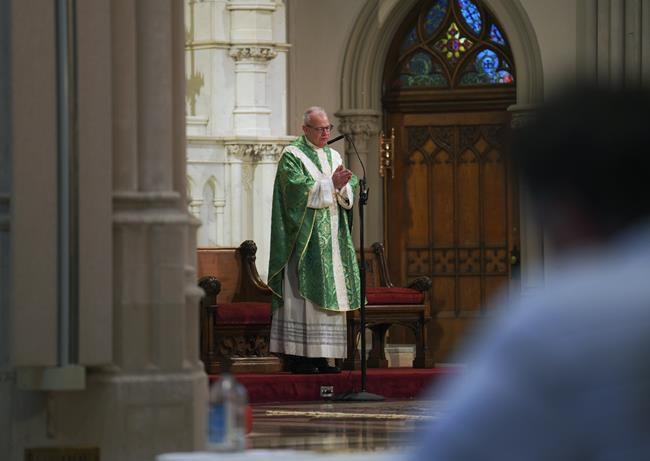
“This law violated the very law of God, that every life is sacred,” he said. “A person cannot support abortion and still be a faithful member of the church.”
Stubna’s comments would be considered divisive by some since U.S. Catholics disagree on abortion rights. Supporters include high-profile members of the faith like President Joe Biden and House Speaker Nancy Pelosi who face Communion restrictions as a result.
Not everyone sat through Stubna’s entire homily. Although unable to ask their reasons, an Associated Press photographer saw one woman leave during it. Security personnel estimated three others also exited early.
Views on abortions are not just polarizing within denominations; the divisions span the religious landscape.
“SCOTUS just dealt a terrible blow to women, to girls, to all childbearing people, to freedom,” said the Rev. Jacqui Lewis, senior minister at Middle Collegiate Church, a multicultural Protestant congregation in Manhattan.
She mourned the overturning of Roe, expressing deep emotions during a service Sunday, saying, “It took safe legal abortions off the table, opening the door for states to rush in and crush reproductive justice. We are reeling. Spinning. So hurt we can hardly move. We are feeling the loss, the pain of it.”
A majority of adults from Buddhist, Hindu, historically Black Protestant, Jewish, mainline Protestant, Muslim and Orthodox Christian faiths support legal abortion in all or most cases, according to a Pew Research Center’s Religious Landscape Study.
Rabbi Sarah DePaolo carved out time at the start of Friday night’s Shabbat service at Congregation Shir Ha-Ma’alot in Irvine, California, to express her disappointment, urging community members to support each other and create space for the fearful.
“One of the most upsetting things about this decision is that while it claims to represent people of faith, it does not represent our faith,” DePaolo said. “It does not reflect our Jewish law. It does not reflect our traditions. It does not reflect our community.”
Catholics are split on the issue while most evangelical Protestants, Jehovah’s Witnesses and members of the Church of Jesus Christ of Latter-day Saints say abortion should be illegal in all or most instances, according to the Pew Research Center study.
The Rev. Samuel Rodriguez, president of the National Hispanic Christian Leadership Conference, views the ruling as a moral and spiritual victory. On Sunday, he told his California congregation at New Season that now is the time for an unprecedented adoption movement.
“We’re gonna adopt babies, but we’re gonna adopt moms, pregnant moms … who have abortions because they can’t afford to have a baby,” he said.
Southern Baptists, who are members of the nation’s largest Protestant denomination, are staunch supporters of anti-abortion views. On Sunday, several pastors praised the ruling from their pulpits.
The congregation at First Baptist Concord in Knoxville, Tennessee, broke into applause when Pastor John Mark Harrison addressed it. He invited a panel of advocates to explain how everyone can continue supporting those with unwanted pregnancies via mentorship, fostering, adoption, addressing systemic issues and more.
“There’s so much anger and emotion,” Harrison said. “What we need to understand is that we’re not called to fuel the emotions of the right or the left. We’re called to walk in and through the gospel of Jesus Christ … and minister to real people in real times of crisis.”
At Central Church, in College Station, Texas, lead Pastor Phillip Bethancourt echoed that overturning Roe is not the finish line: “It’s the starting gate of a new chapter. Abortion should be not just be unlawful but unnecessary and unthinkable.”
David Rhoades, lead pastor of Broadview Baptist Church in Lubbock, Texas, said in an email the court decision was on a par with the Emancipation Proclamation and Juneteenth, and will reverberate for years.
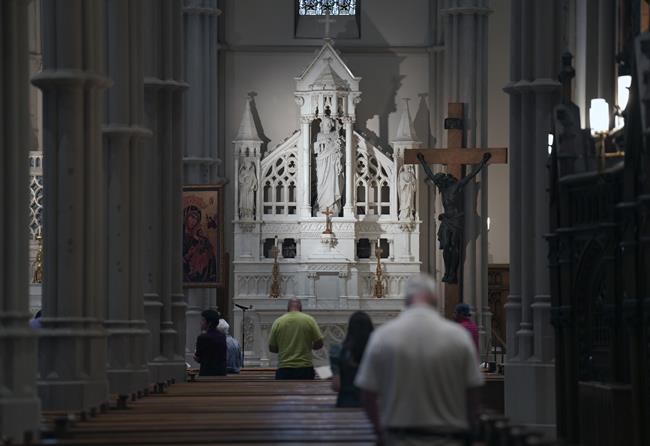
He hoped church members left Sunday’s service with a clear understanding of what they must do next, including ”minister to both the baby and its mother, and continue to work to elect pro-life representatives.”
Other faith leaders doubled down on their support for abortion rights.
Women should be able to make their own decisions, preached the Rev. Fletcher Harper at the Episcopal Church of Our Saviour in Secaucus, New Jersey.
“Outlawing abortion is a sinful act that perpetuates male domination and the subjugation of women,” he said. “It extends the coercive power of the state into a place where it should have no business.”
During a service Sunday at the Unitarian Universalist Church of the South Hills in Mt. Lebanon, Pennsylvania, director of music Mary Pratt read aloud a denominational statement affirming it would remain “committed to reproductive justice.”
Pratt said members were shocked and grieving, although they expected the outcome. “They were looking for reminders of why we need to get back out and fight,” she said.
The start of services at Pilgrim United Church of Christ in Durham, North Carolina, included two verses of “We Shall Overcome” and a prayer by the Rev. Melinda Keenan Wood for those outraged, heartbroken and fearful about Roe’s demise.
“We know that this decision will be measured in deaths, incarcerations and life-altering trauma as politicians rush to control the most painfully intimate of decisions,” Keenan Wood said.
A prominent Black pastor in Columbus, Ohio — Bishop Timothy Clarke of the First Church of God — tried to strike a balance in his Saturday message to congregants, acknowledging conflicting views on abortion and calling on the church to show compassion.

“I know and love persons in both camps,” Clarke said. “They are sincere, committed. … They truly see this as a life altering issue.”
___
Meyer reported from Nashville, Tennessee, and Crary from New York. AP Religion Team members Peter Smith and Jessie Wardarski in Pittsburgh; Luis Andres Henao, in Princeton, New Jersey; Mariam Fam in Winter Park, Florida; Deepa Bharath in Los Angeles; and AP writer Tom Foreman Jr. in Winston-Salem, North Carolina, contributed.
___
Associated Press religion coverage receives support through the AP’s collaboration with The Conversation US, with funding from Lilly Endowment Inc. The AP is solely responsible for this content.
Related Articles
Roe v. Wade decision prompts protests in Canada
Advertisement Advertise With Us
Advertisement Advertise With Us
The Free Press acknowledges the financial support it receives from members of the city’s faith community, which makes our coverage of religion possible.