Pope cracks down on new Catholic religious start-ups

Advertisement

Advertise with us

ROME (AP) — Pope Francis has taken another step to reign in new religious groups in the Catholic Church after their unregulated proliferation in recent decades led to abuses in governance that allowed spiritual and sexual misconduct to go unchecked.

Read this article for free:


or

Already have an account? Log in here »

To continue reading, please subscribe:

Subscribe and receive a limited-edition Free Press branded hat or tote.

Digital Subscription

One year of digital access for only $205*

  • Enjoy unlimited reading on winnipegfreepress.com
  • Read the E-Edition, our digital replica newspaper
  • Access News Break, our award-winning app
  • Play interactive puzzles

*First annual payment billed as $205.00 + GST for one year. This annual subscription will automatically renew at $233.00 + GST every 52 weeks (10% off the regular annual price of $259.35). Offer available to new and qualified returning subscribers only. Cancel any time.

To continue reading, please subscribe:

Add Free Press access to your Brandon Sun subscription for only an additional

$1 for the first 4 weeks*

  • Enjoy unlimited reading on winnipegfreepress.com
  • Read the E-Edition, our digital replica newspaper
  • Access News Break, our award-winning app
  • Play interactive puzzles
Start now

*Your next Brandon Sun subscription payment will increase by $1.00 and you will be charged $17.95 plus GST for four weeks. After four weeks, your payment will increase to $24.95 plus GST every four weeks.

Hey there, time traveller!
This article was published 15/06/2022 (1576 days ago), so information in it may no longer be current.

ROME (AP) — Pope Francis has taken another step to reign in new religious groups in the Catholic Church after their unregulated proliferation in recent decades led to abuses in governance that allowed spiritual and sexual misconduct to go unchecked.

Francis issued a new decree published Wednesday that requires prior Vatican approval for bishops to erect new associations of the faithful, often the first step in the creation of a new apostolic society or institute of consecrate life.

The decree follows a similar one issued in 2020 that required prior Vatican approval for d iocesan-level religious orders, suggesting the Vatican was now cracking down even further to better regulate the origins of these new forms of religious life and take the decisions about them out of the hands of local bishops.
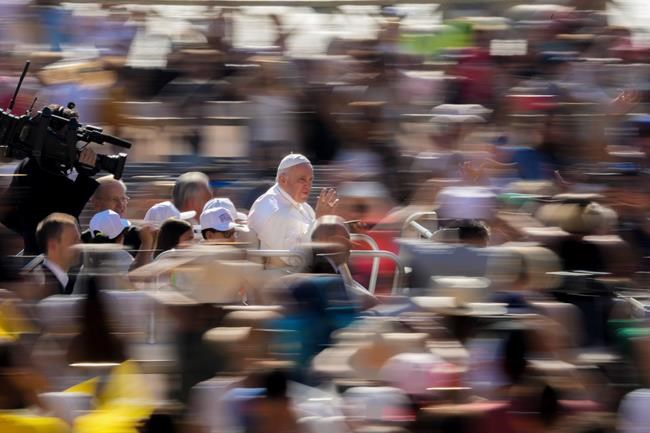
Pope Francis arrives to his weekly general audience in St. Peter's Square at The Vatican Wednesday, June 15, 2022. (AP Photo/Andrew Medichini)

Francis has taken a series of disciplinary and regulatory actions in recent years after some founders and leaders of religious orders and new lay institutes turned out to be religious frauds who sexually and spiritually abused their members.

Some groups have been suppressed, others have been taken over by the Vatican for periods of reform while all have become subject to greater Vatican oversight.

In 2021, the Vatican also imposed term limits on the leaders of lay movements, which proliferated following the second Vatican Council in the 1960s as a new way for rank-and-file Catholics to get involved in the church beyond typical parish life. The Vatican said the term limits were necessary to prevent personality cults from arising around charismatic leaders.

One lay group targeted by the new reform was Communion and Liberation, an influential group in Italy that has a consecrated branch with a few members who help run the household of Emeritus Pope Benedict XVI.

The term limits last year forced out Communion and Liberation’s Spanish head, the Rev. Julian Carron, who had been in charge since 2005.

Just this week, the head of the Vatican’s laity office, Cardinal Kevin Farrell, wrote to Carron’s successor complaining that Carron and his followers were still exercising influence against the Vatican’s reforms. According to a copy of the letter, Farrell faulted what he said was the “false doctrine” Carron promoted, claiming the unique spirit of the group passed from the founder through leaders like himself.

Farrell said Communion and Liberation’s new leadership must accept the Vatican’s line and “recognize the problems and review the teachings, practices, methods of government and internal organization forms that were shown to be inadequate or even harmful.”

Report Error Submit a Tip

The Free Press acknowledges the financial support it receives from members of the city’s faith community, which makes our coverage of religion possible.

More Stories

Letters, Oct. 8

6 minute read 2:01 AM CDT

A call for digital revolution

Re: MPI on new path after Project Nova debacle (Oct. 6)

Computer scientist Melvin Conway once stated, “Any organization that designs a system (defined broadly) will produce a design whose structure is a copy of the organization’s communication structure.”

This is seen clearly in the Manitoba government’s online service. The Manitoba government has a “Data MB” portal to view government data sets, but data about vehicle collisions is only accessible from Manitoba Public Insurance’s Manitoba Collision Dashboard. If you need to find information on a Manitoba surgeon, that information is on Shared Health’s website, but if you need surgical wait times, that’s on the main government website.

This week’s silly geopolitical spat

Gwynne Dyer 4 minute read Yesterday at 2:01 AM CDT

“I would not like to call this an incident. Let’s say it’s a diplomatic misunderstanding,” said Ukrainian Foreign Affairs Minister Andrii Sybiha. But the South Korean president definitely sees it as a serious incident, and he has already gone public with it.

“If (Ukraine’s) refusal to acknowledge the facts and issue a public apology continues, we will take additional measures,” President Lee Jae-myung wrote on X. He probably means cutting the non-military aid South Korea gives to Ukraine. (There is no military aid, since the constitution bans Seoul from providing arms to a country actively involved in a war).

What monstrous misdeed did the Ukrainian government commit to deserve such harsh words from a country that is generally sympathetic to Ukraine’s struggle against its giant neighbour? Have the South Koreans discovered Ukrainian spies in the Blue House?

No, it’s what we professionals call a “spat.”

All sideshow, little substance

Editorial 4 minute read Preview

All sideshow, little substance

Editorial 4 minute read 2:00 AM CDT

Well, there’s one thing that can be said about Winnipeg’s 2026 mayoral race that sets it apart from most previous campaigns for city council’s top position:

It isn’t boring.

In most civic elections, the power of incumbency and/or familiarity gives one mayoral candidate such a profound advantage that the outcome is all but a foregone conclusion and the lead-up to voting day becomes both uninteresting and largely irrelevant.

This year’s race, to the contrary, has been noteworthy for the unusual level of friction, controversy and mud-slinging that has been injected into the early part of the campaign.

Read
2:00 AM CDT

‘Necessary active role’: corporate declaration of action adds initial signees

Gabrielle Piché 3 minute read Yesterday at 7:10 PM CDT

A model canoe took its maiden voyage Wednesday — into the arms of the National Centre for Truth and Reconciliation’s executive director.

Stephanie Scott and her team received the miniature wooden canoe during a ceremony at Assiniboine Park in Winnipeg.

They also left with a freshly signed corporate declaration of action, where national companies pledged their commitment to reconciliation.

“Your commitment, your courage is so important,” Scott told a room of roughly 15 people in the Pavilion. “It is a very long journey that we’re all on.”

Alzheimer’s has sent my mother back in time

Pam Frampton 5 minute read Preview

Alzheimer’s has sent my mother back in time

Pam Frampton 5 minute read Yesterday at 2:01 AM CDT

My mother does a lot of time-travelling — time-shifting, the Alzheimer’s Society calls it.

I wonder how it feels to be in the present at one moment and then suddenly catapulted deep into the past. Is it a jolting experience or a smooth transition to go back and forth in time?

Mom will never be able to tell me. There is so much she can never tell me now.

She can still recite her children’s names when prompted, but she doesn’t ask us about our lives. Instead, she talks about her younger siblings, their grandfather who was hard of hearing, the isolated place where they used to live whose inhabitants were resettled nearly 60 years ago.

Read
Yesterday at 2:01 AM CDT

Fantastical, moving graphic memoir explores addictions, organ procurement and more

Reviewed by Candida Rifkind 4 minute read Preview

Fantastical, moving graphic memoir explores addictions, organ procurement and more

Reviewed by Candida Rifkind 4 minute read Saturday, May. 30, 2026

At the heart of Mary Shelley’s 1818 classic Frankenstein and its many pop culture adaptations is the scene in the mad scientist’s lab where Victor Frankenstein, helped by a bolt of lightning, animates the grotesque figure made out of human and animal parts lying on his anatomy table.

As much as Shelley’s novel is a philosophical investigation into the desire of modern science to create new life, it is also a gruesome window into the clandestine European trade in graveyard and battlefield body snatching that fuelled early 19th-century anatomy research, medical training and public dissection theatres.

Whose bodies ended up on the slab to advance medical knowledge? As Montreal-based artist Arizona O’Neill explains in her captivating first graphic narrative, it was inevitably poor, racialized and criminalized bodies that were deemed appropriate for the indignities of public display and dissection in earlier periods.

But what about today? This is the central question driving the story of Opioids & Organs, O’Neill’s beautifully drawn story of coming to terms with her father’s untimely death due to a fentanyl overdose as well as the awful truth that Canada’s post-2015 opioid crisis has greatly increased the number of organs available for donation, mostly from otherwise healthy young men like her father.

Read
Saturday, May. 30, 2026