Vatican Museum’s Indigenous ‘gifts’ belong in Canada, delegates say

Advertisement
Read this article for free:
or
Already have an account? Log in here »
To continue reading, please subscribe:
Digital Subscription
One year of digital access for only $1.44 a week*
- Enjoy unlimited reading on winnipegfreepress.com
- Read the E-Edition, our digital replica newspaper
- Access News Break, our award-winning app
- Play interactive puzzles
*Billed as $5.77 plus GST every four weeks. After 52 weeks, price increases to the regular rate of $19.95 plus GST every four weeks. Offer available to new and qualified returning subscribers only. Cancel any time.
To continue reading, please subscribe:
Add Free Press access to your Brandon Sun subscription for only an additional
$1 for the first 4 weeks*
- Enjoy unlimited reading on winnipegfreepress.com
- Read the E-Edition, our digital replica newspaper
- Access News Break, our award-winning app
- Play interactive puzzles
*Your next Brandon Sun subscription payment will increase by $1.00 and you will be charged $17.95 plus GST for four weeks. After four weeks, your payment will increase to $24.95 plus GST every four weeks.
Read unlimited articles for free today:
or
Already have an account? Log in here »
Hey there, time traveller!
This article was published 30/03/2022 (1677 days ago), so information in it may no longer be current.
ROME — As delegates from First Nations, Métis and Inuit communities travelled by bus from Rome’s airport to their hotel Sunday morning, a tour guide proudly pointed out various landmarks.
They included an ancient Egyptian obelisk in a square along the way — one of eight in Italy’s capital city taken from that country by the ancient Romans.
Nearing the hotel, the guide exclaimed about Santa Maria Maggiore, considered one of the “jewels” of the Catholic churches in Rome. The ceiling, she said, was gilded with some of the first gold from the Americas, given to Pope Alexander VI by King Ferdinand and Queen Isabella of Spain.
Listening to her, I wondered: how are the Indigenous people on the bus hearing this? In my mind I could hear them saying, “Oh, yeah, just more stuff stolen from us.”
That memory came to mind following a visit to the Vatican Museum on Wednesday.
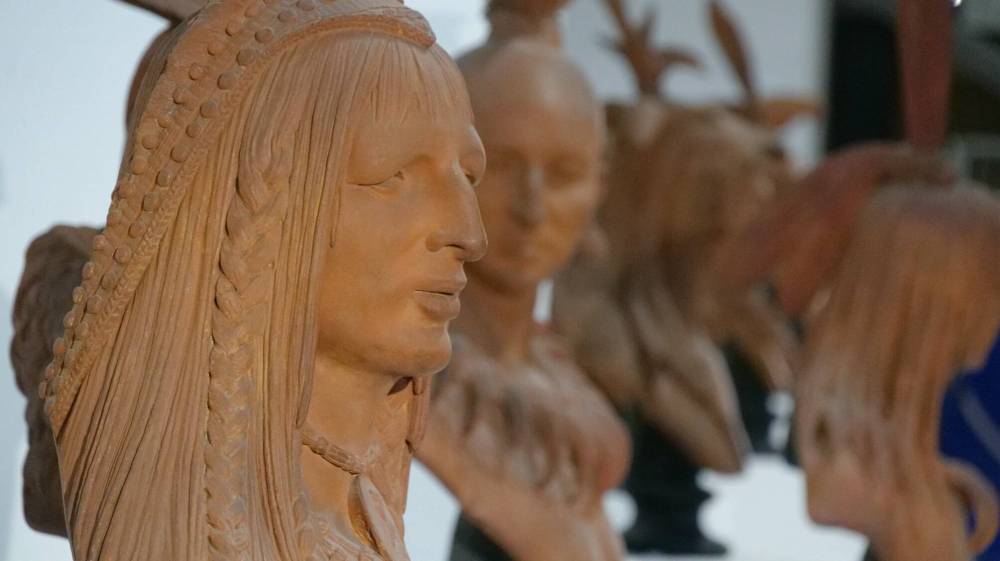
While on the tour, led by curator and lead preservationist Father Nicola Mapelli, delegates saw items from Canadian Indigenous groups, including carvings, masks, gloves, pipes, rugs and wampum belts.
Most of the objects were collected by Pope Pius XI for a world mission exhibition in 1925.
The goal of the exhibition was to illustrate and promote the global mission work of the Catholic Church. More than 100,000 objects and documents were on display.
While the Vatican says the objects from Indigenous people were given as gifts, not everyone is so sure. Delegates insist further dialogue about the return of the items is required.
“Those artifacts tell a story about our communities. Those are our history,” said Métis National Council president Cassidy Caron. “We’ve heard from our survivors that many of them need that to go forward.”

“What they now need to recognize is that they hold things of ours that tell our story, and these are our priceless cultural works and they do need to come home.”
Rosanne Casimir, Kúkpi7 (Chief) of the Tk’emlúps te Secwépemc in Kamloops, B.C., was on the tour of the museum.
“I saw some things from B.C.,” she said. “I wish we had more time to be there to ask questions.”
In a response to the media coverage about the museum tour, the Canadian Conference of Catholic Bishops provided a statement about the artifacts.

The objects, the statement said, represent a cross-section of works by Indigenous artists and artisans from various regions of the country, and have been “preserved as part of a broader commitment to inclusiveness and dialogue and to celebrating diverse cultures around the world.”
The plan is for the objects to be compiled into a North American exhibit in the future.

Mapelli spoke to the delegates about his desire to work hand in hand with them to learn more about the artifacts and to seek their guidance about what should be returned to local communities, as well as what should be shared with the museum’s seven million annual visitors, the statement added.
“Father Mapelli has reached out to Indigenous leadership in Canada to discuss some of these artifacts and seek their guidance, with additional dialogue planned.”
John Longhurst is in Rome this week to cover the papal visit by Indigenous people for the Free Press. See coverage of the visit at www.winnipegfreepress.com/papalvisit
The Free Press is committed to covering faith in Manitoba through our Religion in the News project. This reporting continues because readers like you step forward to fund it.
Donate now to support our reporting on religion.
Your donation is eligible for a charitable tax receipt.
BECOME A FAITH JOURNALISM SUPPORTER
John Longhurst has been writing for Winnipeg's faith pages since 2003. He also writes for Religion News Service in the U.S., and blogs about the media, marketing and communications at Making the News.
Our newsroom depends on a growing audience of readers to power our journalism. If you are not a paid reader, please consider becoming a subscriber.
Our newsroom depends on its audience of readers to power our journalism. Thank you for your support.
Related Articles
Papal visit 2022: Full coverage from Rome

Advertisement Advertise With Us
Advertisement Advertise With Us
History
Updated on Wednesday, March 30, 2022 2:45 PM CDT: Adds cutline
The Free Press acknowledges the financial support it receives from members of the city’s faith community, which makes our coverage of religion possible.