‘Reconciliation was possible:’ Indigenous priest reconciles faith with identity

Advertisement

Advertise with us

Cristino Bouvette’s mind often goes to his grandmother when he thinks about reconciliation: her strength, her empathy and her ability to forgive. He is a Roman Catholic priest and his kokum, Amelia Mae Bouvette, was a residential school survivor.

Read this article for free:


or

Already have an account? Log in here »

To continue reading, please subscribe:

Subscribe and receive a limited-edition Free Press branded hat or tote.

Digital Subscription

One year of digital access for only $205*

  • Enjoy unlimited reading on winnipegfreepress.com
  • Read the E-Edition, our digital replica newspaper
  • Access News Break, our award-winning app
  • Play interactive puzzles

*First annual payment billed as $205.00 + GST for one year. This annual subscription will automatically renew at $233.00 + GST every 52 weeks (10% off the regular annual price of $259.35). Offer available to new and qualified returning subscribers only. Cancel any time.

To continue reading, please subscribe:

Add Free Press access to your Brandon Sun subscription for only an additional

$1 for the first 4 weeks*

  • Enjoy unlimited reading on winnipegfreepress.com
  • Read the E-Edition, our digital replica newspaper
  • Access News Break, our award-winning app
  • Play interactive puzzles
Start now

*Your next Brandon Sun subscription payment will increase by $1.00 and you will be charged $17.95 plus GST for four weeks. After four weeks, your payment will increase to $24.95 plus GST every four weeks.

Hey there, time traveller!
This article was published 24/03/2022 (1656 days ago), so information in it may no longer be current.

Cristino Bouvette’s mind often goes to his grandmother when he thinks about reconciliation: her strength, her empathy and her ability to forgive. He is a Roman Catholic priest and his kokum, Amelia Mae Bouvette, was a residential school survivor.

“She was a woman of deep faith,” Bouvette says from Calgary.

In recent years, Bouvette, 35, has been asked on numerous occasions how he reconciles being Indigenous and being a priest.
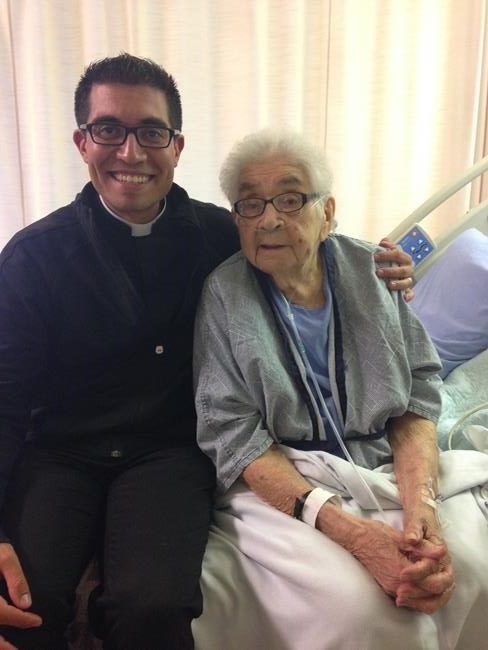
Cristino Bouvette (left), an Indigenous priest, says he often thinks of his grandmother, Amelia Mae Bouvette (right), a residential school survivor, when he considers the Catholic Church’s role in reconciliation. THE CANADIAN PRESS/HO-Gerald McMaster **MANDATORY CREDIT**

For a long time there was no conflict, he says. Christianity was ingrained in his grandmother. She grew up a member of the United Church of Canada and members of the family were ordained ministers.

Hymns echoed through the rooms of her Alberta farmhouse where a young Bouvette would eat his grandmother’s bannock and celebrate his Cree identity.

“There was a harmony, I would say, in all of those factors and components in my life.”

But when the young man was in seminary school, he became much more aware of the tragic implications of residential schools. It was then he thought to himself, “I wonder if this hurts kokum, that her grandson was going to become a priest?”

An estimated 150,000 Indigenous children were forced to attend residential schools over a century.

Amelia Mae Bouvette was seven in 1926 when she was removed from her family on the Saddle Lake Cree Nation in east-central Alberta and taken to the Edmonton Indian Residential School, which was operated by the United Church. She would stay there until 1938. Her grandson says it was a source of indescribable pain.

Decades later, after she’d raised 14 children and had careers helping her community, she was peeling potatoes with her grandson in her kitchen.

Was she offended or worried that he’d decided to become a priest, Bouvette asked?

His grandmother responded that she’d met good nuns and priests in her life, and she hoped he would be one of them.

“She was already then beginning to teach me that reconciliation was possible.”

His grandmother died in 2019 one month short of her 100th birthday.
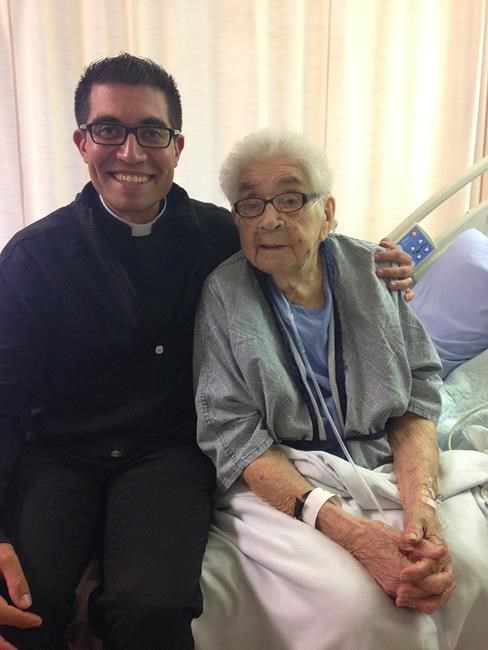
Cristino Bouvette (left), an Indigenous priest, says he often thinks of his grandmother, Amelia Mae Bouvette (right), who was a residential school survivor when he considers the Catholic Church’s role in reconciliation. THE CANADIAN PRESS/HO-Gerald McMaster **MANDATORY CREDIT**

The theme of a delegation to Rome next week is how Indigenous Peoples and the Catholic Church can come together toward healing and reconciliation.

In Winnipeg, Geraldine Shingoose has no intention to forgive or reconcile.

From Tootinaowaziibeeng First Nation in Manitoba, Shingoose spent nine years in the Muscowequan Residential School in Saskatchewan. Shingoose says her time there was her first real exposure to Christianity and it was a traumatic and abusive experience.

The school opened in the 1880s and closed in 1997. Unmarked graves were first discovered there during water line construction in the early 1990s.

In 2018 and 2019, at least 35 potential unmarked graves were located on the site with using ground-penetrating radar.

Shingoose says the injustices at residential schools were thrust back into the spotlight when 215 potential graves were found near the Kamloops Residential School in British Columbia last year.

Shingoose wanted answers.

“The Catholic Church committed a crime,” she says.

Shingoose went to St. Mary’s Cathedral in Winnipeg and sat outside for about 10 hours until she was able to get a meeting with the archbishop.

The conversation didn’t feel sincere and she did not feel heard, she says.

She doesn’t support the delegation to the Vatican and suggests it’s a “colonial tactic” the church is using to distract from ongoing injustices against Indigenous people.
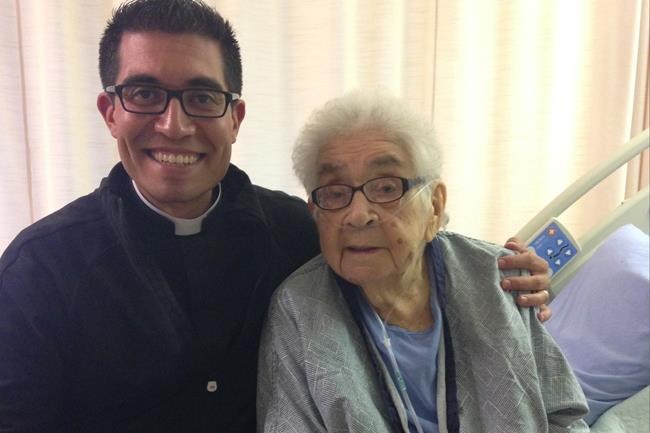
Cristino Bouvette (left), an Indigenous priest, says he often thinks of his grandmother, Amelia Mae Bouvette (right), who was a residential school survivor when he considers the Catholic Church’s role in reconciliation. THE CANADIAN PRESS/HO-Gerald McMaster **MANDATORY CREDIT**

“Would you go visit someone that murdered your child and ask them for an apology?”

Like many Indigenous people who are Christian and Catholic, recent discoveries of unmarked graves at former residential school sites have left Bouvette thinking deeply about the role and responsibility of the church to foster healing.

He understands how the delegation is important to some, but adds the church “cannot give the impression of checking boxes.”

Repairing the relationship and making amends happens in the quiet moments in the living room of a home on a First Nation, he says. It happens when he sits and listens to elders for hours and truly hears what they say.

“Regardless of what happens at the Vatican, regardless of whether the Pope comes to Canada, regardless of what the Pope has to say, there’s so much ongoing work that … we must not lose sight of,” Bouvette says. “We have been doing it and it needs to continue.”

Bouvette says the church must continue working toward forgiveness and understanding even if some Indigenous people aren’t ready to forgive. No number of apologies or money can take away the pain, he says, so reconciliation doesn’t have a timeline.

“We can’t talk about reconciliation if forgiveness is off the table.”

This report by The Canadian Press was first published March 24, 2022.

Report Error Submit a Tip

The Free Press acknowledges the financial support it receives from members of the city’s faith community, which makes our coverage of religion possible.
More Stories

Not making the grade: rethinking student assessment

Maggie Macintosh 5 minute read Preview

Not making the grade: rethinking student assessment

Maggie Macintosh 5 minute read Thursday, Oct. 5, 2023

As most students in B.C. began the new school year without traditional grades, a former Manitoba teacher living in that province is urging colleagues here to do their homework on modern assessment and experiment with marking.

Starting this year, public and private school teachers in British Columbia are assessing kindergarten through Grade 9 with a scale describing a student’s level of understanding — “emerging,” “developing,” “proficient” or “extending” — instead of letter grades.

Grade 10, 11 and 12 students will continue to receive traditional letter grades and percentages.

“What’s wrong with percentages? There’s nothing wrong with them. They are a wonderful little tool, as long as they stay in their lane,” said Myron Dueck, an education consultant who was born in Winnipeg, where he graduated from teachers’ college in 1994.

Read
Thursday, Oct. 5, 2023

Three could prove an awkward crowd

Maureen Scurfield 4 minute read 2:00 AM CDT

DEAR MISS LONELYHEARTS: My girlfriend and I — two women in our late 20s — are finally getting married.

Previously, we were both living with guys and it didn’t ever work for us. She thinks marriage itself was not her problem, but that guys are basically not suited to “loving” in the special ways two women can love.

So, here I am getting ready to give marriage another go — but with her! She’s a woman who’s a wonderful chef, decorator and a mother of two from her previous marriage. The problem we have as partners? I don’t care for the domestic arts myself — but I’d still like to have a child of my own.

That brings up another issue. I also have a male friend who’d be happy to get me pregnant — an old pal of mine who is a bachelor and would like to be a father and continue being platonic friends with me. He’d also help support the child financially.

The election of our discontent

Matthew Frank 7 minute read Preview

The election of our discontent

Matthew Frank 7 minute read Yesterday at 2:37 PM CDT

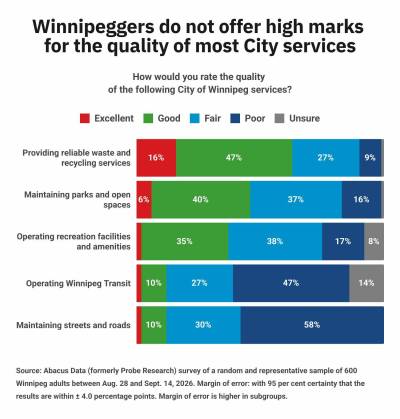
There’s an undercurrent of unhappiness running through the Winnipeg electorate as the municipal election day approaches.

One-half of Winnipeggers believe the city is heading in the wrong direction, according to a new Abacus Data poll, with nearly one-third unsure if Winnipeg is regressing or progressing.

Only 21 per cent of residents believe the city is on the right track, the Free Press-commissioned poll found.

That discontentment extends to how the city spends its tax dollars, with four in 10 Winnipeggers believing they receive poor value for what they pay in property taxes.

Read
Yesterday at 2:37 PM CDT

Magic number for marathon man

Eric Willemsen 5 minute read Sunday, Oct. 13, 2019

VIENNA — Roger Bannister, 1954. Eliud Kipchoge, 2019?

Like the sub-four-minute mile, running a marathon in less than two hours had seemed impossible — until Saturday. But this time, there’s an asterisk: Olympic champion Kipchoge performed his feat under conditions so tightly controlled to maximize his success that it won’t appear in the record books.

The 34-year-old Kenyan completed the 42.195 kilometres (26.2 miles) in one hour, 59 minutes, 40.2 seconds at the INEOS 1:59 Challenge, an event set up for the attempt.

Ahead of the event, Kipchoge even compared the feat to being “like the first man on the moon.”

Norway's Ruud wins Olympic gold year after father's death

Jake Seiner, The Associated Press 5 minute read Preview

Norway's Ruud wins Olympic gold year after father's death

Jake Seiner, The Associated Press 5 minute read Wednesday, Feb. 9, 2022

The decorated alpine athlete was disqualified from her first two races in Beijing, but still has plenty of events to come.

Read
Wednesday, Feb. 9, 2022

Uncanny acting and bittersweet script a fitting tribute to Laurel and Hardy

Randall King  4 minute read Preview

Uncanny acting and bittersweet script a fitting tribute to Laurel and Hardy

Randall King  4 minute read Friday, Feb. 1, 2019

Laurel and Hardy, arguably one of the greatest comedy teams ever to grace the Vaudeville stage and screen, enjoyed a long and fruitful partnership. In fact, it lasted so long, it might as well have been a marriage.

That is the dramatic gist of this film by Jon S. Baird (Filth), who examines the duo in their career twilight, touring the music halls and theatres of England, circa 1953.

The Lancashire-born Stan Laurel (Steve Coogan) has the advantage of being on home turf. Oliver Hardy (John C. Reilly) is hobbled by health issues. While their routines are very much rooted in the English music hall tradition, they are past their prime. Feature films are the medium of choice for comedy duos. Laurel, who has a plaintive moment staring at a freshly installed billboard for the latest Abbott and Costello movie, is trying to cut a deal for a new film based on the legend of Robin Hood. It becomes increasingly obvious that the English producer he’s trying to contact is avoiding him.

Hardy is under different stresses, including failing health and an unhealthy penchant for the vices of drinking and gambling.

Read
Friday, Feb. 1, 2019