‘A chilling effect:’ Lawyer argues Alberta government wanted to censor church pastor

Advertisement

Advertise with us

EDMONTON - A lawyer for an Alberta pastor accused of violating COVID-19 rules says the province's health agency decided to penalize the church leader as a way to censor him.

Read this article for free:


or

Already have an account? Log in here »

To continue reading, please subscribe:

Subscribe and receive a limited-edition Free Press branded hat or tote.

Digital Subscription

One year of digital access for only $205*

  • Enjoy unlimited reading on winnipegfreepress.com
  • Read the E-Edition, our digital replica newspaper
  • Access News Break, our award-winning app
  • Play interactive puzzles

*First annual payment billed as $205.00 + GST for one year. This annual subscription will automatically renew at $233.00 + GST every 52 weeks (10% off the regular annual price of $259.35). Offer available to new and qualified returning subscribers only. Cancel any time.

To continue reading, please subscribe:

Add Free Press access to your Brandon Sun subscription for only an additional

$1 for the first 4 weeks*

  • Enjoy unlimited reading on winnipegfreepress.com
  • Read the E-Edition, our digital replica newspaper
  • Access News Break, our award-winning app
  • Play interactive puzzles
Start now

*Your next Brandon Sun subscription payment will increase by $1.00 and you will be charged $17.95 plus GST for four weeks. After four weeks, your payment will increase to $24.95 plus GST every four weeks.

Hey there, time traveller!
This article was published 04/05/2021 (1981 days ago), so information in it may no longer be current.

EDMONTON – A lawyer for an Alberta pastor accused of violating COVID-19 rules says the province’s health agency decided to penalize the church leader as a way to censor him.

James Kitchen told the trial of James Coates that his client was charged the same day he preached a sermon criticizing Alberta’s leadership on the pandemic.

Coates was ticketed Dec. 20 under the Public Health Act after health inspectors said he held services at GraceLife Church in Spruce Grove that ignored capacity limits, physical distancing and masking.
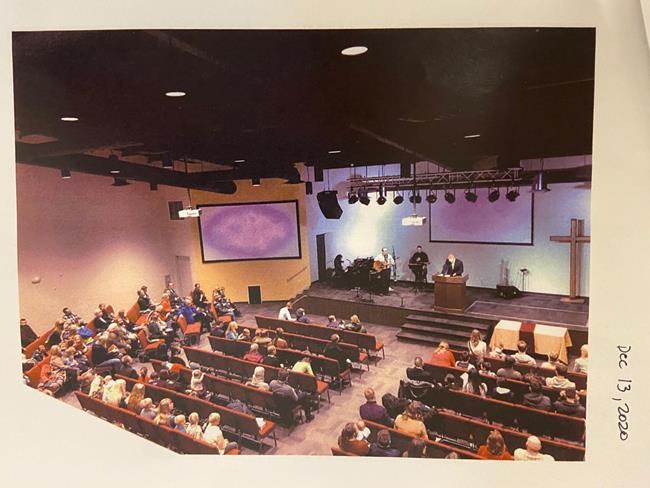
A church service that took place at GraceLife Church on Dec. 13, 2020, n Spruce Grove, Alta., is shown in this handout image taken by an inspector with Alberta Health Services and provided by Alberta's provincial court. THE CANADIAN PRESS/HO-Provincial Court of Alberta *MANDATORY CREDIT*

Kitchen argued it’s not a coincidence that the same day Coates had preached a sermon critical of how Premier Jason Kenney’s government was handling the COVID-19 crisis.

“He (had) just preached a sermon that’s critical of the government, which is different than the other Sundays that RCMP and (Alberta Health Services) has shown up,” Kitchen told the trial in Edmonton on Tuesday.

“The best explanation for why that ticket was issued that particular Sunday after the sermon was preached because it’s meant to impose a chilling effect on pastor Coates. It was to send a message …’You better stop criticizing the government for what they’re doing.'”

Provincial court Judge Robert Shaigec said he needs a few weeks to reach a decision and adjourned the case until June 7.

He said he needs to determine whether the pastor’s rights were infringed upon and, if so, whether the government’s health restrictions are reasonable.

Shaigec heard that health inspectors monitored at least three GraceLife services before Dec. 20 and noted violations of COVID-19 regulations in their reports.

Kitchen told the court that inspectors were also at the church on the morning of Dec. 20, before Coates gave his sermon, but it wasn’t until after he was done preaching that RCMP returned to ticket him.

The lawyer called the ticket a form of censorship. He added that health orders meant to curb the spread of COVID-19 violate other charter rights in relation to freedom of expression, assembly and worship.

“We know how important this is to Christians as soon as you look at any history in the Middle Ages or Roman times when the church was born … gathering in person was fundamental.”

By forcing the pastor to remove 85 per cent of his congregants from services, Kitchen added that churchgoers are unable to express themselves the way they would in person.

A Crown prosecutor, whose identity is protected under a publication ban, argued that no one stopped Coates or his congregants from worshipping. She said the church previously livestreamed services when two members tested positive for COVID-19.

“By Mr. Coates being allowed to operate with 15 per cent capacity, he was still able to practise all of those broad protected Charter of Rights. He still was able to practise his religion. He’s still able to have multiple services. He’s still able to go online,” the Crown said.

On the first day of the trial Monday, the health inspector who issued the ticket to Coates testified she observed many “risky” behaviours at the church during four inspections in November and December.

Janine Hanrahan said during one service about 200 congregants were seen cheering, clapping and standing shoulder to shoulder. Typically, the church can fit more than 600 people in its building, but a 15 per cent capacity limit allows 92 inside.

Coates, 41, also testified that the church had 37 Sunday services without any positive cases before health officials closed it and fenced it off in early April.

In February, Coates was also held in custody for violating a bail condition not to hold services. He was released 35 days later, after pleading guilty, and was fined $1,500.

Lawyer Lieghton Grey, who is also representing Coates, said the time the pastor spent in jail was unjust as he lost 10 pounds. He said harassment Coates has faced has also taken a toll on his mental well-being.

“That’s time he can’t get back and also the psychological harm is irreparable.”

This report by The Canadian Press was first published May 4, 2021.

—-

This story was produced with the financial assistance of the Facebook and Canadian Press News Fellowship.

Report Error Submit a Tip

The Free Press acknowledges the financial support it receives from members of the city’s faith community, which makes our coverage of religion possible.

More Stories

Banning controversial songs is a tone-deaf solution

Jen Zoratti  10 minute read Preview

Banning controversial songs is a tone-deaf solution

Jen Zoratti  10 minute read Friday, Dec. 7, 2018

Along with sipping egg nog and trimming trees, Canadians engaged in another reliable holiday tradition this week: debating whether or not Baby, It’s Cold Outside promotes date rape.

On Tuesday, three of the country’s major broadcasters — CBC, Rogers and Bell Media — announced they’d be putting the chill on the contentious duet, written by American songwriter Frank Loesser in 1944, and would not be playing it on their radio stations this year.

Several American radio stations have also put the song on their naughty lists, arguing it has no place in the #MeToo era. 

Through a modern lens, it’s not hard to see how some people might view this song as a woman being pressured into sex by a guy who won’t take no for an answer. 

Read
Friday, Dec. 7, 2018

Odermatt wins super-G, keeps season title hopes alive

The Associated Press 3 minute read Preview

Odermatt wins super-G, keeps season title hopes alive

The Associated Press 3 minute read Sunday, Mar. 7, 2021

SAALBACH-HINTERGLEMM, Austria - Marco Odermatt dominated the penultimate men’s World Cup super-G of the season Sunday to keep himself in the race for the discipline title.

The Swiss skier finished his gutsy run on the Schneekristall course 0.62 seconds ahead of runner-up Matthieu Bailet.

The Frenchman was the 2016 junior world champion and earned his first podium result on the World Cup circuit.

Vincent Kriechmayr, the double world champion from Austria, trailed Odermatt by 0.81 in third, a day after he won the downhill on the same hill. Another Austrian, Raphael Haaser, finished two-hundredths behind Kriechmayr in fourth.

Read
Sunday, Mar. 7, 2021

Olympic soccer, boxing qualifiers in China affected by virus

The Associated Press 2 minute read Preview

Olympic soccer, boxing qualifiers in China affected by virus

The Associated Press 2 minute read Wednesday, Jan. 22, 2020

KUALA LUMPUR, Malaysia - Olympic qualifying events in two sports were moved from the Chinese city of Wuhan on Wednesday because of an outbreak of a deadly viral illness.

A four-nation Asian qualifying group for the women’s soccer tournament was switched from the city at the centre of the health scare to Nanjing.

The Asia-Oceania boxing qualifying tournament scheduled for Feb. 3-14 in Wuhan was cancelled. No new plans were announced.

The decisions followed Chinese health authorities telling people in Wuhan to avoid crowds and public gatherings.

Read
Wednesday, Jan. 22, 2020

Chinese city at centre of virus outbreak is major crossroads

Elaine Kurtenbach, The Associated Press 3 minute read Preview

Chinese city at centre of virus outbreak is major crossroads

Elaine Kurtenbach, The Associated Press 3 minute read Friday, Jan. 24, 2020

The city of Wuhan is one of China's largest industrial hubs and a major crossroads. The capital of Hubei province has 11 million people and is under an unprecedented, open-ended lockdown to try to prevent the spread of a virus that first appeared in the city last month.

HISTORY: An inland port on the north bank of the Yangtze River, which stretches from far western China to Shanghai, Wuhan is said to be about 3,500 years old. It came under British control in the 1800s as a treaty port and like much of China was occupied by the Japanese during World War II. It was the site of the Wuchang uprising in 1911 that eventually brought on the downfall of the Qing dynasty and the founding of the modern Republic of China. That government was vanquished by communist forces in 1949, leading to the current People's Republic of China.

INDUSTRY: Wuhan is the birthplace of China's steel industry, drawing on iron ore and coal from nearby mines. It's also a major manufacturing centre for textiles, machinery, trucks and consumer products. Given its central location, it's the main distribution point in central China for river, railway, road and other transport. The local government says 300 of the world's top corporations have invested in the city. That includes companies like Walmart and automakers such as Honda, Nissan and PSA Citroen Pugeot.

HIGHLIGHTS: The city has high levees protecting it from flooding along the Yangtze and one of its most famous landmarks is the scenic but heavily polluted East Lake. The ancient, five-story Yellow Crane Tower, rebuilt several times, is featured in famous Tang dynasty poems. Wuhan is called one of the “furnaces" of the Yangtze, thanks to its extremely hot and humid summers.

Read
Friday, Jan. 24, 2020

Scare up some social reconnection this fall

Maureen Scurfield 4 minute read 2:00 AM CDT

DEAR MISS LONELYHEARTS: I’m an emotional mess. My lesbian girlfriend and I broke up in August, and now I hold the lease on the apartment we shared. It’s a great big old place with two spacious balconies.

I just got new roommates — two younger friends who really love it here — but secretly I’m still feeling lonely. Every minute of living here reminds me of my girlfriend because we decorated the place together and hung out on the balconies to sunbathe in the summer.

Would it help to move out of my beloved old block with its memory triggers? Maybe, but what if I died of loneliness in a new place? I need people around me, and no one but my ex-girlfriend has really been the right person. Please help. I feel sick about this.

— Love-Nest Sadness, Winnipeg

City emergency crews to administer drug that stops opioid withdrawal symptoms

Joyanne Pursaga 5 minute read Preview

City emergency crews to administer drug that stops opioid withdrawal symptoms

Joyanne Pursaga 5 minute read Monday, Aug. 10, 2026

Winnipeg Fire Paramedic Service crews will soon give out a medication that stops withdrawal symptoms after someone is treated for an opioid overdose.

Emergency workers will be administering a drug called buprenorphine, after Health Canada granted WFPS permission to use the controlled substance.

“Buprenorphine is a medication that offers people who are in active addiction — so those people who have received naloxone as a result of an overdose and those that are experiencing significant and, at times, dangerous withdrawal symptoms — just a bit of a reprieve … (It) reduces cravings and prevents those immediate withdrawal symptoms, which allows more time to connect those patients to further care,” said Michelle Long, WFPS assistant chief of paramedic operations.

The treatment option is in response to a persistently high number of WFPS opioid calls.

Read
Monday, Aug. 10, 2026