The end of the road
From the blood, sweat and tears of the trail to luxury on the big river
Advertisement
Read this article for free:
or
Already have an account? Log in here »
To continue reading, please subscribe:

Digital Subscription
One year of digital access for only $205*
- Enjoy unlimited reading on winnipegfreepress.com
- Read the E-Edition, our digital replica newspaper
- Access News Break, our award-winning app
- Play interactive puzzles
*First annual payment billed as $205.00 + GST for one year. This annual subscription will automatically renew at $233.00 + GST every 52 weeks (10% off the regular annual price of $259.35). Offer available to new and qualified returning subscribers only. Cancel any time.
To continue reading, please subscribe:
Add Free Press access to your Brandon Sun subscription for only an additional
$1 for the first 4 weeks*
- Enjoy unlimited reading on winnipegfreepress.com
- Read the E-Edition, our digital replica newspaper
- Access News Break, our award-winning app
- Play interactive puzzles
*Your next Brandon Sun subscription payment will increase by $1.00 and you will be charged $17.95 plus GST for four weeks. After four weeks, your payment will increase to $24.95 plus GST every four weeks.
Read unlimited articles for free today:
or
Already have an account? Log in here »
Hey there, time traveller!
This article was published 06/08/2022 (1505 days ago), so information in it may no longer be current.
St. Louis and the end of the trade route
I had been looking forward to running the electrical installation at my church’s new building on Winnipeg’s north Perimeter, but, alas, I would be rolling somewhere down on the Mississippi River during the finishing stages of construction, so the role of foreman went to someone else. In thinking about it with a bit of sadness, the words of another paddle-wheel passenger came to mind:
Oh I left a good job in the city
Working for the man every night and day
And I never lost one minute of sleeping
Worrying about the way things might’ve been
Big wheel keep on turning
Proud Mary keep on burning
Rollin’, rollin’, rollin’ on the river
(From Proud Mary by Creedence Clearwater Revival)
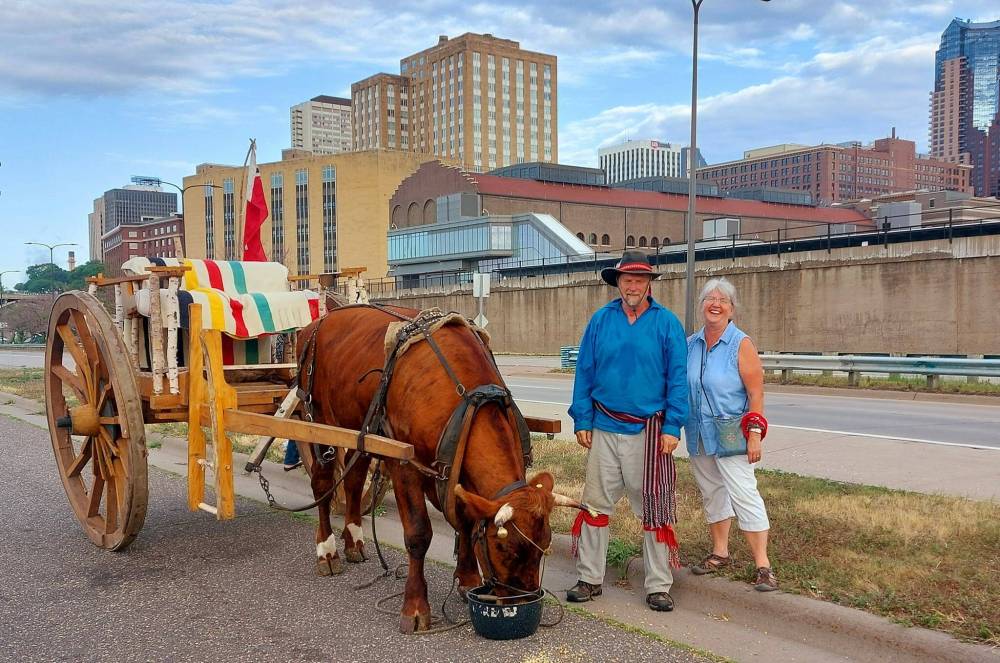
Photo by Terry Doerksen
Terry and Patty Doerksen at the end of the trail.
Patty and I have been on the road for 11 weeks. The first 10 were the blood, sweat and tears of travelling by ox and cart down the Red River Trail. This last week has been one of luxury on a paddle-wheeler down the Mississippi. Together those two legs formed the trade route that saw furry natural products heading south to St. Louis and high-tech manufactured products heading back to Red River, as our city was called back then.
I could have gotten used to a life on the river, but every paddle-wheeler eventually ties up to dock. In a week, I’ll be back to my “good job in the city.” That’s going to take a mental change of gears! But first there are a couple of things to check out in St. Louis, and an import-export business to wrap up.
Twin-brother city
Winnipeg has several official “sister cities.” If we ever consider adopting brothers into the family, I have a couple of suggestions. Don’t worry — both of them are saints! Of course there is St. Paul, our counterpart at the other end of the Red River Trail, but if Paul is like a brother, Louis is more like an identical twin.
For instance, Winnipeg and St. Louis are at transportation crossroads where a river from the west flows into a north-south waterway — Winnipeg being at the forks of the Assiniboine and Red, while St. Louis has the Missouri and Mississippi; both were important Indigenous trading centres before being visited by French-Canadian explorers; both developed as hubs in the fur trade; and both are called “Gateway to the West.”
Even identical twins have features that distinguish them . Though both cities are associated with a great big arch, one arch is metallic and the other more cartographic. St. Louis has the shiny, stainless-steel Gateway Arch. Winnipeg is the capital of the Keystone Province. Manitoba’s shape is reminiscent of that keyhole-shaped stone at the top of an actual gateway arch and its location on the map joins the provinces from the east to those in the west.
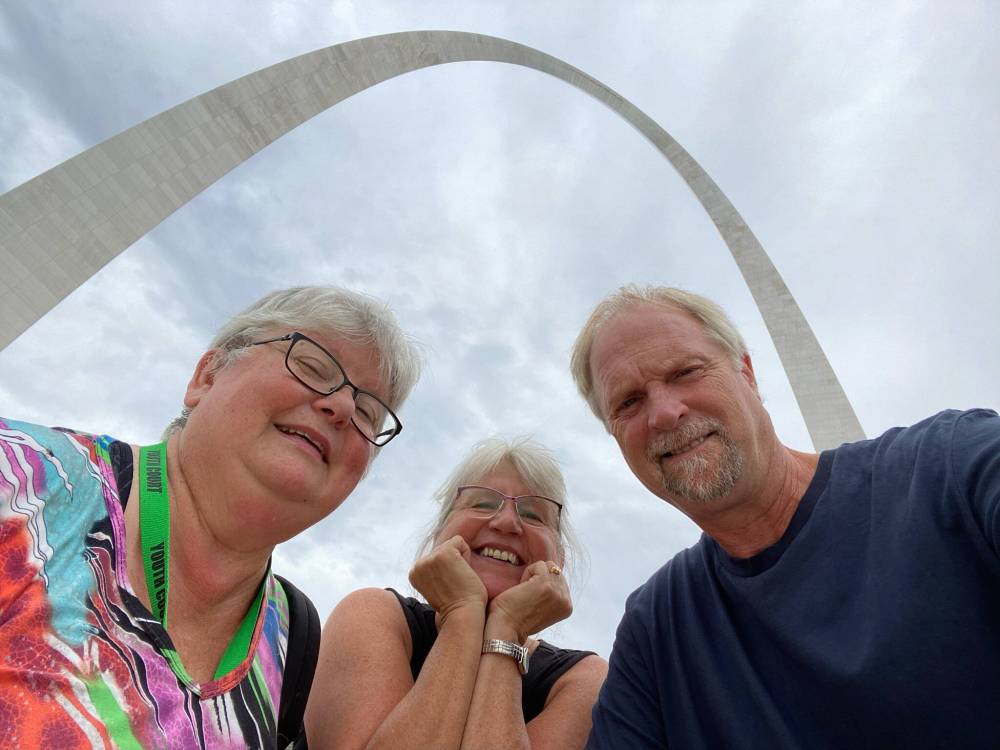
Photo by Terry Doerksen
With MaryBeth at Gateway Arch.
Amazing ‘arch’-itecture
Probably the coolest, and certainly the largest monument in the Western Hemisphere, Gateway Arch is 630 feet (192 metres) high. You wouldn’t guess it, but it’s exactly as wide as it is high. The best thing about this arch is that you can take a cramped little tramway pod right to the top and look out of the narrow windows at the miniature Mississippi city below you.
For comparison: Winnipeg’s new tallest building at 300 Main is 465 feet (141 metres) high. The McDonald’s golden arches across Lagimodiere Boulevard from my place are 18 feet (5.5 metres) high. (I got that number with a combination of rigorous triangulation and random guesswork.) Toshuk Tagh, the biggest natural arch in the world, spans a canyon in a barely-accessible mountainous region of China. From the canyon floor it’s 1,500 feet (457 metres) high. That would be 2.5 Gateway Arches or 83 golden arches stacked up.
Cahokia and the Three Sisters
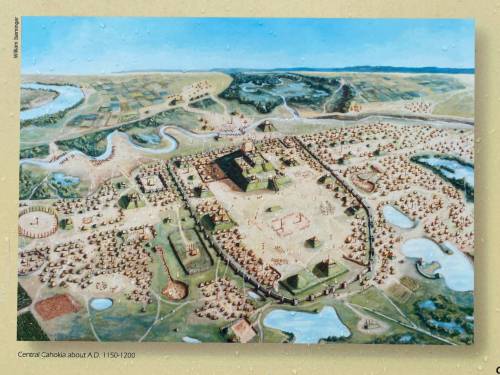
The other architectural wonder on my bucket list was across the Mississippi from Gateway Arch — the ancient city of Cahokia. During its heyday around 1100 AD it had a population close to 40,000 people — bigger than contemporaneous London or Paris. Imagine Brandon in population and area. Cahokia was the mothership of the Mississippian culture that spread its way up and down the riverways and spilled over into Manitoba. This culture was especially known for two things: its earthen mounds and the Three Sisters.
As we climbed up the 156 stairs of the highest mound, I empathized with those workers who had built this structure so long ago. I thought about their millions of trips up the growing hill with heavy baskets of earth dug from a distant pit. Then, looking down from the top of the mound, I imagined the scene of 900 years ago with the life of a bustling city below me. Patty and I had a similar experience near Souris, Man., when we visited Linear Mounds National Historic Site — an outlier of this same Mississippian culture. Only there it was a scene of grieving and loss. Every spring the mounds were extended by the burial of those who had died in the winter. But life must go on, so the mourners would turn west from there to follow the buffalo migration. As we pondered the past, words from a Christmas carol kept playing in my mind: the hopes and fears of all the years… Different age. Different culture. Same struggles.
MaryBeth, a friend from Tennessee, joined us at Cahokia and brought a picnic feast consisting of various dishes of beans, corn and squash: the Three Sisters. Apart from the mini pumpkin pies we had for desert, and with a snug home instead of a picnic shelter, this could have been a lunchtime scene in another millennium right here at this same spot — or even in Lockport. It was discovered not so long ago that the Cahokians had exported their seeds and their agriculture that far north. Their way of life had made the jump from the Mississippi River system to the lower Red. The farming necessities that would be supplied from St. Louis to the community of Red River so many years later was just carrying on an old tradition.
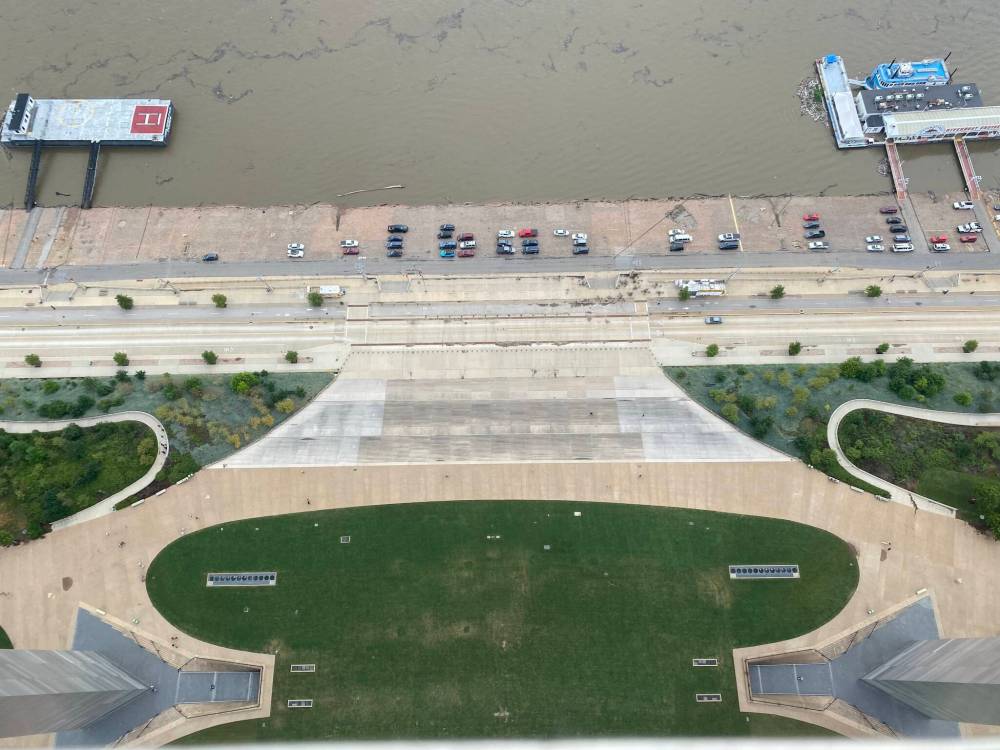
Photo by Terry Doerksen
Looking down on the Mississippi River and the legs of the Gateway Arch.
Arch-rivals
Winnipeg’s trade relationship with St. Louis that declined with the fur trade in the late 1800s was reborn in the late 1900s. During the time Thomas Steen played for the Winnipeg Jets in the 1980s, his son Alexander was born in Winnipeg. Alex went on to play for the St. Louis Blues. During the time Dave Lowry played for the Blues in the 1990s, his son Adam was born in St. Louis. Adam went on to play for the Winnipeg Jets.
So who won that round of trade? The jury is still out, but I’ll have to give the edge to St. Louis. In 2019 the two sons battled each other in their birth cities and in their adopted homes, but the Blues won the series in six and went on to win the Stanley Cup. At least no one suggested trading the names of our cities. St. Win-is and Lose-ipeg.
It’s a different story when it comes to the fathers. We got them both in the end. Before his stint on city council, Thomas Steen helped bring the Manitoba Moose to Winnipeg — the first step in bringing back the Jets. And then Dave Lowry missed his father-son times so much that he moved to Winnipeg and became Adam’s coach.
The season after winning the cup was Alex Steen’s last. Alex’s 1,000th game in the NHL happened to fall on a night when the Blues were visiting the Jets. The Winnipeg fans gave a pretty classy and heartfelt tribute to honour one of their own.

Fair trade
I saw this statement on a what-to-do-in-St.-Louis website:
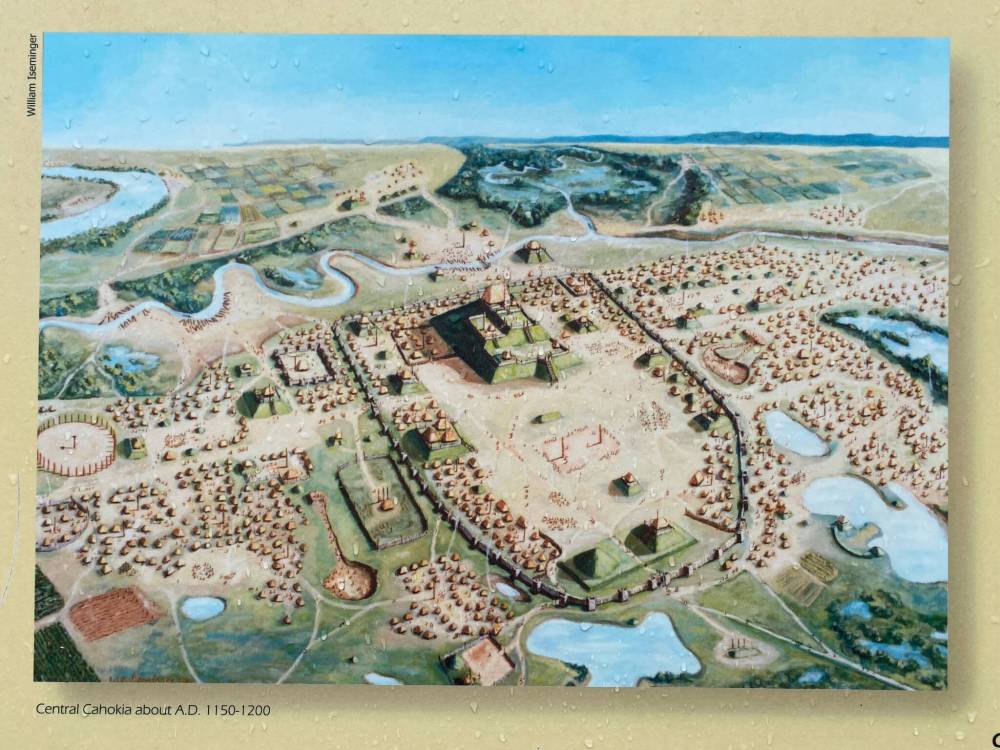
Illustration by William Iseminger
Central Cahokia, circa 1150-1200. Cahokia was the mothership of the Mississippian culture.
“Shoutout to Canada for taking french fries and smothering them with cheese curds + gravy. We can’t thank you enough. Here’s St. Louis’s best spots for traditional and creative takes on poutine…”
Fair is fair, so I have to return the shoutout. By “fair” I mean the 1904 World’s Fair in St. Louis. As the story goes, Antoine Feuchtwanger (I’m not making this up) was having trouble selling his frankfurters at his food stand at the fair. They were too hot to handle. His brother had a brilliant idea. “Put them in a roll!” The birth of the hot dog.
What would summer be without a wiener roast at Bird’s Hill, a drive to Lockport for footlongs or a dog at a Goldeyes game?
A greasy import
While in St. Louis, we stayed in the 19th century home of Frederick Lehmann, who had been on the board of that 1904 World’s Fair. I decided to explain my one remaining task to Marie, the current owner of this house-turned-bed-and-breakfast. I told her I had exported some buffalo wool down the Red River Trail and auctioned it off in St. Paul. Like the Red River merchants of old, I now wanted to pick up something in St. Louis I could import back home. I didn’t really need any of the usual items: farming implements, bolts of cloth, sacks of sugar. Marie offered me a greasy, magnetized screwdriver. Just the thing I needed as an electrician! Marie had worked many years for Schaeffer Oil and Grease — started in 1839, and the oldest surviving company in St. Louis. Importers from Red River would have shopped from this same supplier for candles and axle grease to resell back home. Marie had managed to salvage this relic from her old job and now passed it on to me, keeping the trade relationship between St. Louis and Winnipeg alive. Patty and I could return home with our journey complete and my trading mission accomplished. And now it’s back to work.

Photo by Terry Doerksen
The flag of St. Louis shows it’s two rivers.

Photo by Terry Doerksen
Gateway Arch from Cahokia.

Photo by Terry Doerksen
At the end of the trail.

Advertisement Advertise With Us
Advertisement Advertise With Us