EU plan aims to help get wheat from Ukraine to the world

Advertisement

Advertise with us

BRUSSELS (AP) — The European Commission proposed helping Ukraine export its wheat and other grains by rail, road and river to get around a Russian blockade of Black Sea ports, which is preventing those critical supplies from reaching parts of the world at risk of food insecurity.

Read this article for free:


By clicking the button above, an account will be created and you will begin to receive some of our recommended newsletters. You may opt out of any newsletter by visiting your Email and Communication Preferences page or by clicking "unsubscribe" at the bottom of any email.

or

Already have an account? Log in here »

To continue reading, please subscribe:

Digital Subscription

One year of digital access for only $1.44 a week*

  • Enjoy unlimited reading on winnipegfreepress.com
  • Read the E-Edition, our digital replica newspaper
  • Access News Break, our award-winning app
  • Play interactive puzzles

*Billed as $5.77 plus GST every four weeks. After 52 weeks, price increases to the regular rate of $19.95 plus GST every four weeks. Offer available to new and qualified returning subscribers only. Cancel any time.

To continue reading, please subscribe:

Add Free Press access to your Brandon Sun subscription for only an additional

$1 for the first 4 weeks*

  • Enjoy unlimited reading on winnipegfreepress.com
  • Read the E-Edition, our digital replica newspaper
  • Access News Break, our award-winning app
  • Play interactive puzzles
Start now

*Your next Brandon Sun subscription payment will increase by $1.00 and you will be charged $17.95 plus GST for four weeks. After four weeks, your payment will increase to $24.95 plus GST every four weeks.

Hey there, time traveller!
This article was published 12/05/2022 (1633 days ago), so information in it may no longer be current.

BRUSSELS (AP) — The European Commission proposed helping Ukraine export its wheat and other grains by rail, road and river to get around a Russian blockade of Black Sea ports, which is preventing those critical supplies from reaching parts of the world at risk of food insecurity.

The European Union’s executive arm said the plan aims to establish alternative routes and ease congestion between borders that also should facilitate getting humanitarian aid and other goods into the war-torn country.

Russia’s invasion of Ukraine has provoked disruptions of global food supplies, with both countries two of the world’s biggest exporters of wheat, barley and sunflower oil. The blockade of Ukrainian ports has been particularly harmful, having accounted for 90% of grain and oilseed exports before the war, the commission said.
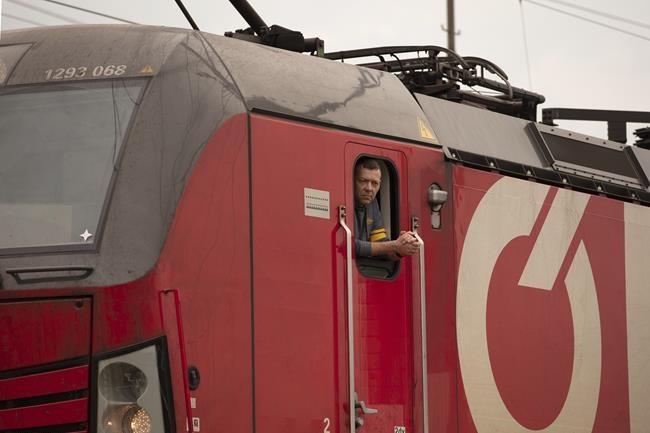
A train driver looks out of his locomotive at the arriving of a Ukrainian freight train with fodder maize, in Vienna, Austria, Friday, May 6, 2022. (AP Photo/Theresa Wey)

“Twenty million tons of grains have to leave Ukraine in less than three months using the EU infrastructure,” said Adina Valean, EU commissioner for transport. “This is a gigantesque challenge, so it is essential to coordinate and optimize the logistic chains, put in place new routes, and avoid, as much as possible, the bottlenecks.”

The potential loss of affordable grain supplies that Africa, the Middle East and parts of Asia rely on has raised the risk of global food shortages and political instability in countries where many people already were not getting enough to eat. The disruptions from the war have further raised food prices, with the high cost of fertilizers — of which Russia is a top exporter — and cooking oils further squeezing the global food chain.

The head of the European Investment Bank said this week that Ukraine is “sitting on 8 billion euros worth of wheat” it can’t export.

In addition to the port blockade, Ukraine’s Foreign Ministry has accused Russia of stealing grain and trying to sell some on global markets. It cited official estimates indicating that Russia already may have stolen 400,000 to 500,000 metric tons of grain that cost over $100 million. It asserted that “practically all ships leaving Sevastopol with a load of grain are carrying the grain stolen from Ukraine,” referring to a major port on the Black Sea.

To get Ukraine’s food supplies to the world, Europe is looking to increase shipments by railroads and trucks. Trains have started carrying loads of grain to Austria and Germany via other EU countries but amount to only a fraction of the Black Sea port capacity.

A key challenge is the diverging rail gauge widths between Ukraine and EU countries. Since Ukrainian railroad cars don’t fit with most of the EU network, goods need to be transferred to trucks or other rail cars adapted to the system.

The EU says the average wait time for the thousands of rail cars at Ukraine’s border with the 27-nation bloc is 16 days, reaching up to 30 days in some places.

To address this congestion, the commission said the most urgent priority is to ensure additional transport vehicles are available to get the grain to EU ports. It said grain-hopper trailers, cargo containers, and barges and vessels “are urgently needed.”
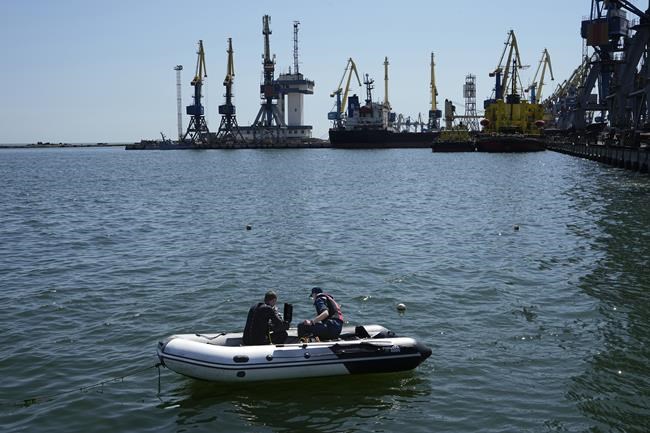
FILE - Servicemen of Donetsk People's Republic Emergency Ministry work to defuse a Ukrainian mine in an area of the Mariupol Sea Port in Mariupol, in territory under the government of the Donetsk People's Republic, eastern Ukraine, on April 29, 2022. This photo was taken during a trip organized by the Russian Ministry of Defense. The European Commission is proposing to help Ukraine move its critical grain supplies to parts of the world at risk of food insecurity. The plan released Thursday, May 12, 2022, by the European Union’s executive arm urges rail, road and river routes to get around a Russian blockade of Black Sea ports. (AP Photo)

With nonmilitary flights grounded in Ukraine, the commission said the new supply routes should be organized mainly via land and river transport, using for instance Ukraine’s ports on the Danube River.

The commission urged member nations to accelerate procedures at border crossing points and increase capacity on EU soil for the temporary storage of Ukrainian exports.

“In the medium to long term, the commission will also work on increasing the infrastructure capacity of new export corridors and on establishing new infrastructure connections,” it said.

The commission’s proposals are nonbinding and mostly intend to facilitate coordination between EU countries, transport operators and equipment suppliers.


Report Error Submit a Tip

More Stories

Letters, Oct. 31

6 minute read 2:01 AM CDT

Civic election a missed opportunity

The outcome of the latest municipal election in Winnipeg is nothing short of baffling. The decline of what was once a proud, beautiful prairie hub is impossible to ignore.

Winnipeg is rapidly sliding into a state of structural and social dilapidation, yet voters have inexplicably chosen to hand incumbent Mayor Scott Gillingham a second term. The decision smells of complacency, and sadly, it represents a massive missed opportunity for real urban renewal.

Walking through downtown Winnipeg today is an exercise in heartbreak. A city centre that should be a bustling economic and cultural core has instead transformed into an absolute eyesore. Encampments and tents are permitted to dot the heart of the city. Streets that used to thrive are now dominated by the tragic, visible reality of severe addiction, with individuals wandering and staggering through public spaces without adequate intervention or care.

Behind the scenes at circus spectacle Odysseo, it's the horses who hold the reins

Erin Lebar / Photos by Ruth Bonneville 15 minute read Preview

Behind the scenes at circus spectacle Odysseo, it's the horses who hold the reins

Erin Lebar / Photos by Ruth Bonneville 15 minute read Wednesday, Jun. 13, 2018

It’s almost 4 p.m. on a particularly steamy May afternoon and Cavalia Odysseo rider Chelsea Jordan is putting on her makeup in the back corner of the very humid artistic tent.

She’s already spent some time layering on foundation, and is now into the decorative portion of the 30-minute process, placing a pair of small gems on her forehead and enhancing her naturally sharp cheekbones with some extra contouring.

“This is the messy part of the business,” she jokes as she sticks on fake lashes over an eyelid covered in earth-toned shadow.

It’s odd that makeup is considered the messy part of the day when Jordan spends the majority of her time surrounded by horses, but as with most people involved in Odysseo, the glitzy and glamorous aspects of being a member of the largest touring production in the world aren’t nearly as fun as the time she gets to spend with her four-legged cast-mates.

Read
Wednesday, Jun. 13, 2018

Teemu Selanne living the good life in southern California

Mike McIntyre 19 minute read Preview

Teemu Selanne living the good life in southern California

Mike McIntyre 19 minute read Friday, Oct. 15, 2021

LAGUNA BEACH — He likes his coffee black. His steak “medium rare plus.” And he’s an extremely generous pour, especially when it comes to a Moscow mule.

His left knee is giving him all sorts of trouble these days, he’s admittedly almost always running behind schedule and his biggest pride and joy are his four children, who keep him and his wife Sirpa hopping with their numerous athletic pursuits.

He is Teemu Selanne, the beloved Winnipeg Jets legend who, you’ll be happy to know, is still living the good life just a stone’s throw from the Pacific Ocean in this little piece of southern California paradise.

Despite being nearly eight years removed from the end of a Hall of Fame hockey career, the Finnish Flash remains a big deal around here. That was clear as we sat down earlier this week for an exclusive chat inside “Selanne’s Steak Tavern” — a high-end eatery he owns that sits along the stunning Pacific Coast Highway.

Read
Friday, Oct. 15, 2021

The long and winding road

Editorial 4 minute read Preview

The long and winding road

Editorial 4 minute read 2:01 AM CDT

As theatre goes, it sent a strong message.

Manitoba Premier Wab Kinew, standing in front of microphones and television cameras, holding up his Indigenous status card and saying that he didn’t feel Canada should have “a race-based form of identification in this country, but that is a reality,” adding that it was time to abolish the Indian Act.

“I think it’s time to abolish the Indian Act, get rid of the Indian Act, move past the Indian Act, and it needs to be done with First Nations people and First Nations governments, of course. I think it’s long overdue that we have a relationship with Indigenous Peoples in Canada that reflects who we are as Canadians today,” he said.

The Indian Act — the name alone suggests how out-dated and out of place the law has become. Originally dating from 1876, the law was put in place to “amend and consolidate the laws respecting Indians” and gave the Minister of the Interior the responsibility to “control and management of the reserves, lands, moneys and property of Indians in Canada.”

Read
2:01 AM CDT

Nine more deaths, 107 new COVID-19 cases in Manitoba

Katie May 6 minute read Preview

Nine more deaths, 107 new COVID-19 cases in Manitoba

Katie May 6 minute read Monday, Dec. 28, 2020

Manitoba is restarting its COVID-19 vaccination efforts, following a five-day break — and amidst questions about the delay.

The planned pause over Christmas was in the name of efficiency, a provincial government spokesman says, offering no other explanation on the reasoning behind the decision not to vaccinate anyone Dec. 24-28.

On Monday, the province announced nine more pandemic deaths and 107 new cases of the novel coronavirus.

As part of Manitoba's vaccination plan, the most recent immunization clinic happened Dec. 23; the next was set to start Dec. 29.

Read
Monday, Dec. 28, 2020

The new normal in Canadian politics

David McLaughlin 5 minute read Preview

The new normal in Canadian politics

David McLaughlin 5 minute read 2:01 AM CDT

“Nothing happening, all at once.”

Welcome to the new normal of Canadian politics, where normality is the new normal. Routine and stable are in; disruptive and excessive are out. Exhibits A and B are the Alberta referendum and the British Columbia election. Voters opted for stability over volatility.

The opposite of being normal is being different from the norm. In politics that means different from where we’ve been and what we’ve come to expect. Two competing trends have dominated our politics for the past decade and a half — progressivism and populism. Think Justin Trudeau and liberal, progressive identity politics in Canada, and Donald Trump and conservative, populist MAGA politics in America. We are now experiencing a swing away from both those trends.

Representing this “new normal” are Prime Minister Mark Carney, for one, and newly elected British Columbia premier, Lorne Doerksen, for another. Both are considered normal because they talk and act like adults in a childish political world. Their political flair is to not have any political flair. They stand out for not standing out.

Read
2:01 AM CDT