Re-wearing disposable masks? Experts weigh in on extending life of pricey respirators
Advertisement
Read this article for free:
or
Already have an account? Log in here »
To continue reading, please subscribe:
Digital Subscription
One year of digital access for only $1.44 a week*
- Enjoy unlimited reading on winnipegfreepress.com
- Read the E-Edition, our digital replica newspaper
- Access News Break, our award-winning app
- Play interactive puzzles
*Billed as $5.77 plus GST every four weeks. After 52 weeks, price increases to the regular rate of $19.95 plus GST every four weeks. Offer available to new and qualified returning subscribers only. Cancel any time.
To continue reading, please subscribe:
Add Free Press access to your Brandon Sun subscription for only an additional
$1 for the first 4 weeks*
- Enjoy unlimited reading on winnipegfreepress.com
- Read the E-Edition, our digital replica newspaper
- Access News Break, our award-winning app
- Play interactive puzzles
*Your next Brandon Sun subscription payment will increase by $1.00 and you will be charged $17.95 plus GST for four weeks. After four weeks, your payment will increase to $24.95 plus GST every four weeks.
Read unlimited articles for free today:
or
Already have an account? Log in here »
Hey there, time traveller!
This article was published 18/01/2022 (1749 days ago), so information in it may no longer be current.
Many Canadians are upping their face mask game as the more transmissible Omicron variant fuels of a fifth wave of the COVID-19 pandemic.
But high-quality respirators including N95s, KN95s and KF94s don’t run cheap, especially if people have to replace them after each use.
One online retailer offers bulk packs of N95s including 10 masks for $17 and 1,250 for $1,859. A note on the website warns customers it’s experiencing “high order volume,” and many products were marked as sold out Tuesday.
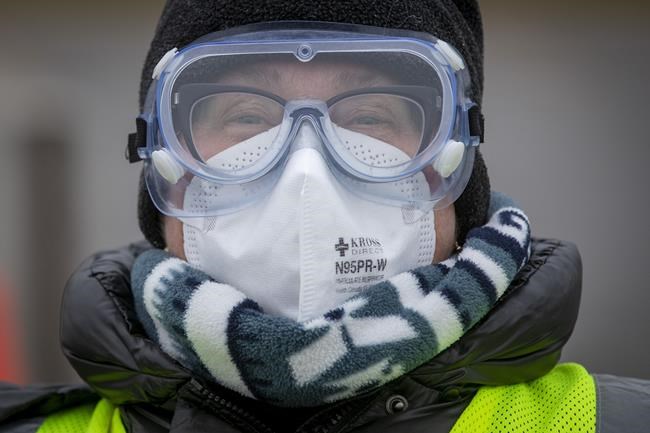
Respirators are designated by a letter and number that indicate where they are certified and filtration level. Properly labelled N95s meet certification standards in the United States while KN95s do the same in China and KF94s in South Korea. Canadian certified masks carry a CA-N95 distinction while FFP2s are European.
All promise to filter out more than 90 per cent of particles.
The Canadian Press asked experts whether it’s safe to extend the life of disposable respirators and how best to do so.
HOW LONG CAN DISPOSABLE RESPIRATORS BE WORN?
Some experts say N95s and their equivalents shouldn’t be reused too frequently, while others say it’s fine to stretch out use in regular, non-health-care settings.
Dr. Kashif Pirzada, an emergency physician in Toronto, said some higher-quality respirators can withstand roughly 40 hours of wear, or four to five days of full-time use on a job. If wearing the mask for shorter intervals at a time, its life can be extended further.
“It can be done, and it’s safe,” Pirzada said, adding that the straps will likely break before the mask becomes ineffective, a sign to switch it out for a new respirator.
Paul Bozek, an associate professor at the University of Toronto’s Dalla Lana School of Public Health who fit-tests N95s for hospital workers, suggested tossing respirators after approximately two weeks, “but not because they ‘expire.'”
He said some N95-level masks have an electric charge on their filter, which helps kill harmful particles as it filters them.
“Especially as you’re breathing moist, humid air over a course of a day or two or longer, eventually that electrical charge just dissipates and you might not have as good filtration efficiency as you originally had,” he said. “But as long as it doesn’t get clogged up so much that you find it difficult to breathe and the straps aren’t broken, it’s certainly easy to wear for at least a week in normal use.”
SHOULD WE SANITIZE RESPIRATORS FOR RE-USE?
Jane Wang, a clinical instructor at the University of British Columbia who’s studied masks extensively, said some can be sanitized with heat — placing them in a paper bag and putting them in a 170-degree oven for 30 minutes — or by dipping them in an isopropyl alcohol solution and letting them dry completely before their next use.
Bozek said those methods can damage certain respirators, however, adding that heating a mask can be dangerous and using alcohol to sanitize one that has an electric charge will hinder its filtration.
Wang said an easier solution is to leave used masks in a clean, enclosed, room-temperature area for a few days. The longer the better to help air them out, she said, but that won’t completely clear any pathogens that might be on the surface.
“There’s a difference between there being some particles on a mask and significant (amounts of) particles. What we’re looking for is a significant reduction in the amount of viral particles; not zero,” she said.
Pirzada said surfaces are not a significant source of transmission so there’s no need to store masks in specific environments for more than 24 hours between use.
Bozek suggested people keep multiple masks on hand to rotate through, stored in areas they won’t be touched, preferably in sunlight to help sanitize them.
WHEN SHOULD WE NOT RE-USE MASKS OR RESPIRATORS?
Wang said masks that are soiled or teared — either the mask material itself or its straps — should not be re-worn. Straps are important for ensuring masks fits tightly around the face, she said, so fraying or stretching prevents them from working effectively.
How long you wear it also matters.
“The longer you wear the mask, the more bacteria (accumulates) on it and the more the fabric becomes weakened by moisture,” she said.
DO WE NEED BETTER MASKS WITH OMICRON?
A review of pre-Omicron literature published by Quebec’s public health institute last week suggested surgical or procedural masks, typically pleated and blue in colour and meant for single-use, work just as well as N95s in real-world settings when worn correctly.
But Bozek said Omicron’s increased transmissibility warrants better protection against viral particles in the air.
He said N95s and KN95s that fit properly filter out more than 90 per cent of particles, while surgical masks “only stop about 50 per cent of them.”
“We certainly know that the better quality masks you wear, the more likely you are to be protected,” he said.
Experts have said fit is one of the most important elements of mask effectiveness — even a five-ply mask can allow viral particles through if there are gaps at the cheeks, chin or top of the nose.
Bozek said glasses that fog up while masked might indicate a poor fit.
WHAT SHOULD WE LOOK FOR WHEN BUYING MASKS OR RESPIRATORS?
The government of Canada’s website says consumers should ensure any mask they buy is approved by Health Canada.
The agency says product packaging should include “GB 2626-2019” for KN95 masks, while KF94s must meet standard “KMOEL-20017-64.” For surgical masks, Health Canada says to look for products that have “ASTM F2100” or “EN 14683” on the box.
Those codes ensure the masks have been tested and meet international standards for filtration, breathability, fluid resistance and flammability, the website says.
Wang said to also make sure masks are purchased from reputable vendors.

Some experts say governments should provide high-quality masks for free.
The Ontario government recently announced it would supply N95s to teachers and education workers ahead of this week’s return to in-person learning, a move Pirzada applauded.
But he said it doesn’t go far enough.
“It really should be … applied to a broader range of sectors,” he said. “Anyone in a high-density work environment should be wearing these masks.”
This report by The Canadian Press was first published Jan. 18, 2022.