Hands the key to keeping a grip in Olympic climbing

Advertisement

Advertise with us

SALT LAKE CITY (AP) — The skin stretches taught, veins pouring in tributaries over the linear lines of the carpals and metacarpals.

Read this article for free:


or

Already have an account? Log in here »

To continue reading, please subscribe:

Subscribe and receive a limited-edition Free Press branded hat or tote.

Digital Subscription

One year of digital access for only $205*

  • Enjoy unlimited reading on winnipegfreepress.com
  • Read the E-Edition, our digital replica newspaper
  • Access News Break, our award-winning app
  • Play interactive puzzles

*First annual payment billed as $205.00 + GST for one year. This annual subscription will automatically renew at $233.00 + GST every 52 weeks (10% off the regular annual price of $259.35). Offer available to new and qualified returning subscribers only. Cancel any time.

To continue reading, please subscribe:

Add Free Press access to your Brandon Sun subscription for only an additional

$1 for the first 4 weeks*

  • Enjoy unlimited reading on winnipegfreepress.com
  • Read the E-Edition, our digital replica newspaper
  • Access News Break, our award-winning app
  • Play interactive puzzles
Start now

*Your next Brandon Sun subscription payment will increase by $1.00 and you will be charged $17.95 plus GST for four weeks. After four weeks, your payment will increase to $24.95 plus GST every four weeks.

Hey there, time traveller!
This article was published 02/07/2021 (1875 days ago), so information in it may no longer be current.

SALT LAKE CITY (AP) — The skin stretches taught, veins pouring in tributaries over the linear lines of the carpals and metacarpals.

The phalanges fall into line like a picket fence with boards of varying lengths, the knuckles unknobby. They’re long, yet not spindly, even muscular — if fingers can be muscular.

The palms are proportional, powerful like mini car compactors. The fingernails are closely cropped, tips arching in unblemished partial ellipses.
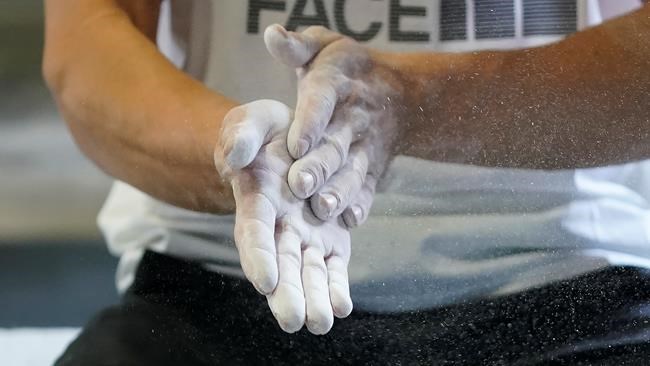
Nathaniel Coleman rubs his hands before climbing during practice on Wednesday, May 26, 2021, in Salt Lake City.
Nathaniel Coleman rubs his hands before climbing during practice on Wednesday, May 26, 2021, in Salt Lake City. "For the most part, people were psyched," American Olympic climber Coleman said. "They knew the sport would get more attention, a lot more inflow of money and kind of be recognized as the high-quality sport that it is." Climbing is an Olympic sport for the first time, and the spotlight will introduce a massive audience to what can be a lonely pursuit. (AP Photo/Rick Bowmer)

The cue is in the cuticles, chalky halos announcing these are the hands of a climber.

Flip over Kyra Condie’s appendages and find more proof: calluses not quite on the fingertips, not quite centered on the final pad of each digit.

“Honestly, my hands are less ugly than people would think they are,” said Condie, one of four American climbers headed to the Tokyo Olympics. “People picture like torn apart, bloodied everywhere. That does happen, but it’s not like a daily occurrence.”

Baseball players need bats and gloves, tennis players racquets, golfers their clubs.

Climbers’ instruments are their hands.

Hands are the main contact point to the only obstacle in the sport, a sheer wall freckled with holds set at an array of angles, some no wider than a fingertip.

Strength, in muscle and skin, is paramount. A breakdown in either is disastrous.

“The hands are our main tool,” U.S. Olympian Nathaniel Coleman said. “Every little muscle in our forearms, in our hands are essential for using our entire body to climb.”

Serious climbing is a constant full-body workout hinged at the fingers.

Those pullups most of us struggle to do more than a couple? Climbers do it from their fingertips, sometimes one handed — over and over again.

They practice on hang boards bolted to walls, dangling by nothing but their fingers. Rest during a climb constitutes clinging to holds with hands and feet.

Climbing’s Olympic debut in Tokyo this month will include three disciplines: lead, bouldering and speed.

All three will take walnut-cracking hand strength.

“Almost more important than anything else is your hands being able to have good finger strength, healthy fingers so you don’t pop a tendon or anything like that,” American Olympic climber Collin Duffy said. “Every single time you’re on the wall, you’re using your hands in some fashion.”

The minutes and hours between those times on the wall are spent making sure their hands aren’t too battered to do it again.

A football or basketball player might be able to tape up an injured digit and keep playing.

Climbers don’t have that luxury. A skin breakdown could mean the end of a competition, a finger pulley injury up to a year on the shelf.

No wonder climbers treat their hands like they have a pair of priceless vases at the end of their arms.

“Imagine if you were an F1 driver and didn’t get to choose your tires, so next time you go out, you have completely burned out tires for the next race,” Condie said. “That’s kind of like what skin is. It’s like, OK, this time the track is wet, but you have no control over it at all.”

Sweat is every climber’s enemy, so they coat their hands in chalk before every climb to prevent slippage. Some take it a step further, bringing battery-operated fans to dry their hands before attacking the wall.

The problem: All the drying can lead to cracking.

Lotions, balms and salves are essential to most climbers’ hand-care toolkits, but there is a fine line. Too soft and the callouses break down, maybe even break off.

Soaking in water has the same effect, so climbers do dishes wearing rubber gloves or, better yet, leave it to someone else. Climbers have been known to wear rubber gloves in the shower before climbing. Find yourself soaking in a hot tub with a group of climbers and you’ll likely be the only person whose hands are in the water.

Files, razors and sandpaper also are essential.

Not for the nails. For the callouses.

An imperfection on a callous can catch on a crystal in the rock or a sharp edge, so those have to be sanded down or trimmed off. Files and sandpaper can prevent cuts from opening up. Razors are good for trimming because fresh skin heals faster than callouses.

Some climbers walk around with rocks in their pocket to try making their skin hard. One climber supposedly burned his fingertips on a hot tea kettle to make his skin harder.

There are even reports of climbers immersing their hands in water and running an electrical current to cut down on excessive sweating.

“People try control it as much as possible,” Condie said. “There are some interesting methods out there, but whatever it takes.”

Those hands are a precious commodity in the climbing world.

___

For more AP Olympics: https://apnews.com/hub/2020-tokyo-olympics

Report Error Submit a Tip

More Stories

No timeline to reopen city-owned fitness facility in North Kildonan after mould discovery

Joyanne Pursaga 5 minute read Preview

No timeline to reopen city-owned fitness facility in North Kildonan after mould discovery

Joyanne Pursaga 5 minute read Tuesday, Aug. 18, 2026

A city-run fitness centre that suddenly closed for repairs last October lacks a set date to reopen, while an investigation on how best to fix it is underway.

Peguis Trail Health and Fitness Centre in North Kildonan was first expected to welcome visitors back within a few weeks when it shut down due to plumbing problems on Oct. 28.

But in February, the city’s website noted a much later reopening date of Oct. 2 after mould was discovered when crews attempted to upgrade the floors.

The city has since hired a consultant to assess the site’s condition, determine what repairs must be done and estimate how much the work would cost, including mould abatement.

Read
Tuesday, Aug. 18, 2026

Public washroom is better way to go

Editorial 4 minute read Preview

Public washroom is better way to go

Editorial 4 minute read Friday, May. 20, 2022

Back in 2018, Winnipeg architect Wins Bridgman of Bridgman Collaborative Architecture saw his idea, a decade in the making, come to life: a pop-up public washroom in Winnipeg’s downtown.

It was a canny campaign, executed in partnership with Downtown BIZ and Siloam Mission, that illustrated a dire human-rights need by actually providing a solution.

Now, the idea has gone from pop-up to permanent. As of May 30, a public washroom at 715 Main St., next to Circle of Life Thunderbird House, will open for daily public use from 7:30 a.m. to 5:30 p.m.

Bridgman designed this structure, known as Amoowigamig. Like the bright-orange pop-up before it, it’s a highly visible building with highlighter-yellow accents, and has a host of safety features, such as alarms that can be triggered from stalls, security cameras outside, and a pair of urinals outside the building, which is also a safety consideration: “The reason people go through the indignity of going (to the bathroom) outside is sometimes because there’s no washroom but also because it might (seem) safer,” Bridgman told the Free Press.

Read
Friday, May. 20, 2022

Elevate things between you by breaking ice

Maureen Scurfield 5 minute read Yesterday at 2:00 AM CDT

DEAR MISS LONELYHEARTS: I work in a high rise downtown and every day I come to work at the same time. I often ride the elevator up with this new guy working a few floors under me. I always feel a little disappointed when he has to get off, and I continue up into the sky.

I’ve worked my way up to speaking pleasantries about the weather, and he responds with cute remarks about the clouds. The good news? He’s not wearing a ring. I also found out his first name from hearing other people say hello to him. Now what?

— Feeling Frustrated! Downtown

Dear Frustrated: Next time you’re on the elevator ride together, say “Hi! My name is such-and-such and I work at such-and-such. Where do you work up here in the clouds?” That should make him smile and break the ice. Then you could consider asking if he might like to join you for a coffee on a work break, if you can co-ordinate it.

A Manitoba pharmacist has been hit with $100,000 in fines and costs after a disciplinary panel found he dispensed a “staggering” amount of drugs that could not be accounted for.

Glen Pauch, who worked at a Portage la Prairie pharmacy, was fined the maximum $25,000 by the College of Pharmacists of Manitoba and ordered to pay another $75,000 toward the cost of the investigation and disciplinary proceedings.

A 28-page disciplinary decision, dated June 9, found more than 39,000 doses went unaccounted for while Pauch was consuming drugs and improperly dispensing controlled substances — including opioids oxycodone and hydromorphone, and Concerta, a stimulant prescribed for ADHD — to 11 patients.

The college found Pauch failed to properly document the drugs he dispensed and did not maintain required records for controlled substances returned to the pharmacy or received from suppliers.

Build the resources to help children with speech

Britney Morrish and Bonnie Bricker 6 minute read 2:00 AM CDT

Imagine your daughter says her first word later than her friends do. You wait, hoping she will catch up. By age three, she still is not putting words together the way other kids her age are. Your doctor refers you to a speech-language pathologist. You expect a call within a few weeks.

Instead, you wait. Six months. A year. Two years.

By the time your daughter is finally seen, she is heading into kindergarten. She still struggles to tell her teacher she needs the bathroom. She still cannot explain when something hurts. She still cannot join in the games her classmates play, because those games need more words than she has.

As a parent, your anxiety grows, the frustration leading to sleepless nights worrying about how your child’s life will be impacted by this lack of support. The rest of your family and circle of friends is deeply affected by this potential crisis, they can see you struggling, you feel the stain of stigma attaching itself to your precious daughter. Where can you turn to help your child?

Close to 5,000 net new health-care workers added since 2023 election, province says

Chris Kitching 6 minute read Preview

Close to 5,000 net new health-care workers added since 2023 election, province says

Chris Kitching 6 minute read Tuesday, Aug. 18, 2026

More doctors and nurses are working in Manitoba than ever before but health-care challenges remain, Premier Wab Kinew says.

The province has added 4,725 net new health-care workers to the provincial system since the NDP won the October 2023 election, Kinew told reporters Tuesday.

The government’s total includes 370 doctors, 1,464 nurses, 2,152 health-care aides and 607 allied health professionals, a group that includes physiotherapists, dietitians, paramedics, medical lab technologists and others.

Kinew said more doctors and nurses are working in Manitoba than ever before.

Read
Tuesday, Aug. 18, 2026