Tennis welcomes fans Down Under, but experts say vaccine key for return here
Advertisement
Read this article for free:
or
Already have an account? Log in here »
To continue reading, please subscribe:
Digital Subscription
One year of digital access for only $1.44 a week*
- Enjoy unlimited reading on winnipegfreepress.com
- Read the E-Edition, our digital replica newspaper
- Access News Break, our award-winning app
- Play interactive puzzles
*Billed as $5.77 plus GST every four weeks. After 52 weeks, price increases to the regular rate of $19.95 plus GST every four weeks. Offer available to new and qualified returning subscribers only. Cancel any time.
To continue reading, please subscribe:
Add Free Press access to your Brandon Sun subscription for only an additional
$1 for the first 4 weeks*
- Enjoy unlimited reading on winnipegfreepress.com
- Read the E-Edition, our digital replica newspaper
- Access News Break, our award-winning app
- Play interactive puzzles
*Your next Brandon Sun subscription payment will increase by $1.00 and you will be charged $17.95 plus GST for four weeks. After four weeks, your payment will increase to $24.95 plus GST every four weeks.
Read unlimited articles for free today:
or
Already have an account? Log in here »
Hey there, time traveller!
This article was published 05/02/2021 (2090 days ago), so information in it may no longer be current.
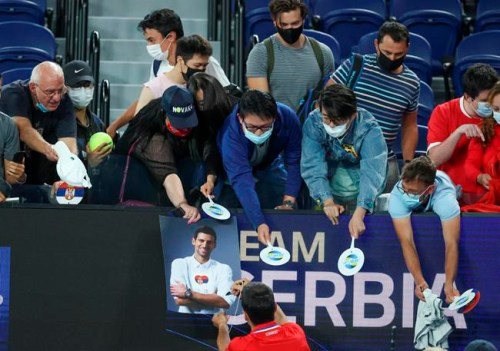
Photos last week of fans sitting shoulder-to-shoulder watching warm-up tennis matches ahead of the Australian Open brought back nostalgia for some, and anxiety for others.
Australia has done well in keeping COVID-19 to miniscule levels, but for those peering in from the rest of the world, seeing 4,000 spectators in close proximity may have looked a little too risky.
And it nearly was.
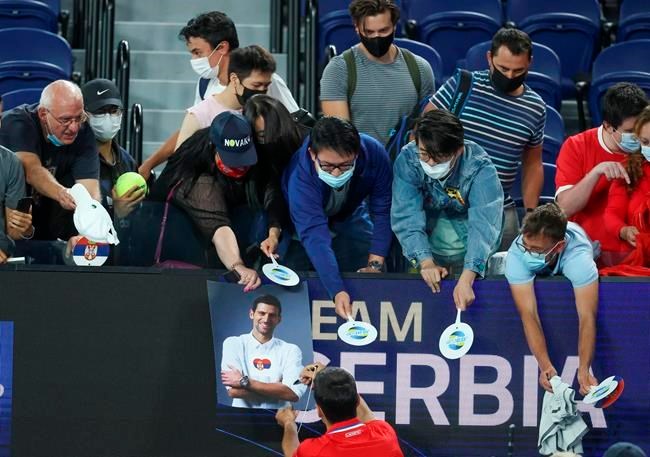
A positive test from a worker in the Australian Open quarantine hotel system this week put the Grand Slam tournament in jeopardy, cancelling one day of tune-up matches and forcing 600 players and staff, who had isolated for 14 days upon arrival, back to their rooms to await test results.
Infectious disease experts say the episode demonstrated how difficult pulling off a safe, large-scale event can be, even in places where community transmission seems nonexistent.
It’s also why sports likely won’t return to normal in Canada until vaccines provide a level of herd immunity, they say.
“Seeing a crowd like that in Toronto right now would be like: ‘Whoa, not good,’ but we have to remember (Australia’s) situation is different,” said Dr. Sumon Chakrabarti, an infectious disease expert in Mississauga, Ont., and avid tennis fan.
“I would estimate we can start talking about fans in stadiums (here) at the end of the year, but it’s still going to look different than Australia.”
Chakrabarti says places like Australia and New Zealand, which drove COVID transmission essentially to zero, are exceptions to the rule.
The Australians did it with a strict, lengthy lockdown and a geographically-isolated location. They also pounced early on flare-ups, reinstating restrictive measures in entire states when a positive test was discovered.
The Australian Open case prompted state-wide restrictions in Victoria, including mandatory indoor masking. But it hasn’t affected plans for fans at the Melbourne event.
Tournament director Craig Tiley said this week organizers were going “full steam ahead” on starting play Monday (Sunday night ET), and with their original goal of 30,000 spectators per day at the two-week long tournament — about half the usual attendance.
Chakrabarti called the positive test a “nightmare” for tournament organizers, but added Australia’s low COVID rate puts the country in a good spot to handle an outbreak, if one were to arise.
“Their hospitals are not overwhelmed,” he said. “They can do what they need to control it.”
Thousands of new COVID cases per day is a different story though, since that leads to increased hospitalizations. But that changes with widespread inoculation.
While various COVID vaccines showed efficacy rates ranging from 66 to 95 per cent in clinical trials, Chakrabarti says they’ve all been exceedingly effective in preventing severe disease and hospitalization.
“If we get to a point where we have 1,000 cases a day but most of them have the sniffles, we’re not going to be too worried about that,” he said.
Should the government’s plan to vaccinate most Canadians by September go smoothly, Chakrabarti says stadiums could start welcoming spectators in limited capacity when new NBA and NHL seasons begin. That could be late 2021 or early 2022, with the latter more reasonable for fan reintroduction, he added.
Dr. Zain Chagla, an infectious disease expert with McMaster University in Hamilton, expects Canadian teams to at least return to their home stadiums and regular travel schedules for their next seasons, as long as vaccinations are on time.
The Toronto Blue Jays and Toronto Raptors — the lone Canadian teams in their respective leagues — had to shift home bases to American cities after returning from COVID shutdowns in an effort to halt constant travel across the border. All three Canadian Major League soccer teams had to do the same thing.
The NHL, meanwhile, created an all-Canadian division this season to avoid border restrictions.
“You could shuttle back and forth over the border knowing … people are protected,” Chagla said. “And COVID hopefully at that point, is more of a manageable illness.”
Chagla says Australia’s ability to host fans before its vaccine rollout begins is a testament to how well the country has handled COVID-19..
Tennis provides natural risk mitigation by its open-air environment, he added, and mandatory quarantine of players and staff will have further limited danger.
But news of the one positive test is “obviously concerning,” he said, and it may signify “a level of community transmission they just don’t know about.”

“So having 30,000 individuals filing into the stadium, using the bathrooms, interacting, there’s certainly risk in that context,” he added.
The Australian Open is the first of four Grand Slam tournaments in the tennis season. The pandemic cancelled last year’s Wimbledon outright and delayed the French Open by four months. The U.S. Open went ahead in a bubble environment without fans, though several top stars didn’t participate.
Catherine Sabiston, a kinesiology professor at the University of Toronto, says not having fans in the stands has affected athletes too, and Grand Slam champions like Petra Kvitova and Novak Djokovic have said they’re thrilled to play in front of thousands again.
“Athletes tend to feed off emotions of the crowd,” Sabiston said. “And they’ve been (missing) that emotion in many ways.”
This report by The Canadian Press was first published Feb. 5, 2021.
Related Articles
Ottawa lays out criteria for quarantine hotels
Advertisement Advertise With Us
Advertisement Advertise With Us