Despite Pfizer success, a lot has to happen before vaccine rollout in Canada: experts
Advertisement
Read this article for free:
or
Already have an account? Log in here »
To continue reading, please subscribe:

Digital Subscription
One year of digital access for only $205*
- Enjoy unlimited reading on winnipegfreepress.com
- Read the E-Edition, our digital replica newspaper
- Access News Break, our award-winning app
- Play interactive puzzles
*First annual payment billed as $205.00 + GST for one year. This annual subscription will automatically renew at $233.00 + GST every 52 weeks (10% off the regular annual price of $259.35). Offer available to new and qualified returning subscribers only. Cancel any time.
To continue reading, please subscribe:
Add Free Press access to your Brandon Sun subscription for only an additional
$1 for the first 4 weeks*
- Enjoy unlimited reading on winnipegfreepress.com
- Read the E-Edition, our digital replica newspaper
- Access News Break, our award-winning app
- Play interactive puzzles
*Your next Brandon Sun subscription payment will increase by $1.00 and you will be charged $17.95 plus GST for four weeks. After four weeks, your payment will increase to $24.95 plus GST every four weeks.
Read unlimited articles for free today:
or
Already have an account? Log in here »
Hey there, time traveller!
This article was published 09/11/2020 (2130 days ago), so information in it may no longer be current.
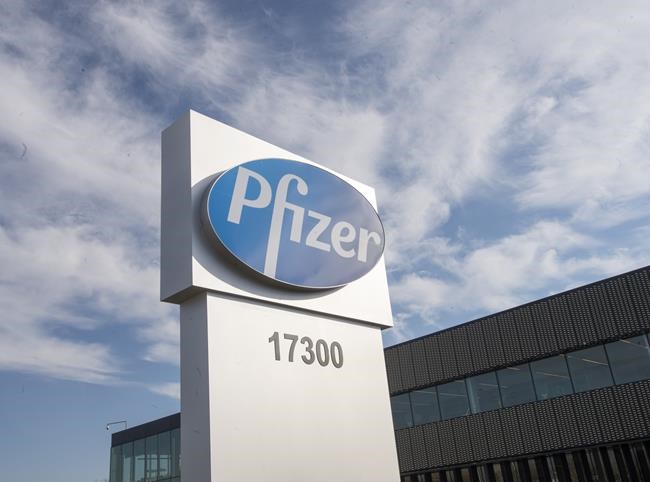
Pharmaceutical giant Pfizer says early results from its coronavirus vaccine trial suggest a 90 per cent efficacy rate at preventing COVID-19, a number that has Canadian infectious disease experts cautiously optimistic that a viable shot can be rolled out by spring of 2021.
Jean-Paul Soucy, an epidemiologist at the University of Toronto, called Pfizer’s announcement “fantastic news (and) very encouraging,” but there are still questions to be answered.
And there are many steps between a vaccine’s approval and its actual rollout.
“It’s important to temper our expectations,” Soucy said. “Even if it does turn out to be 90 per cent effective, keep in mind that what we’re seeing is very preliminary data.”
Pfizer’s interim analysis, from an independent data monitoring board, saw 94 infections recorded so far in a study that enrolled nearly 44,000 people in the United States and five other countries.
The company did not provide more details about those cases, and cautioned the initial protection rate might change by the time the study ends.
A tracking site created by experts at McGill, led by epidemiologist Nicole Basta, says 53 COVID vaccines are currently being developed and tested in 126 trials across 35 countries.
Basta says Pfizer’s vaccine, one of 11 currently in Stage 3 trials, is notable as the first one to have produced results.
“That’s why the announcement today is very, very exciting,” she added. “They have shown, at least with their interim analysis, really high efficacy.
“And that gives us a lot of hope and promise for not only this vaccine, but a lot of the vaccines that are in late stages of trials.”
Pfizer says it’s on track to file an emergency use application with U.S. regulators later this month.
While Soucy expects Pfizer’s vaccine to gain approval soon, actually rolling it out will take time.
Canada already guaranteed supply of potential vaccine candidates when it signed agreements with a number of pharmaceutical companies including Pfizer months ago, which Soucy says will accelerate the timeline.
Prime Minister Justin Trudeau said Monday he hopes to see a vaccine rollout in Canada early next year. But he noted some of the initial doses will require special handling that could complicate distribution efforts.
The Pfizer vaccine specifically needs to be stored at an ultra-low temperature. It’s also dispensed in two doses, which requires people go back to a pharmacy or doctor’s office to receive a second shot weeks after the first.
Dr. Lynora Saxinger, an associate professor of medicine at the University of Alberta, expects multiple vaccines to be in circulation within the next year. And logistical issues can be ironed out in the meantime.
“These are challenges, not barriers,” she said. “It seems to be a bit of a difficult vaccine … with needing two doses and a really strong cold chain for distribution, but all of those things are workable.
“At the end of the day, what we need is something that’s protective.”
While Pfizer suggests their vaccine does protect against COVID to a great degree, there are still plenty of unknowns.
Soucy says its unclear whether it protects against asymptomatic cases because only those with symptoms were tested in the trial.
Dr. Gerald Evans, an infectious disease expert with Queen’s University, is skeptical of the 90 per cent efficacy rate, since he expects trial participants would have been told to continue with other safety measures — like keeping two metres distance from others and wearing masks — after receiving their vaccine.
“It could be that those in the vaccine group were better at following the rules and that’s why they didn’t get COVID,” Evans said.
A full breakdown of participants in the trial would be helpful to see, he added.
While Pfizer stated that participants in the study were diverse, Evans argues the blind nature of the trial means that by chance, more vulnerable people may have ended up in the non-vaccine control group than in the one that did receive shots.
“Was it actually a true randomization? Were there equal numbers of men, women, old people, young people, white people, non-white people, in these groups?” Evans said. “If so, then you can say, ‘Yeah, this looks very interesting.'”
Saxinger says Pfizer’s vaccine trial also does not tell us how long immunity lasts, and boosters may be required.
Still, she believes it’s an encouraging revelation.
“We’re going to continue to learn more. But the fact is, a lot of people have received the vaccine (in trials) and the results are pretty solid,” she said.
The normal process from development to approval to rollout could take years but COVID vaccines are being developed at an accelerated pace.
Saxinger says while some may worry about trials proceeding too quickly, she’s confident they’ve gone at a safe pace.
And Soucy says the speedy nature was to be expected.
“We’ve had such unprecedented global efforts to deal with this situation and we’ve managed to produce several vaccines that have a lot of promise on a heroic schedule,” he said. “But certainly we want to give it a bit longer, and Pfizer’s giving a bit longer to make sure adverse reactions are not showing up.”
Side effects for Pfizer’s trial have been acute so far, such as headaches that go away fairly quickly. But that will be something to keep an eye on as they progress to a fourth stage, the experts say.

Soucy says Pfizer’s preliminary data shouldn’t cause anyone to abandon other COVID precautions, and to remember that a vaccine is months away at best.
“We shouldn’t look at this and say: ‘I guess COVID’s over,'” he said. “(The vaccine) still has to get approval and we still have to see more long-term safety impact.
“So we do have to emphasize we’re going into a pretty dark winter. But I think we can see that light at the end of the tunnel much more clearly now.”
— With files from The Associated Press
This report by The Canadian Press was first published Nov. 9, 2020.
Related Articles
Promising vaccine still faces hurdles
Advertisement Advertise With Us
Advertisement Advertise With Us