UN cautions that virus plasma treatment still experimental

Advertisement

Advertise with us

LONDON - The World Health Organization on Monday cautioned that using blood plasma from COVID-19 survivors to treat other patients is still considered an experimental therapy, voicing the concern as a U.S. boost for the treatment has many scientists afraid formal studies will be derailed.

Read this article for free:


By clicking the button above, an account will be created and you will begin to receive some of our recommended newsletters. You may opt out of any newsletter by visiting your Email and Communication Preferences page or by clicking "unsubscribe" at the bottom of any email.

or

Already have an account? Log in here »

To continue reading, please subscribe:

Digital Subscription

One year of digital access for only $1.44 a week*

  • Enjoy unlimited reading on winnipegfreepress.com
  • Read the E-Edition, our digital replica newspaper
  • Access News Break, our award-winning app
  • Play interactive puzzles

*Billed as $5.77 plus GST every four weeks. After 52 weeks, price increases to the regular rate of $19.95 plus GST every four weeks. Offer available to new and qualified returning subscribers only. Cancel any time.

To continue reading, please subscribe:

Add Free Press access to your Brandon Sun subscription for only an additional

$1 for the first 4 weeks*

  • Enjoy unlimited reading on winnipegfreepress.com
  • Read the E-Edition, our digital replica newspaper
  • Access News Break, our award-winning app
  • Play interactive puzzles
Start now

*Your next Brandon Sun subscription payment will increase by $1.00 and you will be charged $17.95 plus GST for four weeks. After four weeks, your payment will increase to $24.95 plus GST every four weeks.

Hey there, time traveller!
This article was published 24/08/2020 (2260 days ago), so information in it may no longer be current.

LONDON – The World Health Organization on Monday cautioned that using blood plasma from COVID-19 survivors to treat other patients is still considered an experimental therapy, voicing the concern as a U.S. boost for the treatment has many scientists afraid formal studies will be derailed.

On Sunday, the U.S. Food and Drug Administration authorized what’s called “emergency use” of the treatment under its special powers to speed the availability of promising experimental drugs during a public health crisis. The action isn’t the same as approving plasma as safe and effective, and numerous rigorous studies are underway to find out if it really works.

So far, “The results are not conclusive,” WHO’s chief scientist Dr. Soumya Swaminathan said during a press briefing. “At the moment, it’s still very low-quality evidence.”
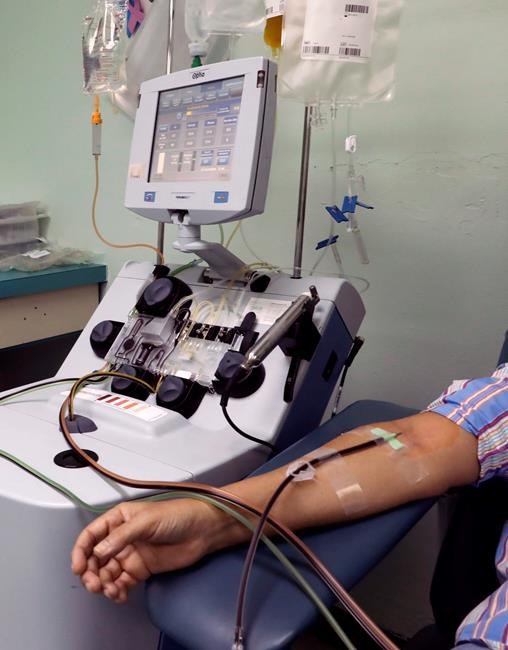
FILE - In this file photo dated Wednesday, May 13, 2020, a recovered COVID-19 patient donates blood products, known as convalescent plasma, at the Arnulfo Arias Madrid Hospital, in Panama City. The U.S. Food and Drug Administration authorized the use of blood plasma for what's called “emergency use” during the coronavirus pandemic, but the World Health Organization (WHO) on Monday AUG. 24, 2020, cautioned that using blood plasma from COVID-19 survivors to treat other patients is still considered an experimental therapy. (AP Photo/Arnulfo Franco, FILE)

Convalescent plasma is a century-old treatment that was used to fight off flu and measles outbreaks in the days before vaccines, and was tried more recently during the Ebola outbreak. When the body encounters a new germ, it makes proteins called antibodies that are specially targeted to fight the infection. The antibodies float in plasma — the yellowish, liquid part of blood — which is collected from COVID-19 survivors and given to patients infected with coronavirus.

Swaminathan said WHO considered plasma therapy to be experimental and that it should continue to be evaluated. She said the treatment is difficult to standardize: Plasma must be collected individually, and people produce different levels of antibodies.

“Of course, countries can do an emergency listing if they feel the benefits outweigh the risks,” she said. “But that’s usually done when you’re waiting for the more definitive evidence.”

In a letter describing the FDA’s emergency action, the agency’s chief scientist said the treatment “should not be considered a new standard of care” for coronavirus infections, and that more data from studies will be available in the coming months.

But already, so many COVID-19 patients have requested plasma rather than agreeing to be part of a research study that many scientists fear they won’t get a clear answer on whether the treatment really works — and if it does, how and when it should be used for the best outcomes.

Martin Landray, of the University of Oxford said that while the therapy offers “huge promise,” there was still no proof it works.

“There is a huge gap between theory and proven benefit,” he said in a statement.

If just a few thousand patients took part in the research “we would have the answer,” said Landray, who is conducting a plasma study in the U.K. “If effective, convalescent plasma could be rapidly used worldwide. If not, it could be abandoned,”

Stephen Griffin, an associate professor of medicine at the University of Leeds, said there was still considerable uncertainty about the immune system’s response to COVID-19, making any potential use of convalescent plasma challenging.
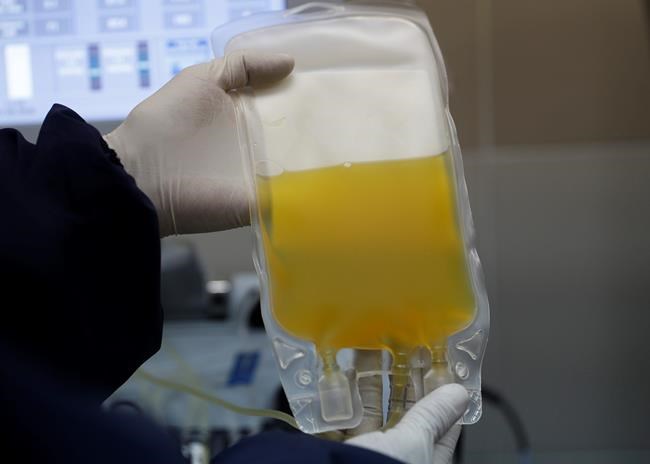
FILE - In this Friday, June 12, 2020 file photo, a doctor holds a bag of blood plasma donated by a COVID-19 survivor at at blood bank in La Paz, Bolivia. The U.S. Food and Drug Administration authorized the use of blood plasma for what's called “emergency use” during the coronavirus pandemic, but the World Health Organization (WHO) on Monday AUG. 24, 2020, cautioned that using blood plasma from COVID-19 survivors to treat other patients is still considered an experimental therapy. (AP Photo/Juan Karita, FILE)

The FDA’s action was announced during a Sunday press briefing by U.S. President Donald Trump, who called it a “breakthrough.”

“It appears that the lessons from hydroxychloroquine have not been learned,” Griffin said, referring to the malaria drug touted by Trump and others as a potential treatment for the coronavirus.

The FDA also granted hydroxychloroquine an emergency authorization before suspending it months later after several trials showed the drug didn’t work against COVID-19 and raised the risk of heart, kidney, liver and other problems.

____

The Associated Press Health and Science Department receives support from the Howard Hughes Medical Institute’s Department of Science Education. The AP is solely responsible for all content.

Report Error Submit a Tip

More Stories

The new normal in Canadian politics

David McLaughlin 5 minute read Preview

The new normal in Canadian politics

David McLaughlin 5 minute read Yesterday at 2:01 AM CDT

“Nothing happening, all at once.”

Welcome to the new normal of Canadian politics, where normality is the new normal. Routine and stable are in; disruptive and excessive are out. Exhibits A and B are the Alberta referendum and the British Columbia election. Voters opted for stability over volatility.

The opposite of being normal is being different from the norm. In politics that means different from where we’ve been and what we’ve come to expect. Two competing trends have dominated our politics for the past decade and a half — progressivism and populism. Think Justin Trudeau and liberal, progressive identity politics in Canada, and Donald Trump and conservative, populist MAGA politics in America. We are now experiencing a swing away from both those trends.

Representing this “new normal” are Prime Minister Mark Carney, for one, and newly elected British Columbia premier, Lorne Doerksen, for another. Both are considered normal because they talk and act like adults in a childish political world. Their political flair is to not have any political flair. They stand out for not standing out.

Read
Yesterday at 2:01 AM CDT

Today’s horoscope

Georgia Nicols 4 minute read Preview

Today’s horoscope

Georgia Nicols 4 minute read 2:00 AM EST

MOON ALERT: There are no restrictions to shopping or important decisions today. The moon is in Leo.

ARIES (March 21-April 19)

Avoid disputes about shared property, inheritances, taxes, debt and insurance issues. This might also include shared expenses. Just coast. Parents should be vigilant about their kids. Social plans might suddenly change. It’s a good day to make art.

TAURUS (April 20-May 20)

Read
2:00 AM EST

Colorado low blow: flood fears rise as Manitoba faces yet another weather warning

Chris Kitching 5 minute read Preview

Colorado low blow: flood fears rise as Manitoba faces yet another weather warning

Chris Kitching 5 minute read Thursday, Apr. 28, 2022

Forecasters are saying with certainty another Colorado low will hit southern Manitoba this weekend, putting flood-hit municipalities — including four already in local states of emergency — on high alert.

The third such event in as many weeks is set to arrive Friday and linger through Sunday, with the bulk of the rain falling Saturday, said Natalie Hasell, warning preparedness meteorologist with Environment and Climate Change Canada.

“There is agreement to the point where, yes, a Colorado low is coming, but exactly what it will mean for southern Manitoba is unclear,” she said Wednesday. “I hope people are prepared for another uncomfortable weekend.”

As municipalities filled sandbags and pumped standing water, weather models still disagreed on the storm’s track.

Read
Thursday, Apr. 28, 2022

Canada tops Dominican Republic in pre-qualifier

Jason Hills, The Canadian Press 4 minute read Preview

Canada tops Dominican Republic in pre-qualifier

Jason Hills, The Canadian Press 4 minute read Sunday, Nov. 17, 2019

EDMONTON - Canada's women's basketball team put its depth on display Sunday in a dominant 110-60 victory over the Dominican Republic in the final game of the FIBA Olympic pre-qualifying tournament.

All 12 players hit the scoresheet, including six in double digits, to help the Canadians finish 3-0 at the tournament and advance to the next Olympic qualifier in February.

Sami Hill led the way with 16 points, three rebounds, two assists and three steals, while 20-year-old Shaina Pellington recorded 14 points. Bridget Carleton and Jamie Scott had 13 points each and Ruth Hamblin had 11 points and five rebounds.

"We got to roll our whole lineups through, and it was fun when we got going," said Canada's coach Lisa Thomaidis. "It was nice to see different lineup contributing and building chemistry.

Read
Sunday, Nov. 17, 2019

Say What?! Sports guys travel to new destination

Steve Lyons and Paul Wiecek 16 minute read Preview

Say What?! Sports guys travel to new destination

Steve Lyons and Paul Wiecek 16 minute read Thursday, Jan. 30, 2020

Say What?! is an email conversation between sports editor Steve Lyons and sports columnist Paul Wiecek. Look for us regularly but intermittently on the Free Press website.


Steve Lyons: Heya. How you doing? How’s 2020 treating you so far?

Few things to get us started:

Read
Thursday, Jan. 30, 2020

Haunted houses aren’t the only places to find jump scares

Jen Zoratti 3 minute read Preview

Haunted houses aren’t the only places to find jump scares

Jen Zoratti 3 minute read Yesterday at 2:01 AM CDT

C’est l’Halloween, to quote the 1981 elementary school French class banger by Matt Maxwell, but you know what’s already plenty scary? Life.

We all have our personal haunted houses, so to speak, hence the popularity of the “a haunted house but it’s just…” meme that pops up every October. Sample: “a haunted house but it’s just a bunch of men telling you you’d be prettier if you smiled.”

In the spirit of the season, I thought I’d offer up a few jump scares of my own.

A haunted house but it’s just Gate E25

Read
Yesterday at 2:01 AM CDT