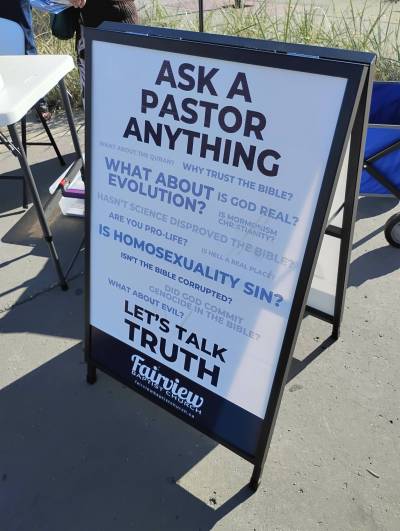
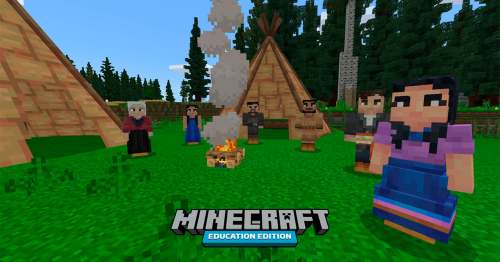
The American story, splintered, and those vying to tell it
Advertisement
Read this article for free:
or
Already have an account? Log in here »
To continue reading, please subscribe:

Digital Subscription
One year of digital access for only $205*
- Enjoy unlimited reading on winnipegfreepress.com
- Read the E-Edition, our digital replica newspaper
- Access News Break, our award-winning app
- Play interactive puzzles
*First annual payment billed as $205.00 + GST for one year. This annual subscription will automatically renew at $233.00 + GST every 52 weeks (10% off the regular annual price of $259.35). Offer available to new and qualified returning subscribers only. Cancel any time.
To continue reading, please subscribe:
Add Free Press access to your Brandon Sun subscription for only an additional
$1 for the first 4 weeks*
- Enjoy unlimited reading on winnipegfreepress.com
- Read the E-Edition, our digital replica newspaper
- Access News Break, our award-winning app
- Play interactive puzzles
*Your next Brandon Sun subscription payment will increase by $1.00 and you will be charged $17.95 plus GST for four weeks. After four weeks, your payment will increase to $24.95 plus GST every four weeks.
Read unlimited articles for free today:
or
Already have an account? Log in here »
Hey there, time traveller!
This article was published 03/06/2020 (2314 days ago), so information in it may no longer be current.
What does the United States of America mean?
Perhaps it’s Storyline No. 1: Americans are part of an epic tale of equality, of optimism and trajectory, a steady path toward prosperity that includes everyone from the melting pot working together to form a more perfect union. Its best days are still ahead.
Maybe it’s Storyline No. 2: The United States was brutal, unfair from the get-go, colonized by quarreling white European factions that shared little but a tendency to overrun indigenous cultures and hold human beings as property. Its best days, if there really were any, are receding.

Or is it somewhere in between: countless shades of gray — infinite competing and overlapping visions of America, including many from those whose stories have been muzzled for a long time.
The hard times that have befallen this nation in 2020 — a deadly pandemic, millions unemployed, political warfare, the upheaval after George Floyd’s death — have revealed an increasingly evident truth: The storylines that have long held the nation together are coming apart.
“The United States is essentially a collage culture. And if you were a certain group, you had the comfort of the solidity of the great American story. It had a coherence,” says Robert Thompson, director of the Bleier Center for Television and Popular Culture at Syracuse University. “And it’s now been broken apart into a million little pieces.”
Since its inception, a nation lacking an existing shared culture instead built its identity on a series of stories. Exceptionalism. Life, liberty and the pursuit of happiness. Equality. Manifest Destiny — the God-given right to expand. The American dream.
“We didn’t have an ancient homeland. We had nothing. So … you needed a story. People need stories of belonging,” says Colin Woodard, author of the new book “Union: The Struggle to Forge the Story of United States Nationhood.”
Such stories emerged in the generation after the founding fathers died, and they grew with the nation, becoming more powerful even as they excluded many who populated American life. It was, in fact, a clash between storylines — the fundamentally different visions the North and South had for the country — that precipitated the Civil War.
It wasn’t until mass culture really emerged in the early 1900s — first movies, then radio and comic books and TV and finally grown-up advertising — that most Americans started hearing identical stories about their country, even if those stories didn’t include them.
An alignment settled in — a potent national culture that was promptly upended by a 1960s “counterculture” that had a different story to tell and no intention of being silenced. Still, many 20th-century textbook notions, however outdated and broad-brush, remain the baseline for how many talk about America.
But now, four decades after 24-hour cable news made Walter Cronkite’s reassuring and avuncular “That’s the way it is” a quaint memory, the media landscape has cracked apart. A fragmented society is bursting at its seams. And as this week reveals, there’s a free-for-all to determine which version of the American story wins the day.
“What tales or myths about America do we cling to in the face of social upheaval? I think that’s what we’re struggling with here,” says Shilpa Davé, a media studies scholar at the University of Virginia who teaches about representations of race and gender in media and popular culture.
“Who gets to pursue these ideals? That’s what’s in contention,” she says.
American mythologies are powerful and persuasive — and comfortingly aspirational. After all, the world’s largest economy became that way in part by selling narratives about itself back to its people across a dizzying array of platforms.
And now, social media: algorithms that sequester Americans in virtual gated communities where they reinforce existing beliefs instead of evolving the story with fellow Americans of other stripes.
This landscape helps make Donald Trump, surfing the waves of TV and Twitter, so successful: A salesman at his core, he understands the mechanics behind storytelling and how to spin a tale that packs a wallop.
“The best and worst leaders build themselves out of stories,” James Poniewozik writes in “Audience of One: Donald Trump, Television and the Fracturing of America,” his 2019 book. “They use their culture’s language … to express what literal language can’t.”
And so you have Trump — atop the bulliest pulpit in the land — characterizing the American story Monday night: “Our country always wins. That is why I am taking immediate presidential action to stop the violence and restore security and safety in America.”
And you have his challenger, Joe Biden, characterizing it this way on Tuesday: “American history isn’t a fairy tale with a guaranteed happy ending. The battle for the soul of this nation has been a constant push-and-pull for more than 240 years. A tug of war between the American ideal that we are all created equal and the harsh reality that racism has long torn us apart.”
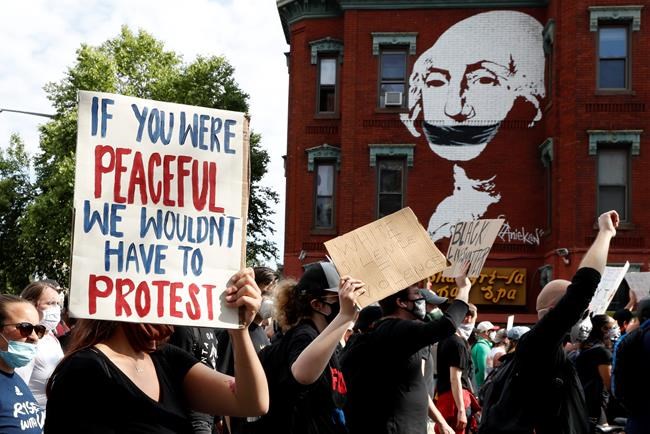
What’s happening in American cities over the past week shows, among many other things, a vision of storylines at war. Over and over, protesters speak of wanting to be heard, of having their stories shape the larger story, of needing the central myth of American life to include them.
Just as vigorously, those triggered by the tumult tell an impassioned story of order, calm and the right to be safe in one’s home and one’s business — something central to the American story right back to the first settlers.
For the moment, these different stories seem utterly irreconcilable.
Many are not primed to hear their fellow Americans’ stories right now. Polarization was already impeding things. Then came the pandemic’s existential threat. And now, the oldest of contentious American storylines — race — has taken a lead role.
How does one forge shared a sense of purpose out of this? How do Americans reassemble the portrait from its fragments?

“We can’t exist as a thousand little pieces,” Davé says. “We all want to believe in this story — that we all are created equal and have the right to pursue life, liberty, justice and happiness. Those are values that we all cling to. The journey to get there, that becomes what we’ve struggled against in history and what we’re struggling against now.”
It is clear that the 20th-century edition of the American story no longer works. But in this country of stories, not having one won’t work either. Does a nation cease to exist when its foundational story breaks apart, when those who tell that story are saying different things?
On the night before he was assassinated in 1968, the Rev. Martin Luther King Jr. summoned the story he believed had been promised to him and his compatriots: “All we say to America is, `Be true to what you said on paper.'”

Everywhere in the nation today, on the streets and in the halls of government, people are summoning their version of the American story. Shouting it. Insisting on it. Certain it is the version that must prevail.
What we know now — after a crazy-quilt century of movies and TV and advertising and social media — is that the people who tell the richest, loudest, most immersive, most appealing story can in fact rule the world.
What will that new American story be?
___
Ted Anthony, director of digital innovation for The Associated Press, has been writing about American culture since 1990. Follow him on Twitter at http://twitter.com/anthonyted
Related Articles
Prosecutors charge 3 more officers in George Floyd's death
Advertisement Advertise With Us
Advertisement Advertise With Us